Most pan swaps work fine and nobody tells you which. Three properties decide every one of them, and knowing those three is more useful than owning another pan.
Heads up: some links on this page earn us a commission at no extra cost to you. It does not change what we recommend or the order. How we are funded.
The short answer
The recipe wants
Reach for
What changes
When it fails
A skillet
A wide, shallow pot or a saute pan
Tall walls trap steam, so food browns less. Cook in smaller batches and leave the lid off
Anything you want a real crust on - searing steak, crisping skin, browning mince
A pot
A deep skillet or a saute pan, for small volumes
Less depth, faster evaporation, so a sauce reduces quicker than the recipe expects
Boiling pasta for four, making stock, or anything that needs volume and a rolling boil
A Dutch oven
Any oven-safe pot with a lid, or a stockpot plus foil
Less thermal mass, so the temperature swings more and the base can catch
Bread baking, which needs the mass and the sealed lid to trap steam
A roasting pan
A half sheet pan with a rack
Low sides let steam escape, which browns better than high walls do
A very large bird or joint producing enough fat to overflow a 1-inch rim
A saucepan
A small skillet, or the smallest pot you own
Wider base means faster reduction and more scorch risk on a thin pan
Anything needing depth - boiling eggs, blanching, a deep-fry of any kind
A nonstick pan for eggs
A well-seasoned cast iron or carbon steel pan, properly preheated
You have to get the heat and the fat right, which is a learned skill rather than a free one
Nothing, eventually - but the first few attempts will stick, and that is normal
Three properties decide every substitution
Pans are not interchangeable by name, they are interchangeable by behavior. Almost every successful swap, and every failed one, comes down to the same three variables. Learn these and you can judge a substitution the recipe has not thought of.
1. Wall height and shape — this decides browning
Tall walls trap steam. Steam keeps the surface of food at boiling point, and browning needs the surface to get much hotter than that. So a pot full of chicken thighs does not brown them; it steams them gray while the base of the pan burns the bits touching it.
Low, flared walls let steam leave, which is why a skillet browns and a saucepan does not. It is also why a half sheet pan roasts vegetables better than a deep roasting tray - roasting pan versus sheet pan has the full version of that argument.
2. Thermal mass — this decides whether the pan forgives you
A heavy pan stores heat and gives it back steadily. A light pan tracks the burner, which makes it responsive and unforgiving. Swap a heavy pan for a light one and the symptom is scorching at the base and a temperature that drops the moment food goes in. Swap the other way and the symptom is overshooting: the pan keeps cooking after you turn the dial down.
This is the variable people ignore most, and it is the reason a Dutch oven substitution is harder than it looks - what stove heat settings actually mean.
3. Surface area per portion — this decides crowding
The real limit on most pans is not capacity, it is how much food can touch the base at once. Crowd a pan and the moisture released cannot evaporate fast enough, so the food steams in its own liquid regardless of how hot the pan was.
Which means the commonest fix for a bad substitution is not a different pan at all: it is cooking in two batches. That one habit rescues more swaps than any piece of equipment.
Can you use a pot instead of a skillet?
Yes for anything with liquid in it, no for anything you want browned. That is the whole answer, and it follows directly from the first property above.
A pot will happily do a curry, a chili, a shakshuka, a pan of greens, a risotto, or anything that spends most of its time wet. In those dishes the browning step is brief or absent and the tall walls are an advantage, because nothing spits onto your hob.
Where it fails is the sear. Three things work against you at once: steam has nowhere to go, the base is usually thinner than a skillet's so it loses heat the moment food lands, and the usable base area is smaller than the pot's diameter suggests because the walls curve inward at the bottom.
If you have no choice, these four adjustments genuinely help:
Use the widest, shallowest pot you own. A 4-quart saute-style pot is a far better stand-in than a tall 8-quart stockpot, even though both are "a pot".
Halve the quantity and cook two batches. Crowding is the failure mode, and this removes it.
Preheat longer than feels necessary, and never cover it. A heavier pot needs more time to come up; a lid guarantees steaming.
Accept less crust and compensate elsewhere. Deglaze the pot and reduce the liquid for flavor rather than chasing a sear you are not going to get.
The honest summary: a pot is a competent substitute for about three-quarters of what a skillet does, and a poor one for the quarter people buy skillets for. If searing is what you cook, that is the gap worth closing with a pan rather than a technique.
Can you use a skillet instead of a pot?
Yes for small volumes, and there is one case where it is dangerous.
A 12-inch skillet with straight-ish sides holds a surprising amount, and it is genuinely better than a pot for anything you want reduced: a wide surface boils liquid off fast. A shallow braise, a pan sauce, a one-pan pasta for two, reheating a portion of stew - all fine, and often better.
It stops working on volume. Pasta for four needs water and a rolling boil, and a skillet gives you neither. Stock needs depth so the bones stay covered during a long simmer. Blanching needs enough water that adding vegetables does not drop it off the boil.
The dangerous case is deep frying. A shallow pan with hot oil in it is a spill and a fire risk, and oil that boils over onto a gas flame is the specific scenario to avoid - the depth of a proper pot is a safety specification, not a convenience. If frying is the plan, read cookware for deep frying first.
The full substitution matrix
Every row is a swap people actually make. "Works" means the dish comes out well; "workaround" means it comes out acceptably with an adjustment; "no" means do something else.
You do not have
Use
Verdict
The adjustment that makes it work
A skillet
A wide shallow pot or saute pan
Workaround
Half batches, no lid, longer preheat. Accept less crust
A skillet
A grill pan
Workaround
Ridges mean only the stripes touch metal, so you get marks rather than an even crust
A saute pan
A skillet plus any lid that fits
Works
Nothing. The flared walls cost you a little capacity, not performance
A stockpot
A Dutch oven
Works
Nothing for volumes it holds. Check your capacity before committing to the recipe
A Dutch oven, on the stove
A heavy stockpot
Workaround
Stir more and use a lower setting - less mass means the base catches sooner
A Dutch oven, for bread
Anything else
No
The sealed heavy lid trapping steam is the mechanism. See baking bread in a Dutch oven
A roasting pan
A half sheet pan with a rack
Works, usually better
Nothing, unless the fat would overflow a 1-inch rim
A roasting pan
A 9 by 13 in glass baking dish
Workaround
Glass browns bases poorly and is not broiler safe. Fine for a covered joint
A saucepan
A small skillet
Works for sauces
Watch for scorching on a thin base; stir more than the recipe says
A saucepan, for boiling eggs
A skillet
No
You need depth to cover the eggs. Use any pot you own
A double boiler
A heatproof bowl over a pan of barely simmering water
Works, usually better
Nothing. See best double boilers - the improvised version is the recommendation
A wok
A large skillet, hottest burner, half batches
Workaround
Covered in full in stir frying without a wok
A cake pan of the right size
A different size, with the math done
Workaround
Area and depth change the bake time. See baking pan size conversion
A steamer insert
A colander or a heatproof plate over a pot, lid on
Works
Keep the water below the food and check it has not boiled dry
A griddle
A sheet pan, in the oven
Workaround
No direct contact heat, so pancakes will not work - but bacon and sausages will
A pizza stone
An upturned sheet pan, preheated
Workaround
Less stored heat so the base is softer. Preheat it for a full 30 minutes
A broiler pan
A sheet pan with a rack
Works
Line the pan - fat under a broiler smokes, and that is what the slotted top is for
Dimensions referenced here are published figures from our product ledger: the Nordic Ware half sheet is 17.9 by 12.9 by 1 in, the Pyrex oblong dish is 3 qt at 9 by 13 in.
Note the difference between this table and a buying question. Everything above assumes the recipe is tonight and the pan is not in your cupboard. If the question is instead whether a specialist pan is worth owning at all - an egg pan, a milk pan, a square skillet, a strainer-lid pasta pot - the pots and pans you do not need answers that one, with what each specialist genuinely gives up.
Oven substitutions follow different rules
On the stovetop the pan is a heat source. In the oven it is mostly a container, and that changes which properties matter. Material governs how the base browns, and depth governs whether anything browns at all.
Metal for metal is almost always fine at the same dimensions. Bare aluminum browns best, which is why professional kitchens use it for sheet pans.
Glass for metal needs a longer bake and browns bases poorly, because glass heats slowly and radiates differently. It is also not broiler safe, and Pyrex publishes a thermal-shock rule that genuinely matters: no sudden temperature change, no liquid into a hot dish - glass versus metal bakeware.
A different size changes the time, not just the fit. Depth of batter drives bake time more than oven temperature does; the arithmetic is in baking pan size conversion.
Check the pan is oven safe before you improvise. Coated pans publish ceilings from 400F upward and the handle usually sets the real limit - oven-safe cookware temperatures.
The half sheet is the most substitutable pan in a kitchen: it stands in for a roasting pan, a broiler pan and a pizza stone, and beats one of those three outright.
Lid substitutions, which are easier than people think
A missing lid stops a lot of cooking unnecessarily. In order of how well they work:
A lid from a larger pan, resting on the rim. It does not need to seal. It needs to stop steam leaving, and a loose lid does that well enough for a braise.
A sheet pan laid flat on top. Unglamorous and effective, and it goes in the oven.
Foil, crimped around the rim. The best seal of the lot, which makes it the right choice for a long oven braise. It is also the workaround for bread in a lidless pot, though it is not as good as a real Dutch oven lid.
A dinner plate. Fine on the stovetop at low heat. Check it is oven-safe before it goes anywhere near an oven, and never under a broiler.
The one that does not substitute: a glass lid under a broiler, or on a pan going above its lid assembly's rating. Glass caps the oven temperature at whatever the whole lid tolerates, which is usually well below the pan - cookware lids explained.
Five substitutions that damage something
Most swaps fail by producing a worse dinner. These five fail by producing a bill.
The substitution
What breaks
Do this instead
A shallow pan for deep frying
Oil overflows. On gas that is a fire, and it is the one item on this page that can hurt you
Use a deep pot filled no more than a third, or do not fry
A coated nonstick pan under a broiler
The coating. Published ceilings start around 400F and a broiler is far above that
Use bare metal - cast iron, carbon steel or clad stainless
Glass bakeware on a stovetop, or under a broiler
The dish, by thermal shock, and it can shatter rather than crack
Metal on the hob. Pyrex publishes that it is not broiler safe
Cast iron slid across a glass or induction top
The hob surface. It is the dragging and the grit, not the weight
Lift it on and off - cast iron on glass top stoves has the detail
A hot pan into cold water to speed up washing
The pan. Thermal shock warps bases permanently and cannot be undone at home
Let it cool, then wash - why pans warp explains the mechanism
The five jobs with no real substitute
Being honest about where improvising stops is the useful half of a page like this. These five are where a technique will not rescue you.
A hard sear. You need a heavy base that holds its temperature when cold food lands on it, and open walls so steam can leave. No pot does both. This is the one gap most kitchens actually have.
Volume at a rolling boil. Pasta for four, stock, blanching. A tall pot is the only answer, and a skillet full of hot oil or water is the worst one.
Bread in a covered pot. The mass and the sealing lid trap steam for the first part of the bake, and that is the whole technique - baking bread in a Dutch oven. Foil over a stockpot gets part of the way and not all of it.
A long acidic braise in bare iron or bare aluminum. Not a performance limit, a material one: acid strips seasoning and reacts with aluminum. Use stainless, enamel or glass - cooking acidic foods and reactive cookware.
Eggs, on day one. A seasoned pan will do eggs beautifully in the end, and it will not do them tonight while you are still learning the heat. That is a real argument for keeping one inexpensive coated pan, replaced when release goes - what to replace nonstick pans with.
For the Dutch oven specifically, is a Dutch oven worth it works through its six jobs and which of them anything else can cover.
If you are buying one pan to stop substituting
Pick by the gap you keep hitting rather than by what a set contains. In the order most kitchens need them:
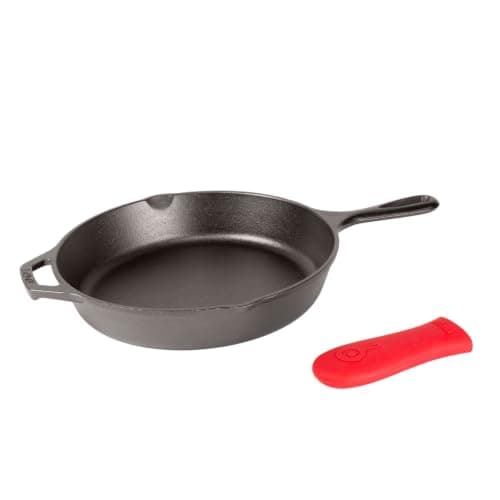
You keep trying to brown things in a pot:a 10.25 in cast iron skillet. The cheapest fix on this page, 550F published, and it cannot be worn out. The honest cost is 5.66 lb and drying it after every wash.
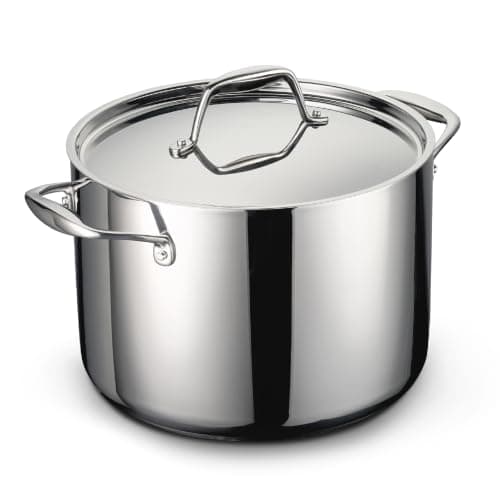
You keep boiling pasta in something too small:an 8 qt clad stockpot. Tri-ply, induction-ready, dishwasher safe. Its published oven ceiling varies by SKU across the Tramontina clad range, so check the listing rather than the line.
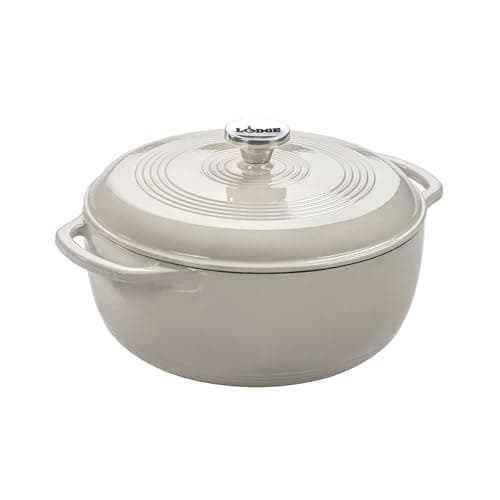
You keep crimping foil over a pot for a braise:a 6 qt enameled Dutch oven. No seasoning, safe with tomato and wine. Heavy, and the oven ceiling is set by the knob, so check the SKU.
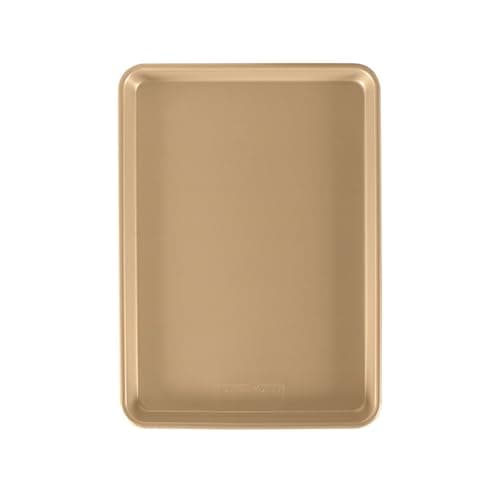
You do not own a roasting pan and keep feeling you should:a half sheet pan instead. For nearly all roasting it is the better pan. Nordic Ware recommends hand washing and does not advise a dishwasher.
What we cannot tell you
We have not cooked these dishes in these pans for you. This site compiles published manufacturer specifications and reasons from the physics of pan geometry and heat; it does not run a test kitchen, and the verdicts above are judgments rather than measurements - how we work.
Where a figure appears on this page it is published by the maker and traceable: the half sheet's 17.9 by 12.9 by 1 in, the Lodge skillet's 10.25 in and 5.66 lb and 550F, the Pyrex dish's 3 qt at 9 by 13 in and its broiler exclusion. Nothing here is a measurement we took ourselves.
The four pans that close the gaps on this page
Each one ends a specific substitution rather than adding a piece to a collection. Prices are live and expire on their own if the daily check stops.
Lodge Seasoned Cast Iron Skillet, 10.25 in (L8SK3)
Searing, cornbread, and anyone who wants one pan that cannot be worn out
These are the products this page's reasoning actually points at. Same rules as everywhere else on the site: published specs, a stated trade-off, and a live price only where one exists.
Top pick · Closes the most substitution gapsSpecs read September 3, 2026
Lodge Seasoned Cast Iron Skillet, 10.25 in (L8SK3)
At 10.25 in, 5.66 lb and 550F published, this is the pan that stops you improvising a sear in a pot. It is also the single cheapest way to end the most common swap on this page.
Best for: Searing, cornbread, and anyone who wants one pan that cannot be worn out
Published specifications for the Lodge Seasoned Cast Iron Skillet, 10.25 in (L8SK3)
Diameter
10.25 in
Weight
5.66 lb
Oven maximum
550F
Induction
Yes - bare iron is ferrous
Seasoning
Pre-seasoned with soy-based vegetable oil, no synthetic chemicals
Warranty
Lifetime
Made in
USA
Care
Hand wash. Lodge's own instructions permit warm soapy water
Good
Effectively unbreakable and fully restorable - a rusted one can be stripped and re-seasoned
Holds heat better than anything else at the price, which is what a sear needs
Lodge publishes its seasoning method openly, so the maintenance is not a mystery
Not good
Heavy
Heats unevenly on a small burner: cast iron conducts at roughly 50 W/m-K, so it is slow to spread and slow to react
Bare iron is reactive; long tomato braises will taste of it
The trade-off. It weighs 5.66 lb empty. You will feel that every time you move it full, and it is the single most common reason a cast iron skillet ends up in a cupboard.
Skip this if. You have wrist or shoulder trouble, or you cook mostly acidic braises. Carbon steel does most of the same jobs at roughly half the weight.
#3 · The one no lidded pot replacesSpecs read September 3, 2026
Lodge Enameled Cast Iron Dutch Oven, 6 qt
6 qt of enamel over cast iron, no seasoning, safe with tomato and wine. The mass and the sealed lid are the whole point, which is why a stockpot plus foil is a workaround rather than a swap.
Best for: Braises, stews, tomato sauce, bread - anything long and wet
Published specifications for the Lodge Enameled Cast Iron Dutch Oven, 6 qt
Material
Cast iron with porcelain enamel, inside and out
Capacity
6 qt
Induction
Yes - the iron under the enamel is ferrous
Seasoning
None required - enamel is not a seasoning surface
Acid
Safe for tomato and wine, unlike bare iron
Oven maximum
Set by the knob material - check the specific SKU; Lodge publishes a lower ceiling than for bare iron
Good
Non-reactive, so it handles the acidic cooking bare iron cannot
No seasoning to maintain
Considerably cheaper than the French enameled pots it copies
Not good
Chipped enamel is not repairable, unlike bare iron's seasoning
Oven ceiling is lower than bare cast iron because of the knob
Heavy, and the enamel makes it heavier than bare iron of the same capacity
The trade-off. The enamel is a glass layer. Chip it and the pot is not restorable the way bare iron is, and Lodge's enamel chips more readily than the premium brands'.
Skip this if. You already own a large stainless stockpot and rarely braise. This duplicates it for most weeknight cooking.
#4 · Replaces the roasting pan outrightSpecs read September 3, 2026
Nordic Ware Naturals Half Sheet, 18 x 13 in
17.9 by 12.9 by 1 in of bare aluminum with an encapsulated steel rim and a lifetime warranty. For nearly all roasting this is the better pan, not the compromise.
Best for: Roasting vegetables, sheet-pan dinners, cookies - the pan you use most weeks
Published specifications for the Nordic Ware Naturals Half Sheet, 18 x 13 in
Exterior dimensions
17.9 x 12.9 x 1 in
Material
Aluminum
Rim
Encapsulated steel rim
Gauge
Not published by Nordic Ware
Warranty
Lifetime
Dishwasher
Hand wash recommended. Automatic dishwasher use is not advised
Made in
America of domestic and imported materials
Good
Aluminum conducts at 237 W/m-K, which is why it browns evenly and a steel pan does not
The encapsulated steel rim is the reason it does not warp in a hot oven
Lifetime warranty on a pan this cheap
Not good
Nordic Ware does not publish a gauge figure, so thickness cannot be compared like for like
Bare aluminum stains and reacts with acid
Not dishwasher safe by the maker's own advice
The trade-off. Bare aluminum discolors and reacts with acid. It will look used within a month and Nordic Ware advises against the dishwasher.
Skip this if. You want a pan that stays looking new, or you will not hand wash. Buy an aluminized-steel coated pan instead and accept the coating as a wear item.
Yes for anything with liquid in it - curry, chili, risotto, greens - and no for anything you want browned. A pot's tall walls trap steam, which keeps the food's surface at boiling point, and browning needs it much hotter than that. If you have no choice, use the widest shallowest pot you own, cook half batches with no lid, and preheat longer than feels necessary.
›Can I use a skillet instead of a pot?
For small volumes, yes, and often better - a wide surface reduces a sauce faster than a pot does. It fails on volume: pasta for four, stock and blanching all need depth and a rolling boil. Never use a shallow pan for deep frying, because oil overflowing onto a gas flame is a fire rather than a spoiled dinner.
›What can I use instead of a Dutch oven?
Any oven-safe pot with a lid for most braises and stews, accepting that less thermal mass means more temperature swing and more risk of the base catching. For bread there is no substitute: the mechanism is a heavy sealed lid trapping steam during the first part of the bake, and foil crimped over a stockpot only gets part of the way there.
›Can I use a baking dish instead of a roasting pan?
Yes for a covered joint, with two caveats. Glass heats slowly and browns bases poorly, so expect a longer time and less color underneath, and glass bakeware is not broiler safe. For most roasting a half sheet pan with a rack is actually the better choice than either, because low sides let steam escape.
›What is the most useful pan to own if I want to improvise?
A half sheet pan and a 10-to-12-inch skillet, in that order of versatility. The sheet pan stands in for a roasting pan, a broiler pan and a pizza stone, and beats the first outright. The skillet covers the one job no pot can fake, which is a hard sear with steam able to escape.
›Do I need a lid, or can I substitute something?
You can substitute, easily. In order of effectiveness: a lid from a larger pan resting on the rim, a sheet pan laid flat on top, or foil crimped around the rim, which gives the best seal and is the right choice for a long oven braise. A dinner plate works on the stovetop at low heat. Never put a glass lid under a broiler.
Sources
Every figure on this page came from one of these. Follow them and check our arithmetic — that is the point.