Heads up: some links on this page earn us a commission at no extra cost to you. It does not change what we recommend or the order. How we are funded.
The short answer
A Dutch oven works for bread because it does two things a home oven cannot: it stores enough heat to drive strong oven spring, and its lid traps the steam the loaf releases, keeping the crust soft long enough to expand before it sets. Preheat the empty covered pot for thirty to forty-five minutes, bake covered for about twenty minutes, then uncovered for twenty to twenty-five. The limiting specification is the lid knob, not the pot.
Why a pot beats an oven
Steam, which is the real trick
A professional bread oven injects steam for the first few minutes of the bake. Steam keeps the surface of the loaf moist and flexible, which lets the dough expand fully before the crust sets. Without it, the crust hardens early and the loaf is restrained - smaller, denser, with a dull surface.
A home oven vents. Any steam you introduce escapes within a minute. A lidded pot solves this without any equipment at all: the loaf releases its own moisture, the lid traps it, and you have a small steam oven for as long as the lid stays on. This is the entire reason the technique exists.
Thermal mass
A preheated cast iron pot holds a large amount of heat, so when room-temperature dough lands in it, the base temperature barely drops. That drives the rapid initial expansion bakers call oven spring. A thin pot loses temperature when the dough goes in and the bread rises less.
The two mechanisms are separable. You can get steam from a lid on a lightweight pot, and mass from an uncovered iron pot. You want both, which is why cast iron with a lid is the standard answer.
The specification that actually decides it
Bread is baked hot - often 450F to 500F. Bare cast iron is rated to 550F and has nothing on it to object. Enameled pots are rated by the knob material rather than by the iron, and that is where pots fail this application.
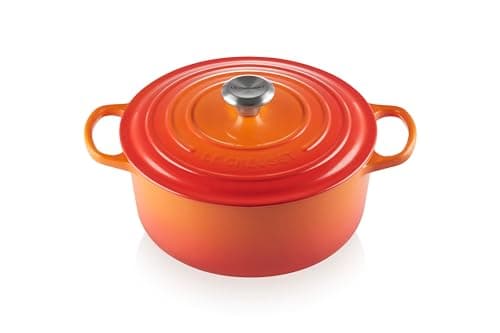
Le Creuset publishes a stainless knob rated to 500F on the Signature line, which is high enough for essentially every no-knead recipe. Many other pots ship with phenolic knobs rated lower, and those will scorch, craze or fail at bread temperatures. Metal replacement knobs are sold for most models and are an inexpensive fix on a pot you already own.
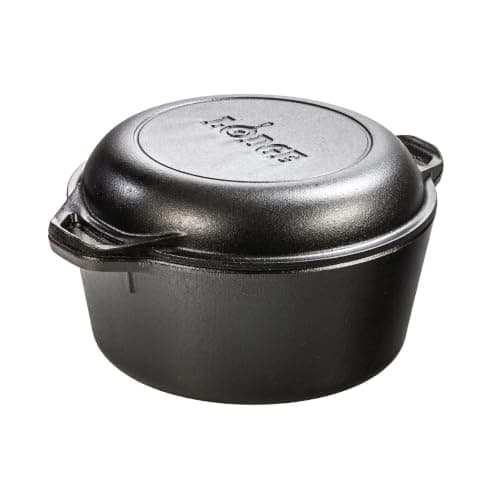
Either works. Enameled is more versatile because it handles acidic braises that bare iron does not, and it needs no seasoning maintenance - enameled cast iron care. Bare iron has a higher ceiling and costs less. A plain combo cooker is the cheapest competent bread pot there is.
Sizing it
Most home loaves use around 500 grams of flour, which suits a pot of roughly 4 to 6 quarts. Too large and the loaf spreads outward into a flat disc instead of rising; too small and it hits the sides and the lid.
4 to 5 qt: ideal for a standard round loaf. The most useful size.
6 qt: fine, and more versatile for everything that is not bread.
7 qt and up: the loaf spreads. Usable but not ideal.
Oval pots: good for batards, less good for rounds.
Preheat the empty pot, covered, for thirty to forty-five minutes at your baking temperature. The pot needs to be genuinely saturated with heat, not merely hot on the outside. This is the step people shorten and then wonder why the loaf is flat.
Shape the loaf on parchment and use the paper as a sling. This removes the hardest and most dangerous part of the process, which is getting dough into a 500-degree pot.
Score the top decisively, about a centimeter deep. The loaf will expand somewhere, and scoring decides where.
Lower it in, lid on, and bake covered for about twenty minutes. This is the steam phase and the lid stays on throughout it.
Remove the lid and bake twenty to twenty-five minutes more until deeply colored. This is the crust phase, and pale bread is almost always underbaked here.
Cool on a rack for at least an hour. The interior is still setting. Cutting hot bread gives you a gummy crumb - best cooling racks.
With the lid on, the fan in a convection oven is doing nothing for the loaf. It earns its place in the second phase, once the lid comes off.
Handling a 500-degree pot
This is the genuinely hazardous part of home bread baking and it deserves more caution than recipes give it.
Dry mitts, both hands, every time. A damp cloth conducts heat instantly and steam burns are the common injury here.
Clear a landing spot before you open the oven, with a trivet already on it.
Lift the lid away from your face. The steam release is substantial.
Never put the hot pot in the sink, and never run water into it. Thermal shock cracks enamel and can warp lighter pots - why pans warp.
Remember the lid knob is as hot as the pot, including stainless ones.
The combo-cooker approach sidesteps most of this: bake on the shallow lid used as a skillet, and invert the deep pot over it. Nothing has to be lowered into a hot well.
When it does not work
Problem
Usually means
Flat, dense loaf
Pot not preheated long enough, or pot too large
Pale, soft crust
Underbaked in the uncovered phase, or oven running cool
Burnt base
Pot too close to the bottom element - move up a rack
Loaf stuck to the pot
No parchment, and bare iron with thin seasoning
Crust splits randomly
Not scored, or scored too shallow
Gummy interior
Cut too soon - it needs an hour on a rack
If the crust and crumb are both consistently disappointing, check the oven itself before changing anything else - oven temperature accuracy.
Pots that take bread temperatures
Check the knob rating on the specific SKU rather than the brand. A stainless replacement knob raises the ceiling on a pot you already own.
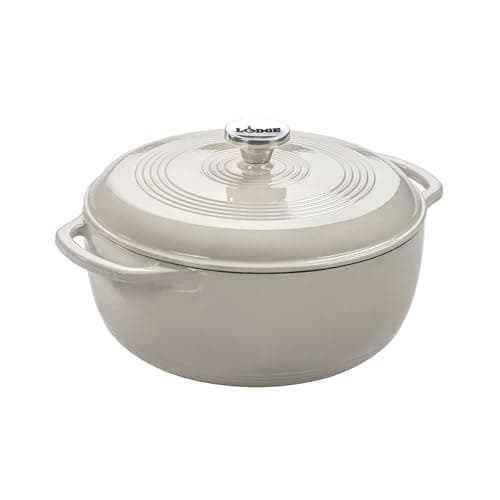
Lodge Enameled Cast Iron Dutch Oven, 6 qt
Braises, stews, tomato sauce, bread - anything long and wet
These are the products this page's reasoning actually points at. Same rules as everywhere else on the site: published specs, a stated trade-off, and a live price only where one exists.
Top pick · Best value for breadSpecs read September 3, 2026
Lodge Enameled Cast Iron Dutch Oven, 6 qt
Six quarts of enameled cast iron at a price that makes a dedicated bread pot reasonable, with enamel that skips the seasoning question.
Best for: Braises, stews, tomato sauce, bread - anything long and wet
Published specifications for the Lodge Enameled Cast Iron Dutch Oven, 6 qt
Material
Cast iron with porcelain enamel, inside and out
Capacity
6 qt
Induction
Yes - the iron under the enamel is ferrous
Seasoning
None required - enamel is not a seasoning surface
Acid
Safe for tomato and wine, unlike bare iron
Oven maximum
Set by the knob material - check the specific SKU; Lodge publishes a lower ceiling than for bare iron
Good
Non-reactive, so it handles the acidic cooking bare iron cannot
No seasoning to maintain
Considerably cheaper than the French enameled pots it copies
Not good
Chipped enamel is not repairable, unlike bare iron's seasoning
Oven ceiling is lower than bare cast iron because of the knob
Heavy, and the enamel makes it heavier than bare iron of the same capacity
The trade-off. The enamel is a glass layer. Chip it and the pot is not restorable the way bare iron is, and Lodge's enamel chips more readily than the premium brands'.
Skip this if. You already own a large stainless stockpot and rarely braise. This duplicates it for most weeknight cooking.
Published specifications for the Le Creuset Signature Round Dutch Oven, 5.5 qt
Material
Cast iron with porcelain enamel inside and out
Capacity
5.5 qt
Interior enamel
Sand-colored, so browning and fond stay visible
Knob
Stainless steel, rated to 500F
Induction
Yes - the iron under the enamel is ferrous
Dishwasher
Dishwasher safe; Le Creuset recommends hand washing
Warranty
Limited lifetime
Made in
France
Good
The pale interior is a genuine cooking advantage: you can see whether the fond is browning or burning
Wide, low-profile handles that a hand in an oven mitt actually fits
The one enameled pot with a real secondhand market, which changes the true cost of ownership
Not good
Costs several times a Lodge enameled pot of the same capacity
The pale interior stains permanently, and Le Creuset says so
Chipped enamel is not repairable on any enameled pot, this one included
The trade-off. You are paying a large multiple of what a Lodge enameled pot costs for a difference in enamel quality, finish and resale value rather than in cooking.
Skip this if. You braise a few times a year. The cooking difference over a Lodge enameled pot is small; the price difference is not.
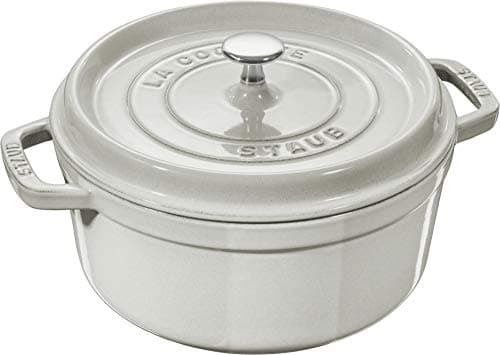
Published specifications for the Staub Round Cocotte, 5.5 qt
Material
Cast iron with enamel inside and out
Capacity
5.5 qt
Interior enamel
Black matte and textured - does not show staining
Lid
Self-basting spikes on the underside
Knob
Metal; the oven rating is set by the knob, so check the specific SKU
Induction
Yes
Warranty
Limited lifetime
Made in
France
Good
Black matte interior is the practical answer to the staining complaint about pale enamel
Heavier lid than most, which matters more than the spikes do on a long braise
Textured interior takes a hard sear better than a glossy enamel does
Not good
You cannot see the fond, which is a real loss on anything you are building a sauce from
Heavy even by enameled cast iron standards
Priced with Le Creuset, so the same skip-if applies
The trade-off. The black matte interior hides fond as well as it hides stains, so you judge browning by smell and by lifting the food rather than by looking.
Skip this if. You want to watch the fond develop. Buy the sand-colored interior instead and accept that it will discolor.
The lid traps the steam the loaf releases, which keeps the crust soft long enough for the dough to expand fully - the same effect a professional bread oven achieves by injecting steam. The pot's thermal mass also drives strong oven spring when cool dough goes in.
›Do you preheat a Dutch oven for bread?
Yes, covered and empty, for thirty to forty-five minutes at the baking temperature. The pot needs to be saturated with heat rather than merely hot on the surface. Shortening this step is the most common reason a loaf comes out flat.
›What temperature can a Dutch oven knob take?
It depends on the material and the specific product. Le Creuset publishes a stainless knob rated to 500F on the Signature line, which suits essentially every no-knead recipe. Phenolic knobs are rated lower and will fail at bread temperatures, though metal replacements are sold for most models.
›What size Dutch oven is best for bread?
Four to five quarts for a standard loaf using around 500 grams of flour. Larger pots let the dough spread outward into a flat disc rather than rising, and pots much smaller than four quarts leave the loaf touching the sides and the lid.
›How do you get bread dough into a hot Dutch oven?
Shape the loaf on parchment paper and use the paper as a sling to lower it in. This is safer and far easier than trying to drop dough into a 500-degree pot. A combo cooker avoids the problem entirely by baking on the shallow lid with the deep pot inverted over it.
Sources
Every figure on this page came from one of these. Follow them and check our arithmetic — that is the point.