Heads up: some links on this page earn us a commission at no extra cost to you. It does not change what we recommend or the order. How we are funded.
The short answer
Buy a standalone oven thermometer. It is the cheapest diagnostic tool in a kitchen.
Preheat for at least twenty minutes, not until the beep - the beep is early.
Read it several times over ten minutes. Ovens cycle above and below the target.
Average the readings and compare with the dial to find your offset.
Compensate by adjusting the dial, or recalibrate if the manual allows it.
Two different problems, often confused
Offset
The oven settles at a temperature that is not the one you set. A dial reading 350F while the cavity holds 325F or 375F is common, and it is consistent - the same oven will be wrong by roughly the same amount every time. This is the one you can correct for.
Cycling
Ovens are thermostatic. The element heats until a sensor is satisfied, switches off, and the temperature falls until it switches on again. The swing in a domestic oven can be substantial in either direction, so "350F" describes an average rather than a steady state. This is normal, is not a fault, and is not correctable - but it explains why baking is less repeatable than recipes imply.
Thermal mass in the oven damps the swing, which is one reason a pizza stone or steel left on a lower rack improves general baking even when you are not making pizza - best pizza stones and steels.
How to measure yours
Hang a standalone oven thermometer from the middle rack, in the center of the cavity. Do not rest it on the floor of the oven or against a wall.
Set the oven to 350F and wait twenty minutes beyond the preheat beep. Nearly every oven signals readiness well before the walls and racks reach temperature, which is why the first tray of cookies is always different from the second.
Read it five times over ten minutes, without opening the door more than you must. You are looking for the high, the low and the average.
Repeat at 400F and 425F. Offset is frequently not constant across the range, and an oven that is accurate at 350F can be badly off at 450F.
Move the thermometer around - front, back, left, right - to map hot spots. Most ovens have one, usually toward the back.
Opening the door drops the cavity temperature sharply and it takes several minutes to recover. Read through the glass where you can, and accept that every peek costs you.
What to do about what you find
What you measured
What to do
Consistently 25F low
Set the dial 25F higher, or recalibrate if the manual allows
Consistently 25F high
Set the dial 25F lower - this is the more damaging direction for baking
Accurate at 350F, off at 425F
Correct per temperature band rather than applying one offset
Swinging widely either side
Add thermal mass - a stone or steel on a lower rack
One side browns faster
Rotate pans halfway, and avoid filling the rack
Off by more than 50F
Worth a service call; the sensor or thermostat may be failing
Many ovens allow a calibration offset through the control panel, usually documented in the manual under calibration or temperature adjustment. Where that exists, use it rather than doing mental arithmetic before every bake.
Reading the symptoms backward
Baking results diagnose an oven surprisingly well, and these patterns are worth knowing before you buy an instrument.
Cookies spreading too much and browning at the edges only: oven running cool. The dough melts before it sets.
Dark bases, pale tops: too much bottom heat, a dark pan, or a rack set too low - sheet pan materials.
Cakes doming and cracking: running hot. The outside sets while the center is still rising.
Cakes sinking in the middle: running cool, or the door was opened early.
Everything at the back browner than the front: normal hot spot; rotate halfway.
A convection fan evens out hot spots but does not fix an offset. If the oven runs hot, it runs hot with the fan on too.
Convection, and the double-adjustment trap
A fan evens out the hot and cold spots in a cavity, which is a real improvement, but it does nothing about a thermostat that is calibrated wrong. Worse, the standard convection adjustment of reducing by 25F is applied automatically by many ovens in their "convection bake" mode. Applying it yourself on top of that, in an oven that already runs cool, stacks three errors - cookware for convection ovens covers the mode properly.
The things worth more than accuracy
An oven being twenty degrees off matters less than these, and they are all free or cheap:
Preheat properly. Twenty minutes past the beep. More than any calibration issue, this is why first batches differ.
Use the right rack. Middle for cakes, lower third for bread and pizza, upper third for browning.
Do not crowd the oven. Airflow needs clearance, in a fan oven and a conventional one.
Oven thermometers on Amazon — the cheapest diagnostic instrument in a kitchen, and the one most kitchens lack.
What to buy, if you are buying
These are the products this page's reasoning actually points at. Same rules as everywhere else on the site: published specs, a stated trade-off, and a live price only where one exists.
Top pick · The pan that reveals oven problemsSpecs read September 3, 2026
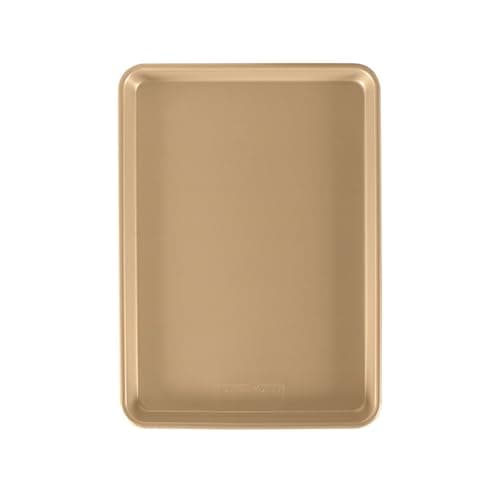
Nordic Ware Naturals Half Sheet, 18 x 13 in
Bake cookies on a light aluminum sheet and uneven browning maps your oven's hot spots better than any instrument.
Best for: Roasting vegetables, sheet-pan dinners, cookies - the pan you use most weeks
Published specifications for the Nordic Ware Naturals Half Sheet, 18 x 13 in
Exterior dimensions
17.9 x 12.9 x 1 in
Material
Aluminum
Rim
Encapsulated steel rim
Gauge
Not published by Nordic Ware
Warranty
Lifetime
Dishwasher
Hand wash recommended. Automatic dishwasher use is not advised
Made in
America of domestic and imported materials
Good
Aluminum conducts at 237 W/m-K, which is why it browns evenly and a steel pan does not
The encapsulated steel rim is the reason it does not warp in a hot oven
Lifetime warranty on a pan this cheap
Not good
Nordic Ware does not publish a gauge figure, so thickness cannot be compared like for like
Bare aluminum stains and reacts with acid
Not dishwasher safe by the maker's own advice
The trade-off. Bare aluminum discolors and reacts with acid. It will look used within a month and Nordic Ware advises against the dishwasher.
Skip this if. You want a pan that stays looking new, or you will not hand wash. Buy an aluminized-steel coated pan instead and accept the coating as a wear item.
›How do I know if my oven temperature is accurate?
Hang a standalone oven thermometer from the middle rack, set the oven to 350F, and wait twenty minutes beyond the preheat beep. Read it several times over ten minutes and average the results. Repeat at a higher temperature, because the offset often changes across the range.
›Why does my oven not reach the set temperature?
Usually it does eventually, but the preheat signal comes well before the cavity, racks and walls are up to temperature. If a thermometer shows a persistent gap after twenty extra minutes, the thermostat is out of calibration or the sensor is failing.
›How much do home ovens vary in temperature?
Two ways. They settle at a temperature offset from the dial, which is consistent and correctable, and they cycle above and below that as the element switches on and off, which is normal and is not. Thermal mass such as a baking stone damps the cycling.
›Can you recalibrate an oven?
Many ovens allow a calibration offset through the control panel, documented in the manual under calibration or temperature adjustment. Where that option exists it is better than mentally adjusting the dial. An error beyond about 50F is worth a service call instead.
›Does a convection fan fix an inaccurate oven?
No. A fan evens out hot and cold spots within the cavity but does nothing about a thermostat calibrated wrong. Be careful not to double-apply the 25F convection reduction, because many ovens already apply it automatically in convection bake mode.
Sources
Every figure on this page came from one of these. Follow them and check our arithmetic — that is the point.