The recipe wants a nine-inch round and you own an eight-inch square. Whether that works is arithmetic, and the answer is usually yes with one adjustment.
Heads up: some links on this page earn us a commission at no extra cost to you. It does not change what we recommend or the order. How we are funded.
The short answer
Compare the area of the two pans. If the areas are within about ten percent, swap them directly and bake as written. If the new pan is larger, the batter is shallower, so reduce the time by a quarter to a third and start checking early. If it is smaller, fill no more than two-thirds deep, bake the excess separately, and add time. A nine-inch round and an eight-inch square are almost exactly equivalent, which is the most useful single fact here.
The only calculation that matters
Batter depth determines bake time, and depth is volume divided by area. Since you cannot change the volume of batter a recipe makes, area is the variable. Work out the area of both pans and compare.
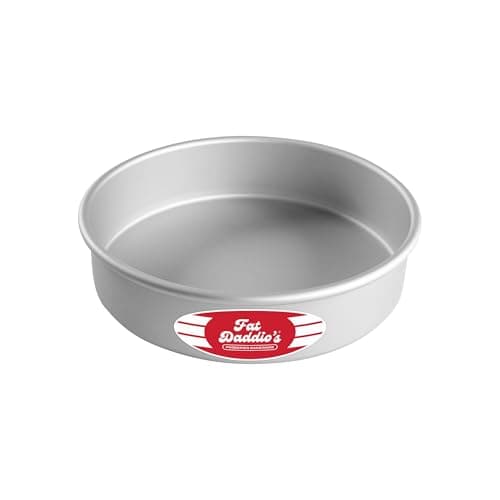
Round pan: multiply the radius by itself, then by 3.14. A nine-inch round has a radius of 4.5, so 4.5 times 4.5 times 3.14, which is about 64 square inches.
Square or rectangular pan: length times width. An eight-inch square is 64 square inches.
Those two numbers are identical, which is why the nine-inch round and eight-inch square swap is the reliable one every baker eventually learns.
The common pans, by area
Pan
Approximate area
Roughly equivalent to
8 inch round
50 sq in
Nothing square - it is the odd one out
9 inch round
64 sq in
8 inch square
8 inch square
64 sq in
9 inch round
9 inch square
81 sq in
Two 8 inch rounds is close
9 by 5 loaf
45 sq in
8 inch round, at greater depth
8.5 by 4.5 loaf
38 sq in
A smaller bake - not interchangeable with 9 by 5
11 by 7
77 sq in
9 inch square
9 by 13
117 sq in
Two 9 inch rounds, or two 8 inch squares
Half sheet, 13 by 18
234 sq in
Two 9 by 13 dishes
12 cup bundt
Volume based, 10 to 12 cups
Two 9 by 5 loaves
Areas are rounded. The ten percent rule covers the rounding comfortably.
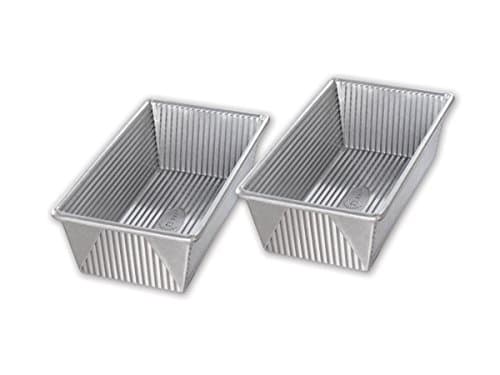
The most common real-world surprise is the loaf pan. A 9 by 5 and an 8.5 by 4.5 look interchangeable on a shelf and differ by around fifteen percent in area, which is enough to overflow a loaf. Check which one a recipe means - best cake and loaf pans.
Depth, and the two-thirds rule
Fill any pan no more than two-thirds deep with batter that rises. Cakes, quick breads and anything with chemical leavening will climb, and the difference between a beautiful loaf and a cleanup job is about a centimeter of headroom.
This is the constraint that makes some substitutions impossible regardless of area. Batter for a 9 by 13 poured into two 8-inch rounds fits by area but may be too deep in each, because rounds are usually shallower than rectangular dishes. When in doubt, pour to two-thirds and bake the remainder as cupcakes or in a small dish alongside.
Cheesecakes, brownies and bar cookies barely rise, so they tolerate deeper filling and more aggressive substitution than cakes. Anything with baking powder or soda in quantity does not.
Adjusting the bake
Larger pan, shallower batter: reduce time by roughly a quarter to a third, keep the temperature. Start checking at two-thirds of the original time.
Smaller pan, deeper batter: add time, and drop the temperature by about 25F so the outside does not set before the center cooks.
Same area, different shape: bake as written and check at the original time. This is the substitution that just works.
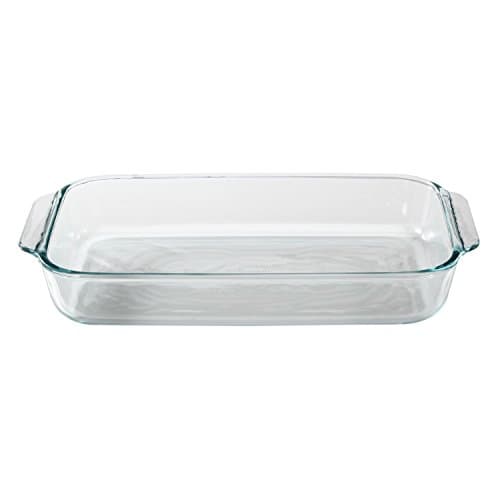
Glass instead of metal: reduce the temperature by about 25F. Glass heats more slowly but holds heat longer, and edges over-bake - glass versus metal bakeware.
Dark pan instead of light: reduce by about 25F. Dark absorbs more radiant heat and browns bases faster - sheet pan materials.
Test for doneness rather than trusting any adjusted time. A skewer in the center, an internal temperature, or the sides pulling away from the pan are all more reliable than arithmetic.
Shapes that do not convert
Tube and bundt pans
These are specified by volume rather than by diameter, because the central tube and the fluting make area meaningless. A recipe for a 12-cup bundt needs a 12-cup bundt, or two loaf pans. Measure an unfamiliar bundt by filling it with water a cup at a time - springform and tube pans.
Springform pans
Convertible by area with other rounds, but not always in practice: cheesecake recipes assume a springform because the cake cannot be inverted out. The size converts; the mechanism does not.
Pie plates
Sloped sides mean the stated diameter is the rim, and depth varies substantially between standard and deep-dish. A deep-dish plate holds roughly fifty percent more - pie and tart pans.
Muffin pans
Standard, mini and jumbo cups differ by roughly a factor of two in each direction. Batter converts across them easily; time does not, and mini muffins can bake in half the time - best muffin pans.
Conversion arithmetic assumes the oven is the temperature it claims. That assumption is wrong more often than bakers expect.
Which pans to own so you rarely need this
Four pans cover the overwhelming majority of recipes without conversion:
These are the products this page's reasoning actually points at. Same rules as everywhere else on the site: published specs, a stated trade-off, and a live price only where one exists.
Top pick · The reference cake panSpecs read September 3, 2026
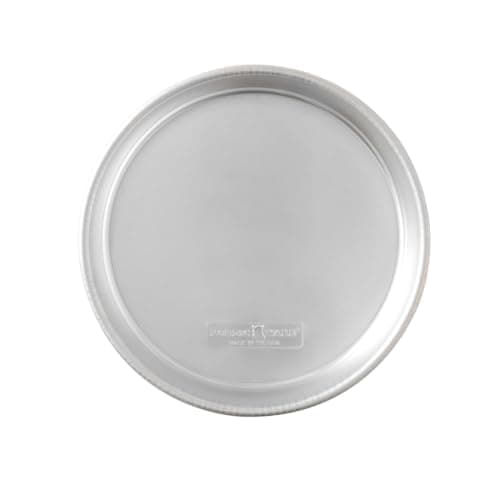
Nordic Ware Naturals Round Cake Pan, 9 in
Nine inches round is the size most American recipes are written for, which makes it the pan to own before any other.
Best for: Layer cakes, and anyone who has had a coated pan flake into a sponge
A 9 inch round has about 64 square inches against 50 for an 8 inch round, so the batter sits noticeably shallower and bakes faster. Reduce the time by roughly a quarter and start checking early. In the other direction, fill no more than two-thirds deep.
›Is a 9 inch round the same as an 8 inch square?
Almost exactly. Both work out to about 64 square inches of area, so batter depth is the same and the recipe bakes as written. It is the most reliable substitution in baking and worth committing to memory.
›How do you convert baking pan sizes?
Calculate the area of both pans - radius times radius times 3.14 for round, length times width for rectangular - and compare. Within about ten percent, swap directly. Outside that, adjust the bake time in proportion to how much shallower or deeper the batter sits.
›Are 9x5 and 8.5x4.5 loaf pans interchangeable?
Not reliably. They differ by around fifteen percent in area, which is enough for a 9x5 recipe to overflow an 8.5x4.5. Check which size a recipe specifies, and if you are using the smaller pan, hold back some batter and bake it separately.
›Do you need to change the temperature when changing pan size?
Only when the batter gets deeper or the pan material changes. A smaller pan means deeper batter, so drop about 25F so the outside does not set before the center cooks. Glass and dark metal also warrant about 25F less than light metal.
Sources
Every figure on this page came from one of these. Follow them and check our arithmetic — that is the point.