Heads up: some links on this page earn us a commission at no extra cost to you. It does not change what we recommend or the order. How we are funded.
The short answer
Buy a twelve-cup standard muffin pan in aluminized steel with a published coating - USA Pan is the one in our ledger, with a silicone-based coating published free of PTFE, PFOA and BPA, plus corrugation that helps release. This is the one bakeware shape where a coating is worth having: a cake pan has one surface to grease and a muffin pan has twelve, each with a corner. If you use paper liners every time, a plain pan is fine and cheaper.
Quick picks
The whole answer, on one screen. Tap a row to jump to the full write-up. Every pick below carries a stated trade-off further down — including the one at the top.
#
Product
Best for
Price
1
USA Pan Aluminized Steel Bakeware
Aluminized steel with a corrugated surface and a coating USA Pan publishes as free of PTFE, PFOA and BPA, warranted for life.
Prices last checked October 22, 2026. Prices move constantly — the number on Amazon when you click is the real one.
How we chose these
We have not baked in them. This page compares published material, coating chemistry where a maker states one, surface treatment, warranty and care guidance. The method is here, and where a figure is not published the product card says so rather than guessing.
One honest note about scope: our ledger contains USA Pan's aluminized steel bakeware, whose published description covers loaf, muffin and cake pans, and it does not contain a separately audited muffin tin from another brand. Where the recommendation is a type of thing rather than a specific audited SKU, we say so and link a tagged search rather than inventing a spec sheet.
Why this is the shape that justifies a coating
This site generally argues against coated bakeware. A bare aluminum sheet pan has nothing to wear out, parchment does the release work, and the coating is a wear item you are paying for twice - the argument in sheet pan materials.
A muffin pan is the exception, for a geometric reason. A cake pan has one flat base and one wall. A twelve-cup muffin pan has twelve deep wells, each with a curved base, a vertical wall and an inside corner where they meet - and that corner is where batter welds itself. Greasing and flouring twelve of those properly is genuinely tedious, and missing one spot ruins a muffin.
So the calculation flips: the coating saves real effort every single bake, rather than saving a step parchment would have covered.
Unless you use paper liners. Liners make the pan surface almost irrelevant, and a plain pan with liners releases as well as a coated one. If you always use liners, buy on price.
Materials, and what each does
Material
Release
Browning
Notes
Aluminized steel with a published coating
Excellent
Good - it browns sides properly
USA Pan's corrugation adds airflow; hand wash only
Bare aluminum, uncoated
Needs grease and flour, or liners
Excellent
Nothing to wear out; discolors with age
Anodized aluminum, uncoated
Needs grease or liners
Excellent
Harder surface; hand wash only
Dark coated steel
Good
Fast - drop the oven by 25F
Common and cheap; the coating is the wear item
Silicone
Excellent
Poor - pale, soft sides
Needs a sheet pan underneath; see our silicone page
Cast iron
Good once seasoned
Excellent, with crisp edges
Heavy; a specialist for cornbread more than muffins
Silicone is the row worth reading twice. It releases beautifully and browns nothing, which is covered in is silicone bakeware safe.
The cast iron row is the one that surprises people, and it is a narrower recommendation than the table can show: a six-well iron pan weighs about five pounds, gives you half the wells of a standard tin, and earns its place only for popovers and savory muffins where a hard browned shell is the point — cast iron bakeware works through where the material does and does not pay for its weight.
Cup sizes
Standard, twelve cups. The default, and what nearly every recipe assumes. Roughly a half-cup capacity per well.
Mini, twenty-four cups. For canapes and small bakes. Bake times drop sharply and burning is easy.
Jumbo, six cups. Bakery-style muffins. Needs a lower oven temperature and longer time, or the outside sets before the middle.
Six-cup standard. Genuinely useful in a small household or a small oven - see bakeware for toaster ovens.
Buy standard first. The temperature adjustments for jumbo and mini follow the same logic as pan substitution generally, which is set out in what size cake pan: shallower batter bakes faster, deeper batter needs lower heat and longer time.
The details that separate good tins from bad
A rim you can grip. A rolled or extended rim gives your oven mitt something to hold. A thin flat edge on a hot, full tin is genuinely awkward.
Rigidity. A flexible tin bends when you lift it full, which tips batter between wells. Heavier gauge steel is worth the small extra.
Wells that are the same depth. Cheap tins are pressed unevenly and bake unevenly as a result.
Corrugation, if it is coated. USA Pan's fluted surface gives the crust less continuous contact and a path for air, which is why it releases without lining. It is also why it is a nuisance to wash.
A light-colored surface unless you want fast browning. Dark tins absorb more radiant heat and want the oven dropped by about 25F.
Twelve wells, twelve inside corners. That geometry - not any property of the batter - is why a coating is worth more here than in a cake pan.
Liners, and what they cost you
Paper liners remove the release problem entirely and add three things: a slightly steamier crumb at the edge, a paler side because the paper insulates, and a running cost.
If you want a browned, crisp muffin edge, bake without liners in a well-greased or coated pan. If you want convenience and portability, use liners and stop thinking about the pan surface at all. Both are legitimate; they are simply different muffins.
Reusable silicone liners sit in between: no running cost, excellent release, and the same insulating pale-sides effect as paper.
Care
Hand wash the coated pans. USA Pan publishes not dishwasher safe, and the corrugation traps batter, so a soft brush is the tool.
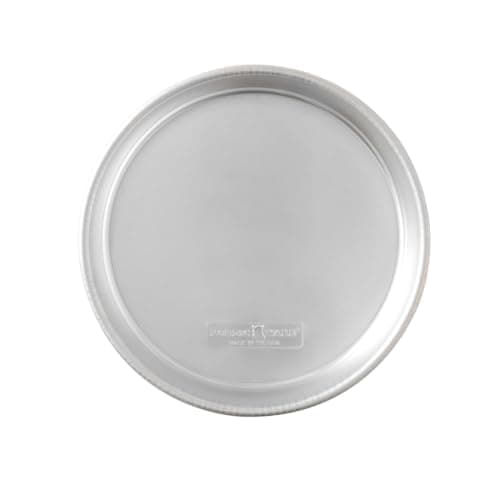
Hand wash bare aluminum too. Nordic Ware advises against automatic dishwasher use because alkaline detergent darkens the metal permanently.
Do not cut in the wells. A knife used to lever a muffin out scores a coating and ends it.
Let it cool before soaking. Thermal shock warps thin tins.
You always use liners: buy the cheapest rigid twelve-cup tin and put the money elsewhere.
You want nothing that can wear out: bare or anodized aluminum, and accept greasing twelve wells - the philosophy behind uncoated pans and anodized ones.
Whatever you buy, put a sheet pan under it - it catches overflow and makes a thin tin carryable.
What we have audited, and what goes with it
The coated aluminized steel is the recommendation for this shape. The uncoated pans are here because they are the philosophy this site applies everywhere else.
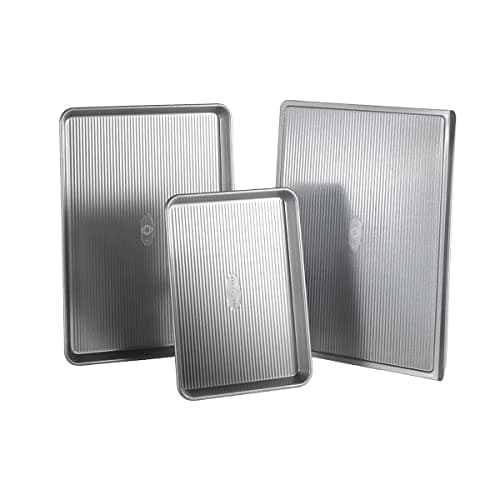
USA Pan Aluminized Steel Bakeware
Loaf pans, muffin pans and cake pans that release without paper every time
Each write-up below gives the published specs, what the pan is genuinely good at, what it costs you, and who should skip it. The trade-off line is there on the top pick too — a recommendation with no downside is an advertisement.
Top pick · Best muffin panSpecs read September 3, 2026
USA Pan Aluminized Steel Bakeware
Aluminized steel with a corrugated surface and a coating USA Pan publishes as free of PTFE, PFOA and BPA, warranted for life.
Best for: Loaf pans, muffin pans and cake pans that release without paper every time
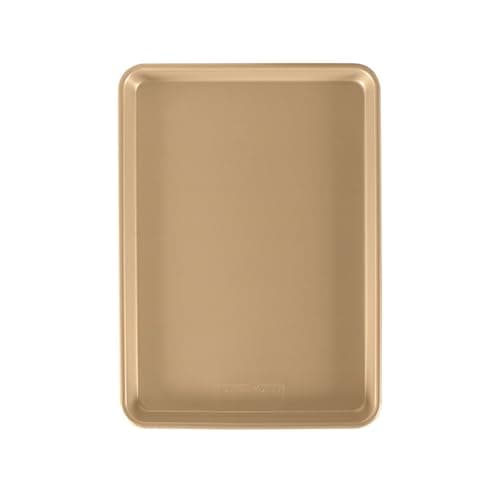
Published specifications for the Nordic Ware Naturals Half Sheet, 18 x 13 in
Exterior dimensions
17.9 x 12.9 x 1 in
Material
Aluminum
Rim
Encapsulated steel rim
Gauge
Not published by Nordic Ware
Warranty
Lifetime
Dishwasher
Hand wash recommended. Automatic dishwasher use is not advised
Made in
America of domestic and imported materials
Good
Aluminum conducts at 237 W/m-K, which is why it browns evenly and a steel pan does not
The encapsulated steel rim is the reason it does not warp in a hot oven
Lifetime warranty on a pan this cheap
Not good
Nordic Ware does not publish a gauge figure, so thickness cannot be compared like for like
Bare aluminum stains and reacts with acid
Not dishwasher safe by the maker's own advice
The trade-off. Bare aluminum discolors and reacts with acid. It will look used within a month and Nordic Ware advises against the dishwasher.
Skip this if. You want a pan that stays looking new, or you will not hand wash. Buy an aluminized-steel coated pan instead and accept the coating as a wear item.
A twelve-cup standard pan in aluminized steel with a published coating. USA Pan's is the one in our ledger - corrugated, with a silicone-based coating published free of PTFE, PFOA and BPA, and a lifetime warranty.
›Should a muffin pan be nonstick?
This is the one bakeware shape where a coating genuinely earns its place. A cake pan has one surface to grease; a muffin pan has twelve deep wells each with an inside corner. Unless you always use liners, in which case the surface barely matters.
›Do paper liners change how muffins bake?
Slightly. Paper insulates, so sides come out paler and a touch steamier than they would in a greased pan. If you want browned, crisp edges, bake without liners. Reusable silicone liners have the same insulating effect.
›What size muffin pan should I buy?
Standard twelve-cup, which is what nearly every recipe assumes. Mini and jumbo tins need temperature adjustments - jumbo wants a lower oven and longer time, mini bakes fast and burns easily.
›Can you put a muffin pan in the dishwasher?
Usually not. USA Pan publishes not dishwasher safe, and Nordic Ware advises against automatic dishwasher use for bare aluminum because alkaline detergent darkens it permanently. Hand wash with a soft brush.
Sources
Every figure on this page came from one of these. Follow them and check our arithmetic — that is the point.