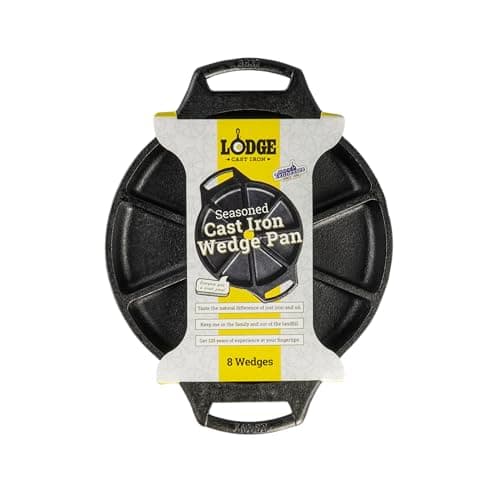
Iron is a browning tool. That makes it the wrong material for most baking and the right one for a short, specific list - and the list is shorter than the catalog.
Heads up: some links on this page earn us a commission at no extra cost to you. It does not change what we recommend or the order. How we are funded.
The short answer
Buy cast iron bakeware for crust, and for nothing else. Iron stores heat and gives it back to whatever touches it, so it browns the surfaces a thin aluminum pan leaves pale - which is a real advantage for cornbread, quick breads and popovers, and a disadvantage for almost everything else. The shape with the strongest case is the Lodge 8-well wedge pan, because every wedge gets two browned faces that no flat pan can produce. The Lodge 8.5-inch loaf pan is the one most people will actually use twice a month. The 6-well muffin pan earns its place only for popovers and savory muffins, and costs you half the wells of a normal tin at five pounds. The cornstick pan is honestly single-purpose. And the finding that runs through all four: Lodge publishes a 550F ceiling and a lifetime warranty for its seasoned cookware, and publishes neither an oven maximum nor a warranty term for any of this bakeware. Same brand, same metal, same foundry.
Quick picks
The whole answer, on one screen. Tap a row to jump to the full write-up. Every pick below carries a stated trade-off further down — including the one at the top.
#
Product
Best for
Price
1
Lodge Seasoned Cast Iron Wedge Pan, 8 Wells
Eight wedges, each browned on two faces, which is the one result a flat pan cannot give you. 11.69 by 8.94 in, pre-seasoned, PFAS-free, South Pittsburg foundry. Skip it if you want a pale tender crumb - this pan is a browning machine and does not have an off switch.
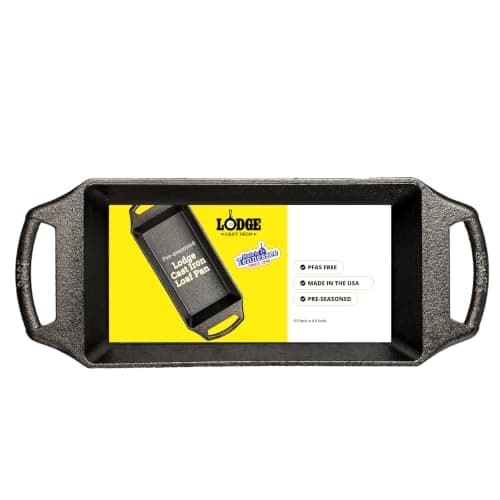
8.5 by 4.5 in and 3.78 lb empty. Banana bread and cornbread loaves come out with a crust a thin steel tin never develops. Skip it for sandwich bread, where a soft even crust is the point, and skip it if lifting four pounds out of a hot oven is a problem.
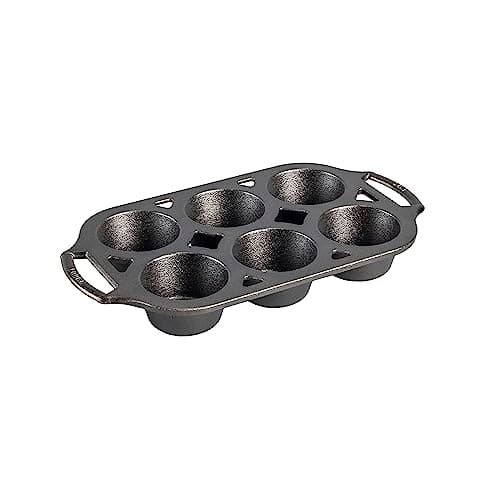
Six wells, 4.9 lb, deep enough for popovers and corn muffins with a hard shell. Skip it if you bake muffins for a household - a twelve-well aluminized steel tin does the job in one batch at a fraction of the weight.
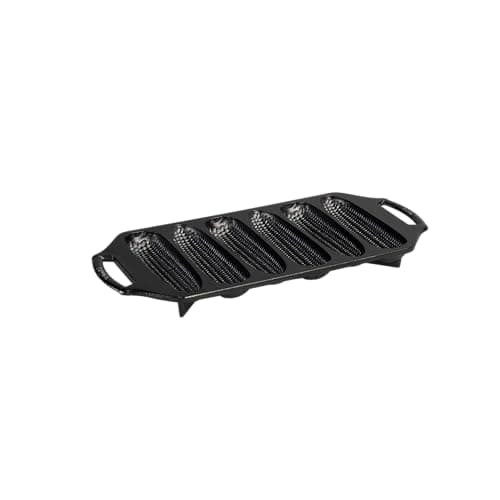
Six ribbed wells, 4.47 lb, dual handles, and a shape nothing else makes. Skip it unless you already know you want cornsticks - make cornbread in a skillet first, then decide whether the shape is worth a dedicated pan.
Prices last checked October 19, 2026. Prices move constantly — the number on Amazon when you click is the real one.
What iron does to a baked good
Baking pans are usually judged on how evenly they spread heat. Cast iron is bad at that, and it is on this page anyway, because it does something different that matters more for a short list of recipes.
Aluminum conducts heat roughly five times better than cast iron and weighs a fraction as much, which is why nearly all bakeware is aluminum or aluminized steel - the site's thermal-conductivity table is on cookware materials compared. What iron has instead is mass: a heavy pan is stored energy. When cold batter hits a preheated iron surface, the pan has enough heat in it to set and brown that surface immediately, rather than cooling down and waiting for the oven to catch up.
That single property explains the entire category.
Crust forms where batter meets iron. This is the advantage, and it is real.
The pan is slow to preheat and slow to let go. Timings written for a steel tin run short, and a loaf keeps baking after you take it out.
Even heat is not what you are buying. If a recipe wants a gentle, uniform, pale bake, iron is the wrong tool and aluminum is the right one - dark versus light baking pans covers why color and absorption matter more than people expect.
The same logic runs through every material on this hub. Glass is slow and gentle, stoneware is slower still, silicone barely browns at all, and bare aluminum is fast and pale — glass versus metal, stoneware and ceramic bakeware and silicone versus metal are the other members of this family. Cast iron is the far end of it.
What we ranked on
Does mass earn its weight here? Every pan on this page is three to five times heavier than its aluminum equivalent. That is only worth it if the recipe wants browning on a surface the pan is touching. Where it does not, we say so.
Can another pan you own do it? A 10 or 12-inch skillet already in your kitchen bakes cornbread, a Dutch oven already bakes bread. We would rather you use those than buy, and the page says where that applies.
What is published? Oven ceiling, warranty, weight, dimensions, coating disclosure. This is where the category falls down and where the page's finding came from.
How hard is it to keep? Bare iron with batter sitting in it for an hour is a different maintenance problem from a skillet you sear in.
We have not baked in any of these. This site compiles what makers publish and links every source — how we work.
The finding: the bakeware is documented worse than the cookware
This is one brand, one metal and one foundry, and the paperwork changes depending on which aisle the product sits in.
Lodge seasoned cookware
Lodge seasoned bakeware (all four here)
Oven maximum
550F, published
Not published on any of the four product pages
Warranty
Lifetime, published
Not published on these listings; the warranty field reads only "Warranty"
Seasoning
Published - vegetable oil, no synthetic chemicals
Published - 100% vegetable oil
PFAS
Published free of PFAS
Published free of PFAS
Made in
South Pittsburg, Tennessee
South Pittsburg, Tennessee
Stovetop use
Yes - this is what a skillet is for
Lodge publishes its cast iron pizza pan as NOT recommended for stovetop use
Read from Lodge's own published listings and product pages on the date stamped on this page. The gap is in the paperwork, not in the metal.
How much does the missing oven number actually matter? In practice, little: bare cast iron has no meaningful oven ceiling of its own — the limit is the seasoning, which is a baked-on polymerized oil layer, not the iron. The published 550F figure on the cookware line is effectively a seasoning figure. So the sensible reading is that these pans behave like the skillets.
But that is our inference, not Lodge's statement, and the distinction is the whole point of this site. We will not print a number a maker did not publish — see oven safe cookware temperatures for the full ledger of what is and is not published across brands.
The four, side by side
Wedge pan
Loaf pan
Muffin pan
Cornstick pan
Wells / shape
8 wedges
One 8.5 by 4.5 in loaf
6 wells
6 cornsticks
Dimensions
11.69 by 8.94 by 1.19 in
12 by 4.69 by 2.88 in
12.69 by 7.06 by 1.56 in
14 in long (see note)
Weight
1.55 lb, per the listing
3.78 lb
4.9 lb
4.47 lb
Handles
None
None
None
Dual
Pre-seasoned
Yes
Yes
Yes
Yes
PFAS
Published free
Published free
Published free
Published free
Oven maximum
Not published
Not published
Not published
Not published
Warranty
Not published
Not published
Not published
Not published
Dishwasher
No
No
No
No
Made in
South Pittsburg, TN
USA
South Pittsburg, TN
South Pittsburg, TN
Could another pan do it?
No - the shape is the product
Yes, a steel tin, with a worse crust
Yes, a 12-well tin, better
No
Where a figure is not published the cell says so rather than guessing. Two listing oddities are worth naming: the wedge pan's published 1.55 lb is far below the others at similar size and we could not reconcile it, and the cornstick pan's length and width fields appear transposed against its own title.
Why the wedge pan is the strongest case
Of everything here, this is the pan whose shape cannot be reproduced.
Cornbread baked flat in a skillet gives you a browned bottom, a browned edge ring and a soft middle — the middle pieces are a different food from the edge pieces, which is why people fight over corner slices. A wedge pan divides the batter before it bakes, so every portion has two angled walls of its own. Each wedge comes out with the crust-to-crumb ratio that, in a flat pan, only the outside pieces get.
That is a genuine, specific result, and it is the kind of thing this site will endorse a single-purpose pan for. The cost is that the portion size is fixed by the mold and the pan browns hard whether the recipe wanted it to or not.
The pan most readers already own. Before buying any bakeware on this page, bake the recipe in this and see whether the shape is what you were missing.
The pan you already own, which is the honest first answer
A 10.25 or 12-inch cast iron skillet is cast iron bakeware. Preheated in the oven and oiled, it bakes cornbread, Dutch babies, skillet cookies, upside-down cakes, focaccia and cobblers, and it does all of them well.
So the sequence we would actually recommend is:
Bake it in the skillet first. If you do not own one, best cast iron skillets and what size skillet cover that purchase, which is a far better first buy than anything on this page.
Notice what is missing. Usually it is portioning rather than browning — you wanted eight equal crusty wedges, not a round you cut up.
Then buy the shape that fixes it. That is a specific gap and a specific pan, which is a much better reason than “cast iron bakes better”.
Batter is not a steak. It sits in contact with the iron for forty minutes, it is often sweet, and it is sometimes acidic. Three consequences follow, and none of them appear on the listings.
Sticking is the main failure, and new pans stick. Factory seasoning is a starting layer, not a finished one. Oil the wells properly for the first several bakes and expect it to improve — the method is the same as seasoning and care, and how to stop baked goods sticking covers the bakeware-specific part.
Acidic batters dull seasoning. Anything with buttermilk, citrus or a lot of fruit sitting in bare iron for an hour will strip some of the layer. It is not ruinous and it re-seasons, but it is why a lemon cake is better off in aluminum — cooking acidic foods in reactive cookware.
Shaped wells are the hardest thing in a kitchen to clean and dry. Ribbed cornstick wells and deep muffin wells hold water in a way a flat skillet never does. Dry them in a warm oven rather than with a towel, and oil them before they go away — the drying failure is the one that rusts cast iron, as restoring rusty cast iron sets out.
None of these pans is dishwasher safe and none of them should ever see one — is bakeware dishwasher safe has the material-by-material version.
Where iron is simply the wrong choice
Worth being blunt, because the category is marketed as an upgrade and for most baking it is not one.
If you are baking
Use
Why
Cornbread, quick breads, popovers
Cast iron
Crust on contact is exactly the point
Layer cakes and sponges
Bare aluminum
You want an even pale rise, not a browned wall
Cookies
A bare aluminum sheet pan
A flat conductive surface, and iron is far too slow to recover between trays
Sandwich bread
A steel or aluminized tin
A soft even crust is the goal, and iron works against it
Delicate or acidic batters
Aluminum, glass or ceramic
Acid sitting in bare iron dulls seasoning
Roasting vegetables
A sheet pan
Surface area beats mass here, and nothing needs the weight
Cast iron is a specialist in a hub full of generalists. The sheet pan and the aluminum cake pan do more of your baking than any pan on this page will.
The general version of this argument is what bakeware you actually need, which lists four pieces — and none of the four is cast iron.
What we cannot tell you
The oven maximum of any of these four pans. Lodge publishes none, and we have declined to carry the cookware line's 550F figure across to products it was not written for, even though the metal is the same.
Nor can we tell you the warranty term — every one of these listings leaves the warranty field blank in substance, while Lodge publishes a lifetime warranty on its seasoned cookware and a Made Right Warranty on its cast iron generally. We also could not reconcile the wedge pan's published weight of 1.55 lb with the 4 to 5 lb figures on the comparable pans in the same line; we have printed what the listing says and flagged it rather than quietly substituting a plausible number.
And we have not baked in any of them, run no browning comparison and own none — our editorial policy.
Which to buy
You want what cast iron is actually good at:the Lodge 8-well wedge pan. Eight portions, two browned faces each.
You want one piece you will use twice a month:the Lodge 8.5-inch loaf pan. Quick breads, with a crust a tin will not give.
You make popovers or savory muffins:the Lodge 6-well muffin pan — six wells, five pounds, and only worth it for the shell.
You own a skillet and have not tried it yet: buy nothing. Bake the recipe in a 12-inch skillet first.
The four, plus the pan that may make them unnecessary
All four bakeware pans are pre-seasoned, published PFAS-free and made in South Pittsburg, Tennessee. None publishes an oven maximum or a warranty term. Prices move constantly - the number on each button is the current one.
Lodge Seasoned Cast Iron Wedge Pan, 8 Wells
Cornbread, scones and anything where a crust on more than one side is the point
Prices last checked October 19, 2026. Prices move constantly — the number on Amazon when you click is the real one.
Every pick, in full
Each write-up below gives the published specs, what the pan is genuinely good at, what it costs you, and who should skip it. The trade-off line is there on the top pick too — a recommendation with no downside is an advertisement.
Top pick · Best case for the materialSpecs read October 18, 2026
Lodge Seasoned Cast Iron Wedge Pan, 8 Wells
Eight wedges, each browned on two faces, which is the one result a flat pan cannot give you. 11.69 by 8.94 in, pre-seasoned, PFAS-free, South Pittsburg foundry. Skip it if you want a pale tender crumb - this pan is a browning machine and does not have an off switch.
Best for: Cornbread, scones and anything where a crust on more than one side is the point
Published specifications for the Lodge Seasoned Cast Iron Wedge Pan, 8 Wells
Wells
8 wedges
Dimensions
11.69 by 8.94 by 1.19 in
Weight
1.55 lb, per the listing - see the cons
Material
Cast iron
Seasoning
Pre-seasoned with 100% vegetable oil, ready to use
Coatings
Published as PFAS-free - iron and oil only
Oven maximum
Not published on this product page
Warranty
Not published on this listing; Lodge publishes a Made Right Warranty for its cast iron
Dishwasher
No - Lodge publishes hand wash, dry, oil
Made in
South Pittsburg, Tennessee, USA
Model
BW8WP
Good
Two browned faces per wedge, which is the whole reason to bake cornbread in iron
Arrives seasoned and needs nothing before first use
Published PFAS-free and made from iron and oil only, with a named US foundry
Not good
No published oven maximum anywhere on the listing
No published warranty term, unlike Lodge's seasoned cookware
The published 1.55 lb weight is far below the other pans in this line at similar size, and we could not reconcile it
Wedge wells mean a fixed portion size you cannot change
The trade-off. Lodge publishes no oven maximum and no warranty term for its bakeware line, in contrast to the 550F and lifetime warranty it publishes for its seasoned cookware.
Skip this if. You bake cakes and want a clean, pale, tender crumb. Cast iron is a browning tool, and here it browns eight surfaces at once whether you wanted that or not.
#2 · The one you will use mostSpecs read October 18, 2026
Lodge Seasoned Cast Iron Loaf Pan, 8.5 in
8.5 by 4.5 in and 3.78 lb empty. Banana bread and cornbread loaves come out with a crust a thin steel tin never develops. Skip it for sandwich bread, where a soft even crust is the point, and skip it if lifting four pounds out of a hot oven is a problem.
Best for: Banana bread, cornbread loaves, pound cake - anything where a dark crust is wanted
#3 · Best for popovers, worst value per wellSpecs read October 18, 2026
Lodge Seasoned Cast Iron Muffin Pan, 6 Wells
Six wells, 4.9 lb, deep enough for popovers and corn muffins with a hard shell. Skip it if you bake muffins for a household - a twelve-well aluminized steel tin does the job in one batch at a fraction of the weight.
Best for: Popovers, corn muffins and savory muffins where a hard browned shell is the goal
#4 · The honest single-purpose panSpecs read October 18, 2026
Lodge Seasoned Cast Iron Cornstick Pan, 6 Wells
Six ribbed wells, 4.47 lb, dual handles, and a shape nothing else makes. Skip it unless you already know you want cornsticks - make cornbread in a skillet first, then decide whether the shape is worth a dedicated pan.
Best for: Crisp cornsticks to go with chili and soup, for someone who will make them repeatedly
Published specifications for the Lodge Seasoned Cast Iron Cornstick Pan, 6 Wells
Wells
6 cornsticks
Dimensions
14 in per the title; the listing puts 6 in the length field and 14.13 in the width field
Weight
4.47 lb
Handles
Dual handles
Material
Cast iron
Seasoning
Pre-seasoned with 100% vegetable oil, ready to use
Oven maximum
Not published on this product page
Warranty
Not published on this listing
Dishwasher
No
Made in
South Pittsburg, Tennessee, USA
Model
BW6CRN
Good
Produces a shape and a crust-to-crumb ratio nothing else makes
Dual handles, which the other pans in this line do not have and which 4.47 lb needs
Arrives seasoned, made from iron and oil, named US foundry
Not good
Genuinely single-purpose, which this site treats as a reason to hesitate
The listing's own length and width fields appear transposed against its title
No published oven maximum and no published warranty term
Narrow ribbed wells are the hardest shape in the line to clean and to keep seasoned
The trade-off. It does exactly one thing. There is no second use for a six-well cornstick pan, and this site's standing position on single-purpose pans applies in full.
Skip this if. You are not already certain you want cornsticks. Make cornbread in a skillet first and decide whether the shape is worth a dedicated pan.
For a short, specific list. Iron stores heat and gives it back on contact, so it browns surfaces a thin aluminum pan leaves pale - which is exactly what cornbread, quick breads and popovers want. For layer cakes, cookies, sandwich bread and anything delicate or acidic it is the wrong tool, because those recipes want an even, gentle, pale bake and aluminum does that far better.
›What temperature can cast iron bakeware go to?
Lodge does not publish an oven maximum for any of the four bakeware pans audited here, which is a real documentation gap - it publishes 550F for its seasoned cookware line. In practice bare cast iron has no meaningful ceiling of its own; the limit is the seasoning, a baked-on polymerized oil layer. That is our inference rather than the maker's statement, and we will not print a figure Lodge did not publish for these products.
›Do I need cast iron bakeware if I own a cast iron skillet?
Usually not. A 10.25 or 12-inch skillet bakes cornbread, Dutch babies, skillet cookies, upside-down cakes, focaccia and cobblers well. Bake the recipe in the skillet first and notice what is actually missing - it is normally portioning rather than browning. A wedge pan exists because you wanted eight equal crusty portions, not because iron bakes better than the pan you own.
›Does cast iron bakeware stick?
New pans do. Factory seasoning is a starting layer rather than a finished one, and batter sits in contact for forty minutes in a way a seared steak never does. Oil the wells properly for the first several bakes and it improves. Shaped wells - ribbed cornstick and deep muffin - are the hardest to rescue once something has welded itself in.
›Can you put cast iron bakeware in the dishwasher?
No, and it is worse than for a skillet. Shaped wells hold water that a flat pan sheds, so a dishwasher both strips the seasoning and leaves the pan wet in the places hardest to dry - which is how cast iron rusts. Hand wash, dry in a warm oven rather than with a towel, and wipe a light film of oil over the wells before storing.
›Is cast iron bakeware non-toxic?
Lodge publishes all four of these pans as PFAS-free and describes them as made from iron and oil only, with the seasoning applied as 100% vegetable oil. There is no coating in the sense that a nonstick pan has one - nothing is applied that can wear through or flake. That is a stronger disclosure than most bakeware carries, and it matters more here than on a skillet because batter sits against the surface for the length of a bake.
›Is a cast iron loaf pan better than a regular loaf tin?
For banana bread, cornbread loaves and pound cake, yes - the mass gives a crust a thin steel tin never develops. For sandwich bread, no: a soft, even crust is the goal there and iron works against it. The practical costs are 3.78 lb empty, a slower preheat that makes timings written for a steel tin run short, and a loaf that keeps baking after you pull it out.
Sources
Every figure on this page came from one of these. Follow them and check our arithmetic — that is the point.