Heads up: some links on this page earn us a commission at no extra cost to you. It does not change what we recommend or the order. How we are funded.
The short answer
Bakeware
Dishwasher?
What happens if you do
Glass
Yes
Nothing - the safest bet in the category
Silicone
Yes
Nothing, though it holds water and grease
Glazed stoneware
Usually
Fine if glazed; unglazed absorbs detergent
Bare aluminum sheet pans
No
Dulls and darkens permanently within a few cycles
Aluminized steel
No
Same dulling, plus rust risk at cut edges
Anodized aluminum
No
Detergent strips the anodized layer - unrecoverable
Coated nonstick bakeware
Check the maker
Coating life shortens; most makers say hand wash
Cast iron and carbon steel
Never
Strips seasoning and rusts within one cycle
Why dishwashers damage bakeware
It is not the heat and it is not the water pressure. Dishwasher detergent is strongly alkaline, far more so than dish soap, because alkalinity is what breaks down baked-on food and grease without scrubbing. Alkaline solutions attack aluminum. Since the majority of bakeware is aluminum or aluminized steel, most of the category is chemically incompatible with the machine.
The visible result is a dull, chalky gray surface, sometimes with a slight iridescence, and it is not a stain. A thin layer of the metal has been converted and removed. No amount of subsequent washing brings it back.
This is different from the darkening bare aluminum acquires with use. That darkening is normal, harmless and arguably an improvement, because a seasoned dark pan bakes better. Dishwasher damage is dull and gray rather than warm and brown, and it happens in cycles rather than years.
Material by material
Bare aluminum sheet pans
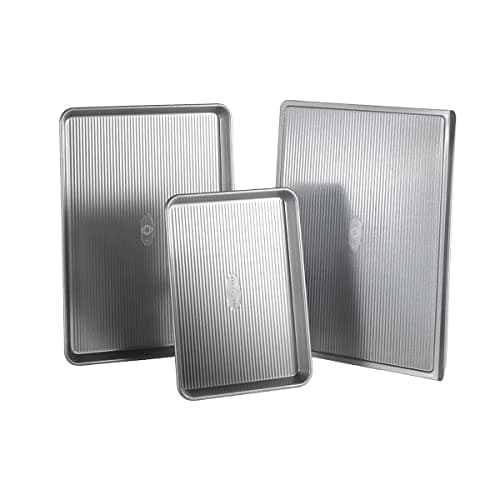
The single most common casualty. A commercial half sheet pan is the most useful piece of bakeware most kitchens own, it costs very little, and it will last decades if it never goes in the machine. It also happens to be the easiest thing in the kitchen to wash by hand, because nothing bonds strongly to it - best sheet pans.
Aluminized steel
Steel core with an aluminum coating, which gets the strength of steel and the conduction of aluminum. The aluminum layer reacts to detergent exactly as bare aluminum does, and any cut or scratched edge exposes steel that can then rust. Sheet pan materials covers the construction.
Anodized aluminum
The clearest no on the list. Anodizing is an electrochemically grown hardened surface, and dishwasher detergent strips it. Once gone it cannot be restored at home, and the pan reverts to bare, reactive aluminum. Fat Daddio's anodized pans are the example in our ledger - the Fat Daddio's review.
Coated nonstick bakeware
Manufacturer-dependent, and worth reading the actual instruction. Many coated pans are labeled dishwasher safe, which is a claim about survival rather than about longevity - the coating will last longer hand washed either way. USA Pan publishes hand wash for its AMERICOAT silicone coating, which is the more typical professional guidance - the USA Pan review.
Glass
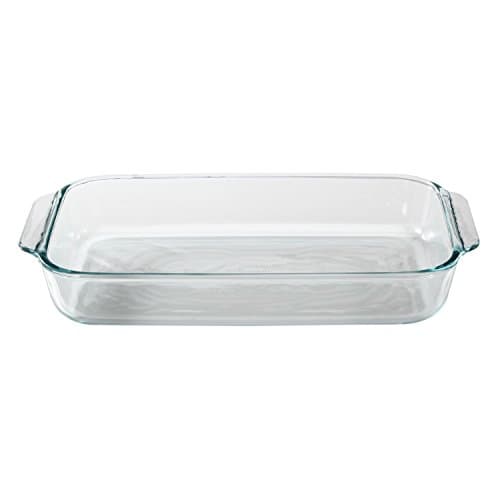
Entirely dishwasher safe. Glass does not react with detergent, does not corrode and does not lose a surface treatment, because it has none. The only rule that matters for glass is thermal shock, which is a separate subject - glass versus metal bakeware.
Silicone
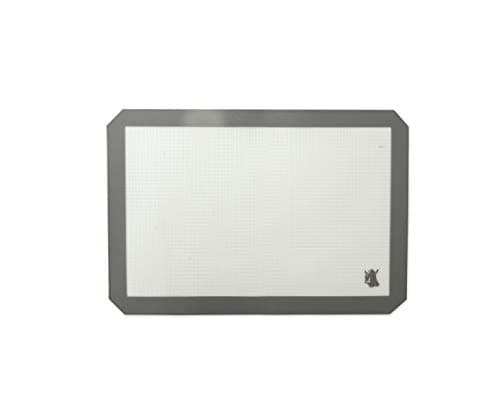
Dishwasher safe and generally fine. The practical annoyance is that silicone holds a greasy film that a machine does not always remove, and it traps water in folds. Neither is damage - is silicone bakeware safe.
Stoneware and ceramic
Glazed stoneware is usually dishwasher safe and most manufacturers say so. Unglazed or partially glazed pieces absorb water and detergent into the porous body, which can then leach flavor into the next bake - stoneware and ceramic bakeware.
Cast iron and carbon steel bakeware
Never. Seasoning is polymerized oil and alkaline detergent removes it, after which bare iron sits in a hot wet box for an hour. A cast iron pan can come out of a dishwasher visibly rusted - restoring rusty cast iron covers the recovery.
What the label actually promises
"Dishwasher safe" means the item will not be destroyed or become unsafe. It is not a claim that it will look the same afterward, or that its useful life is unchanged. This is why so many manufacturers print "dishwasher safe" on the box and "hand wash recommended for best results" in the instruction leaflet, and why the leaflet is the one to follow - how to read a cookware listing.
The same distinction applies across cookware generally - dishwasher-safe cookware covers pots and pans, where the materials and the stakes are different.
Anodized and aluminized pans look similar and wash completely differently. The finish, not the shape, decides.
Hand washing bakeware, quickly
The objection to hand washing is effort, and most of that effort is avoidable.
Soak while the oven is still warm. Hot water into a warm pan lifts nearly everything without scrubbing. The pan should be warm, not hot - do not pour cold water into a screaming hot pan.
Use the bake time. Fill the used pan and leave it while you eat.
Line the pan. Parchment or a silicone mat means the pan barely needs washing at all, which is most of the argument for them - best silicone baking mats.
Baking soda paste for baked-on grease, not oven cleaner, which is caustic and does the same thing a dishwasher does.
Dry immediately, especially aluminized steel and anything with a cut edge.
These are the products this page's reasoning actually points at. Same rules as everywhere else on the site: published specs, a stated trade-off, and a live price only where one exists.
Top pick · The dishwasher-proof choiceSpecs read September 3, 2026
Pyrex Basics Oblong Glass Baking Dish, 3 qt
Glass is unaffected by detergent, heat or repeat cycles - the one bakeware material with no caveat at all.
Best for: Casseroles, gratins and baked pasta - wet dishes that go oven to table to fridge
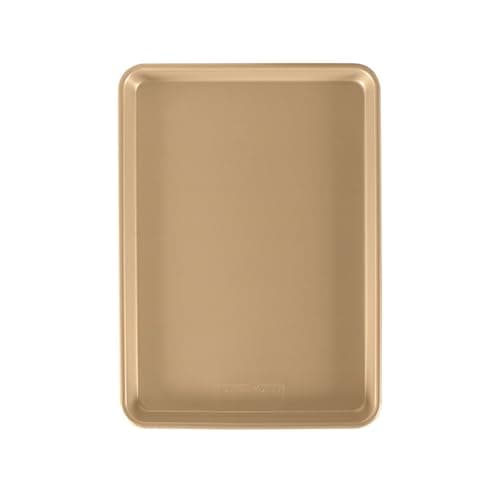
Published specifications for the Nordic Ware Naturals Half Sheet, 18 x 13 in
Exterior dimensions
17.9 x 12.9 x 1 in
Material
Aluminum
Rim
Encapsulated steel rim
Gauge
Not published by Nordic Ware
Warranty
Lifetime
Dishwasher
Hand wash recommended. Automatic dishwasher use is not advised
Made in
America of domestic and imported materials
Good
Aluminum conducts at 237 W/m-K, which is why it browns evenly and a steel pan does not
The encapsulated steel rim is the reason it does not warp in a hot oven
Lifetime warranty on a pan this cheap
Not good
Nordic Ware does not publish a gauge figure, so thickness cannot be compared like for like
Bare aluminum stains and reacts with acid
Not dishwasher safe by the maker's own advice
The trade-off. Bare aluminum discolors and reacts with acid. It will look used within a month and Nordic Ware advises against the dishwasher.
Skip this if. You want a pan that stays looking new, or you will not hand wash. Buy an aluminized-steel coated pan instead and accept the coating as a wear item.
Bare aluminum and aluminized steel sheet pans should not go in. Dishwasher detergent is strongly alkaline and alkaline attacks aluminum, leaving a dull gray surface that cannot be restored. Sheet pans wash easily by hand, which is why professionals do it that way.
›Why did my baking pan turn gray in the dishwasher?
The alkaline detergent reacted with the aluminum and removed a thin layer of the surface. It is corrosion rather than a stain, so it will not wash off. It is different from the warm brown darkening bare aluminum acquires with normal use, which is harmless.
›Is nonstick bakeware dishwasher safe?
It depends on the maker, and the label is worth reading carefully. Dishwasher safe means the pan will survive, not that the coating life is unaffected. Most manufacturers recommend hand washing for best results, and coatings do last noticeably longer that way.
›Can glass bakeware go in the dishwasher?
Yes, without any caveat. Glass does not react with detergent, does not corrode and has no surface treatment to strip. The only rule that matters for glass bakeware is avoiding sudden temperature changes, which is a separate issue from washing.
›What happens if cast iron goes in the dishwasher?
The detergent strips the seasoning and the pan then sits in a hot, wet environment for an hour, so it can come out visibly rusted. It is recoverable by scrubbing back and re-seasoning, but there is no reason to put cast iron in a machine at all.
Sources
Every figure on this page came from one of these. Follow them and check our arithmetic — that is the point.