Every care instruction on this site says medium heat. Nobody defines it. Here is what the numbers on your dial are doing, and the three recipes they translate into.
Heads up: some links on this page earn us a commission at no extra cost to you. It does not change what we recommend or the order. How we are funded.
The short answer
A stove dial sets how fast energy goes into the pan, not what temperature the pan reaches - so the same number produces a different surface temperature in a thin coated pan than in a cast iron skillet. As rough working definitions on a domestic hob: low holds a pan around 200 to 250F and is for melting and gentle simmering; medium sits roughly 300 to 375F and is where almost all everyday cooking belongs, including every coated pan on the market; medium-high runs about 400 to 450F for browning and stir-frying; and high is for boiling water and preheating heavy bare metal, nothing else. The reason it matters is that coated pans publish ceilings between 400F and 450F - Zwilling Clad CFX at 400F, OXO at 430F, Calphalon Premier at 450F - and an empty coated pan on high crosses all of them in under two minutes.
The dial is not a thermometer
This is the whole page in one idea. Turning a knob to 5 does not request 5 units of temperature. It opens a gas valve a certain amount, or switches an electric element on for a certain fraction of its cycle, or asks an induction coil for a certain power level. All three are rates of energy delivery.
What temperature the pan reaches depends on the pan: its mass, its thickness, its material, how wide it is relative to the heat source, and whether there is food in it absorbing energy. A thin aluminum pan on medium will get hotter than a cast iron skillet on medium, because the same energy is heating a fraction of the metal. This is also why "medium heat" in a recipe is honest shorthand rather than a precise instruction.
It follows that the only way to know a pan's temperature is to read the pan, not the dial. The rest of this page is how to do that.
The four settings, and what each one is for
The temperatures below are the pan surface, for a typical pan on a typical domestic hob, and they are ranges rather than figures. Treat them as the band each setting lives in.
Setting
Pan surface, roughly
What it is for
What goes wrong here
Low (1-2)
200-250F
Melting chocolate and butter, holding a sauce, gentle simmering, keeping food warm
On induction, low is produced by pulsing full power on and off, so delicate things still scorch
Medium (3-5)
300-375F
Eggs, pancakes, fish, sauteing vegetables, almost all everyday cooking, every coated pan
Nothing. This is where most cooking belongs and where most people spend too little time
Medium-high (6-8)
400-450F
Browning meat, stir-frying, reducing a sauce fast, getting a crust
Coated pans cross their published ceilings in this band. Oil past its smoke point starts here
High (9-10)
Above 450F, and climbing with nothing to stop it
Boiling water, preheating bare cast iron or carbon steel, searing in heavy metal
An empty pan on high has nothing absorbing the energy. This is how pans are destroyed
Pan-surface bands for a domestic hob. The number on the dial is a rate of energy delivery; the pan decides the temperature.
The published ceilings your dial is about to cross
Here is why this is a safety page and not just a technique page. Coated pans publish an oven maximum, and that figure is a statement about the coating as much as the body. The numbers in our ledger cluster tightly in the band that medium-high reaches.
Pan
Published maximum
Setting that crosses it
Zwilling Clad CFX, 10 in
400F
Medium-high
T-fal Professional, 12 in
400F for the line
Medium-high
OXO Good Grips Pro, 10 in
430F for the line
Medium-high
Calphalon Premier, 10 in
450F for the Premier line
Medium-high to high
Scanpan Classic, 10.25 in
500F
High
Caraway ceramic, 10.5 in
550F, with low-to-medium heat published as guidance
High
Lodge cast iron, 10.25 in
550F - structural, no coating to degrade
High, deliberately
All-Clad D3, 10 in
600F, oven and broiler safe
High, deliberately
Oven maximums as published by each maker. On a coated pan this is a coating specification; on bare metal it is a structural one.
Notice what Caraway publishes alongside its 550F figure: low to medium heat as care guidance. Those two numbers are not in conflict - one is what the pan survives, the other is what keeps the coating working. Where a maker publishes both, the care figure is the one to cook by.
The single worst thing you can do to a coated pan is preheat it empty on high. There is no food and no oil absorbing energy, so the surface temperature runs away in well under two minutes - past the published ceiling and towards the point where coatings begin to degrade, which is above roughly 500F. Put the fat in first, always.
How to read the pan instead of the dial
Four tests, in ascending order of precision. None of them needs equipment except the last.
The water test, for stainless
Flick a few drops of water into the dry pan. If they sizzle and evaporate, it is warm but not ready. If they form beads that skate across the surface without boiling away, the pan is in the right zone for food to release. That is the Leidenfrost effect, and it is the single most useful thing to learn about a stainless pan - why food sticks.
The oil test, for everything
Oil tells you the temperature if you watch it. Still and thick means too cool. Loose, thin and flowing like water means ready. Shimmering with faint wisps means you are at the top of medium-high. Smoking means you have passed the oil's smoke point and should start again - the fat has begun to break down and it will taste of it.
The sound test, for anything with moisture
A quiet pan is a steaming pan, and steaming is not browning. A proper sizzle that settles into a steady crackle is the sound of water leaving fast enough for the Maillard reaction to get going. Silence after the first minute usually means the pan was too cool or too crowded.
An infrared or probe thermometer, for calibrating yourself once
If you want to stop guessing, measure your own hob once. Put your usual pan on each setting for three minutes, note the surface temperature, and write the four numbers inside a cupboard door. Every stove is different, and knowing yours converts this whole page into four specific figures - instant-read thermometers.
The same setting on four different stoves
Your dial behaves differently depending on what is under it, and the differences are large enough to change technique.
Stove
How low power is made
What that means for you
Gas
A smaller flame - genuinely continuous and genuinely low
The best stove for delicate work. Flame also licks up the sides, so pan walls get hotter than on anything else
Electric coil
The element cycles on and off, and holds heat after switching off
Slow to respond in both directions. Take the pan off the heat rather than turning the dial down
Smooth top radiant
Same cycling, under glass, with the glass storing heat too
The laggiest of the four. Flatness matters because conduction is the only transfer path
Induction
Power levels, but low settings are often full power pulsed on and off
Superb at high heat, awkward at the bottom. Mass in the pan smooths the pulse
Preheating a coated pan empty on high. The one unforgivable habit. It crosses a published ceiling in under two minutes and it is the realistic route to degrading a coating.
Using high to speed up medium work. A hotter pan does not cook chicken faster, it burns the outside while the inside lags. Heat is not throughput.
Cooking on low to be gentle. On an electric or induction hob low is pulsed, not gentle, and food sits in contact with a cycling surface. Gentle is medium with mass, or a water bath.
Hot pan into cold water. Thermal shock warps bases permanently, and on a smooth top or induction hob a warped base is the end of that pan's usefulness - why pans warp.
Loose, thin, flowing oil is medium-high. Wisps of smoke mean you have gone past the point where the fat is still doing its job.
The pan decides how forgiving the dial is
A final practical point. Thin pans track the dial closely, which makes them responsive and unforgiving. Heavy pans lag behind it, which makes them slow and stable. Neither is better; they want different settings.
Thin coated pan: live on medium, never preheat empty, accept that it will never sear well.
Clad stainless: medium for cooking, a proper preheat on medium-high before protein goes in, and the water test to tell you when.
Cast iron and thick carbon steel: preheat slowly - five minutes on medium beats two on high, which only heats the center. Then turn the dial down, because the pan is now the heat source.
One pan from each heat category
A heat battery that wants a slow preheat and a low dial, a responsive clad pan that wants the water test, and a thin coated pan that should never leave medium.
Lodge Seasoned Cast Iron Skillet, 10.25 in (L8SK3)
Searing, cornbread, and anyone who wants one pan that cannot be worn out
Prices last checked October 6, 2026. Prices move constantly — the number on Amazon when you click is the real one.
What to buy, if you are buying
These are the products this page's reasoning actually points at. Same rules as everywhere else on the site: published specs, a stated trade-off, and a live price only where one exists.
Top pick · Wants a slow preheat, then a low dialSpecs read September 3, 2026
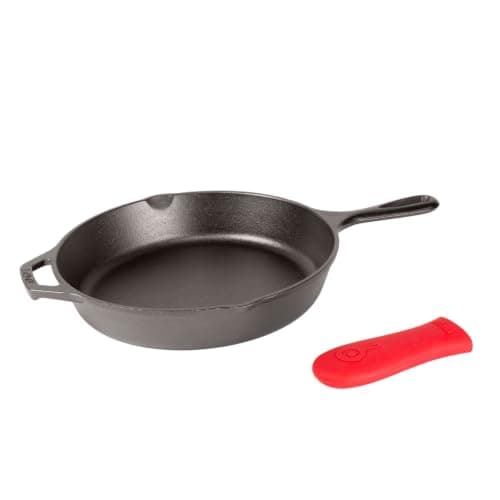
Lodge Seasoned Cast Iron Skillet, 10.25 in (L8SK3)
Five minutes on medium beats two on high, because high only heats the metal over the burner. Once it is up to temperature the pan is the heat source and the dial comes down. Published 550F, with no coating to degrade.
Best for: Searing, cornbread, and anyone who wants one pan that cannot be worn out
Published specifications for the Lodge Seasoned Cast Iron Skillet, 10.25 in (L8SK3)
Diameter
10.25 in
Weight
5.66 lb
Oven maximum
550F
Induction
Yes - bare iron is ferrous
Seasoning
Pre-seasoned with soy-based vegetable oil, no synthetic chemicals
Warranty
Lifetime
Made in
USA
Care
Hand wash. Lodge's own instructions permit warm soapy water
Good
Effectively unbreakable and fully restorable - a rusted one can be stripped and re-seasoned
Holds heat better than anything else at the price, which is what a sear needs
Lodge publishes its seasoning method openly, so the maintenance is not a mystery
Not good
Heavy
Heats unevenly on a small burner: cast iron conducts at roughly 50 W/m-K, so it is slow to spread and slow to react
Bare iron is reactive; long tomato braises will taste of it
The trade-off. It weighs 5.66 lb empty. You will feel that every time you move it full, and it is the single most common reason a cast iron skillet ends up in a cupboard.
Skip this if. You have wrist or shoulder trouble, or you cook mostly acidic braises. Carbon steel does most of the same jobs at roughly half the weight.
#2 · Tracks the dial closelySpecs read September 3, 2026
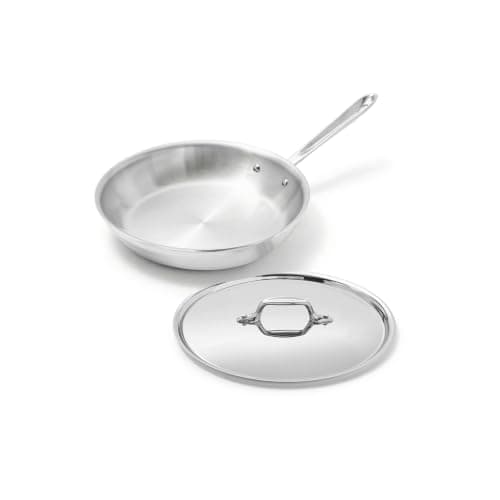
All-Clad D3 Stainless 10 in Fry Pan
Low mass means it changes temperature nearly as fast as you change the setting, which makes it responsive and unforgiving. Published at 600F and oven and broiler safe, so the dial is never the limit.
Best for: One good open-stock stainless pan bought instead of a cheap full set
Published specifications for the All-Clad D3 Stainless 10 in Fry Pan
Construction
Fully bonded tri-ply, aluminum core
Oven maximum
600F, oven and broiler safe
Induction
Yes - compatible with any stovetop
Dishwasher
Handwash only (All-Clad published)
Handle
Double-riveted stainless
Weight
3.0 lb (model 4110)
Warranty
Limited lifetime
Made in
Bonded, engineered and assembled in Canonsburg, PA
Good
600F is the highest oven ceiling of any stainless pan on this site
The one pan here whose manufacturing location is published down to the town
Genuinely repairable-adjacent: rivets are the only failure point and the warranty covers them
Not good
Hand wash only
The flared rim makes it a poor pan for anything with liquid
Costs several times what a Tramontina or Cuisinart pan of the same construction costs
The trade-off. Hand wash only. All-Clad publishes that plainly, and it is a real daily cost on a pan you will use every day.
Skip this if. You want a dishwasher-safe pan, or you are buying a whole kitchen on a fixed budget - one D3 skillet costs what a full clad set can cost.
#3 · Should never leave mediumSpecs read September 3, 2026
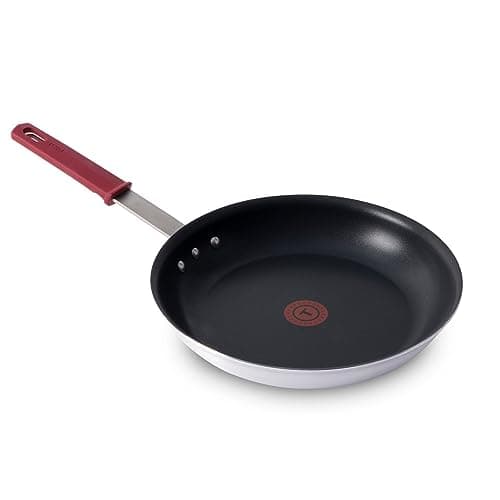
T-fal Professional Total Nonstick Fry Pan, 12 in
A thin aluminum body under PTFE with 400F published for the line, and a Thermo-Spot pattern that turns solid red at cooking temperature. Put the fat in before the heat, every time.
Best for: Eggs and pancakes on a budget, replaced without regret every couple of years
Roughly a 300 to 375F pan surface on a typical domestic hob, which is usually settings 3 to 5 on a dial of 10. It is a range rather than a figure, because the dial sets how fast energy enters the pan and the pan's mass and thickness decide what temperature it reaches.
›What number is medium heat on an electric stove?
About 4 or 5 on a dial numbered to 10, but electric elements cycle on and off and hold heat after switching down, so the setting lags the result in both directions. Calibrate yours once with a thermometer: three minutes on each setting with your usual pan, and write the numbers down.
›Why should you never preheat a nonstick pan empty?
Because nothing is absorbing the energy, so the surface temperature runs away. Coated pans publish oven maximums between 400F and 450F, and an empty coated pan on high crosses that in under two minutes, heading towards the point where coatings begin to degrade above roughly 500F. Put the fat in first.
›How do I know when a stainless pan is hot enough?
Flick a few drops of water into the dry pan. Sizzling and evaporating means it is warm but not ready. Beads that form and skate across the surface without boiling away mean the pan is in the zone where food will release. That is the Leidenfrost effect and it is more reliable than any dial setting.
›Is high heat ever the right setting?
For boiling water, for preheating heavy bare cast iron or carbon steel, and for searing in a pan with real thermal mass. That is close to the whole list. For a thin pan, a coated pan, or anything you want cooked through rather than crusted, high heat burns the outside and does not speed anything up.
›Why does my induction hob burn things on the lowest setting?
Many induction hobs cannot deliver a very small continuous power, so at low settings they pulse full power on and off and average it down. The average is low, the instantaneous temperature is not. Use a heavier pan to smooth the pulse, keep food moving, or switch to a bowl over simmering water.
Sources
Every figure on this page came from one of these. Follow them and check our arithmetic — that is the point.