Your pan works on induction and something is still wrong. Almost every one of these symptoms is the pan and the hob disagreeing about physics, not a fault.
Heads up: some links on this page earn us a commission at no extra cost to you. It does not change what we recommend or the order. How we are funded.
The short answer
Symptom
Most likely cause
The fix
Loud buzzing or humming at high power
The bonded layers of a clad or disc-bottom pan vibrating against each other at the coil frequency
Drop to a lower power level, or use a heavier single-metal pan. It is not damage
Rattling or skating across the glass
A base that is no longer dead flat, so it rocks on a surface with no burner grate to hold it
Check flatness with a straight edge. A warped pan cannot be fixed; a convex base is permanent
Fine scratches on the cooktop
Dragging a pan rather than lifting it, almost always bare cast iron
Lift, never slide. Keep the glass and the pan base free of grit
Browning in a ring, pale in the middle
The pan is wider than the coil, and induction heats only the metal above the coil
Match pan diameter to element diameter, or use a pan with more thermal mass to even it out
Food scorching on the lowest settings
At low power many hobs cycle full power on and off rather than reducing it continuously
Use a thicker pan, a diffusing layer of liquid or fat, or move delicate work to a gas ring
The hob stops detecting a pan mid-cook
Base diameter below the element minimum, or a base that lifted away as it heated
Use a larger pan or a smaller element. Intermittent detection on an emptying pan is normal
What this page is, and what it is not
This page assumes your pan already works. If the question is whether a pan will work at all - the magnet test, which materials couple, whether an adapter disc is worth it - that is cookware for induction cooktops, which owns the compatibility question and the pans worth buying for the hob.
Everything below is the next set of problems: a compatible pan on a working hob that is buzzing, rattling, scorching or browning in a ring. Nearly all of it comes down to one fact about how the hob works, so it is worth thirty seconds on that first.
One fact explains most of the list
An induction hob does not heat the glass and it does not heat the pan evenly. A coil under the surface generates an alternating magnetic field; that field induces currents in ferrous metal directly above it, and that metal becomes the heating element. The glass is cold except where the pan has warmed it.
Two consequences follow, and between them they account for the majority of induction complaints. First, only the part of the base sitting over the coil is heated, so a pan wider than the element gets a hot ring and a cooler center. Second, the field is doing mechanical work on the metal, which is why pans make noise - and why a pan built from bonded layers makes more noise than one cast in a single piece.
Buzzing, humming and whining
The most-reported induction complaint, and the least serious. The field causes very slight movement in the pan's metal. In a single-piece pan - bare cast iron, a thick carbon steel pan - there is nothing to rattle against anything else. In a clad pan, several bonded layers of different metals each respond slightly differently, and the result is audible.
You can expect it to be loudest at the top of the power range, on a lighter pan, and with a lid resting loose on top. None of that is damage and none of it shortens the pan's life.
Drop one power level. Most buzzing disappears between maximum and about eighty per cent, and almost nothing you cook needs maximum for longer than a boil.
Seat the lid properly or take it off. A loose lid on a vibrating pan is a surprisingly large share of the noise.
Use a heavier pan for the noisy job. Mass damps vibration; a 5.66 lb Lodge skillet is essentially silent where a thin clad pan sings.
Rattling, skating and a pan that will not sit still
Rattling is a different problem from buzzing and it does mean something. A gas hob has a grate that holds a pan in place and tolerates a base that is not quite flat. Induction has a sheet of glass and nothing else, so flatness stops being a nicety.
Lay a straight edge across the base. If you can see light under the middle the base is convex and the pan will rock; if you can see light at the edges it is concave and it will heat in a ring. Either way it is permanent - a warped base cannot be trued at home, and the usual cause is thermal shock from a hot pan hitting cold water. The mechanism and the prevention are in why pans warp.
Scratched glass, which is almost always technique
Cast iron does not scratch a ceramic hob by being heavy. It scratches it by being dragged, and by having a slightly rough cast base that traps grit. A 5.66 lb skillet slid six inches across a glass surface with one grain of salt under it will leave a mark; the same pan lifted on and off will not.
Lift pans on and off. Never slide, never pivot, never rotate in place.
Wipe the hob and the pan base before cooking. Grit is the abrasive, not the iron.
Do not put a hot pan down on a wet hob, or a wet pan on a hot one - and keep sugar spills off the glass entirely, because they bond to it.
Enameled cast iron is the gentler option if this worries you, since the base is smooth glass-on-iron rather than raw casting - cast iron on glass top stoves has the full version of this argument.
Browning in a ring, pale in the middle
This one surprises people who moved from gas, where a flame spreads and licks up the sides. On induction the heated area is defined by the coil, not by the pan, and pans are routinely wider than the coil they sit on.
Two things fix it. Match the pan to the element - a 12 in pan on a small element will always have a cool rim. Or buy mass: a thick pan conducts heat sideways from the heated zone before it reaches the food, which is exactly what thermal mass is for. A 3 mm carbon steel pan or a cast iron skillet evens out a small element in a way a 2 mm clad pan cannot.
This is the single best argument for owning one heavy pan on an induction kitchen. It is not about searing power - it is about turning a ring of heat into a surface of heat.
Scorching at low settings, and why "simmer" is hard
Induction is better than gas at the top of its range and worse at the bottom, and the reason is in how low power is produced. Many hobs cannot deliver a genuinely small amount of continuous power, so at low settings they pulse: full power for a moment, off for a moment, repeating. The average is low. The instantaneous temperature is not.
For boiling water that is irrelevant. For melting chocolate, holding a custard, reducing a delicate sauce or warming milk, it is the difference between a smooth result and a scorched base.
Put mass between the pulse and the food. A thick base smooths the cycling out. This is the one job where a heavy pan beats a responsive one.
Use a water barrier. A bowl over a pan of barely simmering water is the oldest answer to this problem and still the best - best double boilers.
Keep something moving in the pan. Stirring redistributes the pulse; an unattended pan on "2" is where things catch.
A hob needs a minimum amount of ferrous metal over the coil before it will fire, and that minimum is usually expressed as a base diameter in the manual. A small milk pan on a large element is the classic failure: enough magnetism to pass the fridge-magnet test, not enough area to satisfy the hob.
Drop-outs mid-cook have a second cause worth knowing. As a thin pan heats, a base that was flat can lift very slightly at the center, breaking contact with the glass. The hob reads that as the pan leaving. It usually settles as the pan comes up to an even temperature, and it is much more common on light pans than heavy ones.
What you see
What is happening
What to do
No response at all, error on the display
Base diameter below the element minimum, or a non-ferrous base
Use a bigger pan or a smaller element; check the manual for the minimum diameter
Fires, then cuts out within a minute
The base lifted off the glass as it heated, or the pan is nearly empty and overheating protection tripped
Add liquid, lower the power, or move to a heavier pan
Works on one element and not another
Element diameters differ across the hob; the small ones have the lowest minimum
Keep small pans on the small element - it is a feature, not a fault
Clicking from the hob at low power
The hob cycling power on and off to average down to your setting
Normal. It is the same mechanism behind scorching at low settings
Three things that are not cookware problems
A fan running after you switch off. The electronics under the glass are being cooled. Every induction hob does this.
The glass being warm where the pan was. That is conducted heat from the pan, not the hob heating itself.
Pacemakers and small appliances. Manufacturer guidance on proximity is in your hob's manual and is a question for that manual, not for us.
When the honest answer is a different pan
Most of this list is technique. Two items on it are not, and they are worth separating out, because people spend a long time trying to fix them.
A warped base is permanent, and on induction it costs you contact, evenness and stability all at once. A pan whose base diameter is below your hob's minimum will never work reliably on that element, whatever you do. In both cases the fix is a pan, and on induction the specification that matters is a flat, ferrous, reasonably heavy base - which in practice means fully clad stainless, bare or enameled cast iron, or thick carbon steel.
Mass for the low-power scorching and the hot ring; a flat ferrous clad base for detection and stability. All three are induction-compatible by their own published specifications.
Lodge Seasoned Cast Iron Skillet, 10.25 in (L8SK3)
Searing, cornbread, and anyone who wants one pan that cannot be worn out
Prices last checked October 6, 2026. Prices move constantly — the number on Amazon when you click is the real one.
What to buy, if you are buying
These are the products this page's reasoning actually points at. Same rules as everywhere else on the site: published specs, a stated trade-off, and a live price only where one exists.
Top pick · Mass, for the hot ring and the low-power pulseSpecs read September 3, 2026
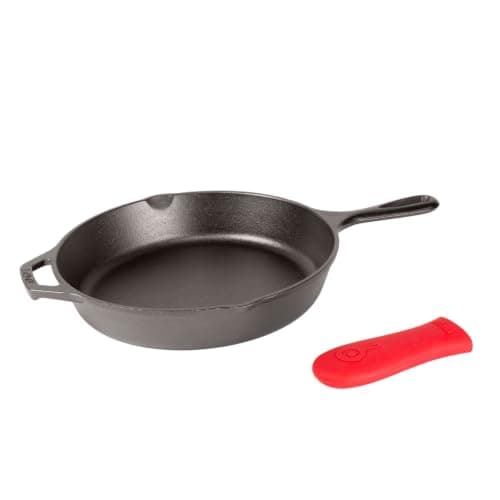
Lodge Seasoned Cast Iron Skillet, 10.25 in (L8SK3)
At 5.66 lb it is essentially silent on induction, conducts heat sideways out of the coil zone, and smooths the on-off cycling that scorches food on low settings. Lift it on and off, never slide it.
Best for: Searing, cornbread, and anyone who wants one pan that cannot be worn out
Published specifications for the Lodge Seasoned Cast Iron Skillet, 10.25 in (L8SK3)
Diameter
10.25 in
Weight
5.66 lb
Oven maximum
550F
Induction
Yes - bare iron is ferrous
Seasoning
Pre-seasoned with soy-based vegetable oil, no synthetic chemicals
Warranty
Lifetime
Made in
USA
Care
Hand wash. Lodge's own instructions permit warm soapy water
Good
Effectively unbreakable and fully restorable - a rusted one can be stripped and re-seasoned
Holds heat better than anything else at the price, which is what a sear needs
Lodge publishes its seasoning method openly, so the maintenance is not a mystery
Not good
Heavy
Heats unevenly on a small burner: cast iron conducts at roughly 50 W/m-K, so it is slow to spread and slow to react
Bare iron is reactive; long tomato braises will taste of it
The trade-off. It weighs 5.66 lb empty. You will feel that every time you move it full, and it is the single most common reason a cast iron skillet ends up in a cupboard.
Skip this if. You have wrist or shoulder trouble, or you cook mostly acidic braises. Carbon steel does most of the same jobs at roughly half the weight.
#2 · Flat ferrous bases, a set at a timeSpecs read September 3, 2026
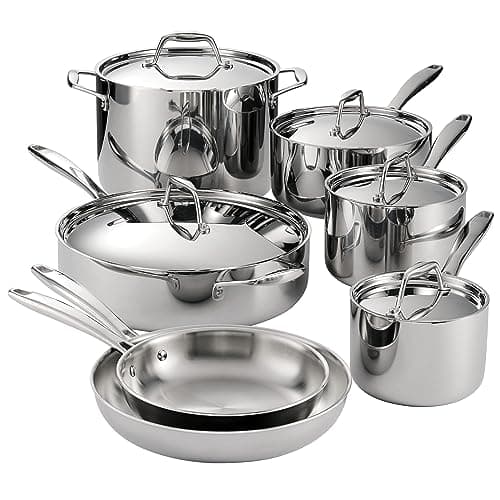
Tramontina Signature Tri-Ply Clad 12-Piece Set
Fully clad with a magnetic stainless exterior, so every piece couples and every base is a flat sheet of steel on glass. The honest cost is that clad pans are the ones that buzz at high power.
Best for: A first kitchen that should not need replacing
Published specifications for the Tramontina Signature Tri-Ply Clad 12-Piece Set
Construction
Tri-ply: 18/10 stainless, aluminum core, magnetic stainless exterior
Pieces
8 in and 10 in fry pans; 1.5, 2 and 3 qt covered saucepans; 5 qt covered deep saute; 8 qt covered stockpot
Oven maximum
500F on the 80116-249DS listing; other SKUs in the line are listed at 350F
Induction
Yes - magnetic stainless exterior
Dishwasher
Listed dishwasher safe
Handles
Precision cast, riveted
Certification
NSF-certified on the 80116-249DS line
Country of origin
Not asserted - retail listings disagree across SKUs (Brazil and China both appear)
Good
Fully clad, not disc-bottom: the aluminum runs up the sidewalls, so sauces do not scorch in a ring at the base
NSF certification on the flagship SKU is a real, checkable third-party mark rather than a marketing badge
Induction-ready without paying an induction premium
Not good
Retail listings disagree on the oven maximum across SKUs in the same line, which is a documentation problem, not a cooking one
Handles run hot on gas
The 12-piece count includes lids; the useful-item count is seven
The trade-off. Handles are the weak point. They are riveted and sturdy, but they get hot on a gas ring in a way the more expensive clad brands' do not.
Skip this if. You want a set you can leave in the oven above 500F, or you cook mostly eggs and pancakes and would rather spend the money on one good nonstick pan.
#3 · The pan to replace a warped one withSpecs read September 3, 2026
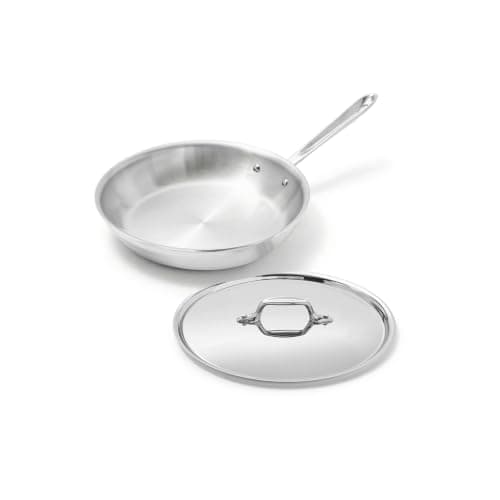
All-Clad D3 Stainless 10 in Fry Pan
Published induction-compatible and 600F, oven and broiler safe. If your problem is a base that rocks, this is the category of fix - a warped base cannot be trued at home.
Best for: One good open-stock stainless pan bought instead of a cheap full set
Published specifications for the All-Clad D3 Stainless 10 in Fry Pan
Construction
Fully bonded tri-ply, aluminum core
Oven maximum
600F, oven and broiler safe
Induction
Yes - compatible with any stovetop
Dishwasher
Handwash only (All-Clad published)
Handle
Double-riveted stainless
Weight
3.0 lb (model 4110)
Warranty
Limited lifetime
Made in
Bonded, engineered and assembled in Canonsburg, PA
Good
600F is the highest oven ceiling of any stainless pan on this site
The one pan here whose manufacturing location is published down to the town
Genuinely repairable-adjacent: rivets are the only failure point and the warranty covers them
Not good
Hand wash only
The flared rim makes it a poor pan for anything with liquid
Costs several times what a Tramontina or Cuisinart pan of the same construction costs
The trade-off. Hand wash only. All-Clad publishes that plainly, and it is a real daily cost on a pan you will use every day.
Skip this if. You want a dishwasher-safe pan, or you are buying a whole kitchen on a fixed budget - one D3 skillet costs what a full clad set can cost.
Because the magnetic field is making very slight movements in the pan's metal. In a clad or disc-bottom pan, several bonded layers respond slightly differently and the result is audible. It is loudest at maximum power and on lighter pans, it is not damage, and it usually disappears a power level or two below maximum.
›Does cast iron scratch an induction cooktop?
Only if you drag it. The scratching comes from sliding a rough cast base across glass with grit underneath, not from the weight. Lift pans on and off, wipe both the hob and the pan base before cooking, and the problem largely disappears. Enameled cast iron has a smoother base if you want more margin.
›Why is my food browning in a ring on induction?
Induction only heats the metal directly above the coil, so a pan wider than the element gets a hot ring and a cooler center. Match the pan diameter to the element, or use a pan with more thermal mass - a thick carbon steel or cast iron pan conducts heat sideways out of the heated zone before it reaches the food.
›Why does food scorch on the lowest induction setting?
Many hobs cannot deliver a genuinely small continuous power, so at low settings they pulse full power on and off and average it down. The average is low but the instantaneous temperature is not. Use a thicker pan, keep something moving, or use a bowl over simmering water for anything delicate.
›Why does my induction hob say there is no pan when there is?
The hob needs a minimum amount of ferrous metal over the coil, usually given as a minimum base diameter in the manual. A small pan on a large element can pass the fridge-magnet test and still not satisfy the hob. Detection can also drop out mid-cook if a thin base lifts slightly off the glass as it heats.
›Can a warped pan be fixed for induction?
No. A base that has gone convex or concave cannot be trued at home, and on induction it costs you contact, even heating and stability at once. The usual cause is thermal shock from putting a hot pan into cold water, which is worth avoiding on every pan you own.
Sources
Every figure on this page came from one of these. Follow them and check our arithmetic — that is the point.