Heads up: some links on this page earn us a commission at no extra cost to you. It does not change what we recommend or the order. How we are funded.
The short answer
Buy a clad stainless saucepan unless you specifically cook milk, oatmeal or scrambled eggs in one. Most saucepan work happens in liquid, and nothing sticks in liquid - so a coating is a wear surface with a lifespan no maker publishes, bought for a job that rarely needs it. Where a coating genuinely helps is dairy and starch, which scorch onto bare metal. If that is your use, buy the cheapest coated saucepan that fits your stove and treat it as a consumable.
Quick picks
The whole answer, on one screen. Tap a row to jump to the full write-up. Every pick below carries a stated trade-off further down — including the one at the top.
#
Product
Best for
Price
1
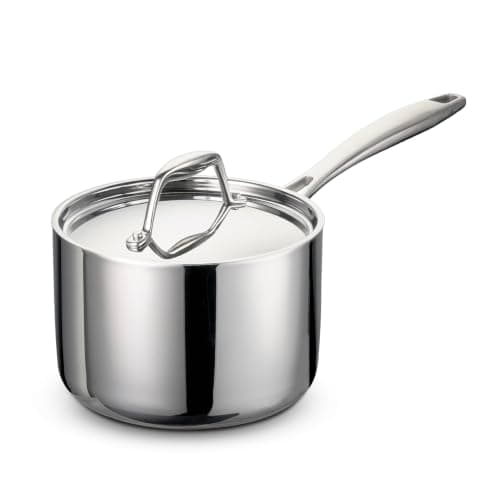
Tramontina Tri-Ply Clad Covered Saucepan, 2 qt
Two quarts of fully clad stainless with nothing on it to wear out - the pan a coated saucepan is usually a worse version of.
Prices last checked October 23, 2026. Prices move constantly — the number on Amazon when you click is the real one.
What we can tell you here
Our audited ledger contains coated skillets and clad saucepans rather than a separately audited coated saucepan, so this page recommends the audited pans and points at a tagged category search for coated saucepans themselves. The method is here.
Why this shape has the weakest case for a coating
Sticking happens where food contacts hot dry metal. In a saucepan, most of what you cook is suspended in liquid, and liquid is what keeps food off the metal in the first place. Rice, stock, blanched vegetables, pasta, sauces with enough moisture — none of them stick to a clean, properly heated stainless pan.
So the coating is doing very little for most of what the pan does, while adding the category's central problem: a lifespan no manufacturer publishes, examined in how long nonstick lasts. You are buying a consumable to solve a problem you mostly do not have.
What you cook in a saucepan
Sticks on clad stainless?
Coating helps?
Rice and grains
Not if the heat is right
Marginally
Stock, soup, blanching
No
No
Pasta
No
No
Tomato and wine sauces
No - and stainless is non-reactive
No
Milk, cream, custard
Yes - dairy proteins bond to hot metal
Yes, clearly
Oatmeal and porridge
Yes - starch gelatinizes onto the base
Yes, clearly
Scrambled eggs and soft curds
Yes
Yes, clearly
Caramel and sugar work
It is meant to
No - and a coating limits the heat
Three rows out of eight. That is the honest size of the case for a coated saucepan.
The three jobs where it wins
Dairy
Milk proteins denature and bond to hot metal, which is why a scorched milk pan is a cliché. A coated surface genuinely prevents it, and a small coated milk pan is a reasonable thing to own if you heat milk often.
Starch
Oatmeal, polenta, rice pudding — starch gelatinizes and welds to the base while everything above it is still liquid. Constant stirring fixes it; a coating fixes it without the stirring.
Soft eggs
Scrambled eggs made slowly in a saucepan is a real technique, and it is the one egg application where the pan is not a skillet. A coating helps for the same reason it helps on a skillet — best nonstick pans for eggs.
Notice all three are low-heat jobs. That matters, because low heat is exactly where a coating is happiest and where its published ceilings — 400F to 450F across our ledger — never come into play.
If you buy one, buy it small
The three jobs above are all small-volume. A 1 to 2 quart coated saucepan covers them, and it is the size that makes sense: you are buying a specialist, so buy the specialist size rather than a general-purpose pan you will regret coating.
1 to 1.5 qt. A milk pan. Correct for dairy and small quantities of anything.
2 qt. Oatmeal for two, sauces, reheating. The largest size worth coating.
3 qt and up. Buy clad. At this size you are boiling and simmering, which needs no coating — what size saucepan covers the sizing.
What to check
Induction, if your hob needs it. Standard aluminum and hard-anodized lines are not compatible and their makers publish that — nonstick cookware for induction.
A published oven ceiling, if you ever finish anything in the oven. Coated pans run 400F to 450F — the full table is here.
A pouring lip, which matters more in a saucepan than in any other shape.
A lid, and what the lid is rated to, since it is often the lowest number in the box.
Whatever the coating, it is a wear surface with no published lifespan. In a saucepan, it is a wear surface doing very little work.
The clad saucepan, which is usually the answer
A fully clad stainless saucepan has no coating to fail, is non-reactive so acidic sauces are fine, tolerates any heat you can produce, and works on induction. It also heats up the sidewalls, which matters more in this shape than any other because a saucepan is mostly wall — the argument in disc bottom versus fully clad.
The technique that makes it work is the same one that makes any bare pan work: heat the pan, then add the fat or the liquid, and do not walk away from milk. Why food sticks to stainless steel covers it, and cleaning burnt stainless covers the recovery when you do.
Making a coated saucepan last
Low to medium heat only. It is what the three jobs need anyway.
Silicone or wood, unless the maker publishes metal-utensil safety — Calphalon does and almost nobody else in our ledger does.
Never stack another pan inside it — the single most common cause of early coating damage — how to store pots and pans.
Hand wash, even where the maker publishes dishwasher safe.
Strip the invisible oil film when release fades before assuming the pan is finished — how to clean nonstick pans.
Each write-up below gives the published specs, what the pan is genuinely good at, what it costs you, and who should skip it. The trade-off line is there on the top pick too — a recommendation with no downside is an advertisement.
Top pick · Best nonstick saucepan alternativeSpecs read September 3, 2026
Tramontina Tri-Ply Clad Covered Saucepan, 2 qt
Two quarts of fully clad stainless with nothing on it to wear out - the pan a coated saucepan is usually a worse version of.
Best for: Sauces, grains and reheating, in the size a kitchen actually uses daily
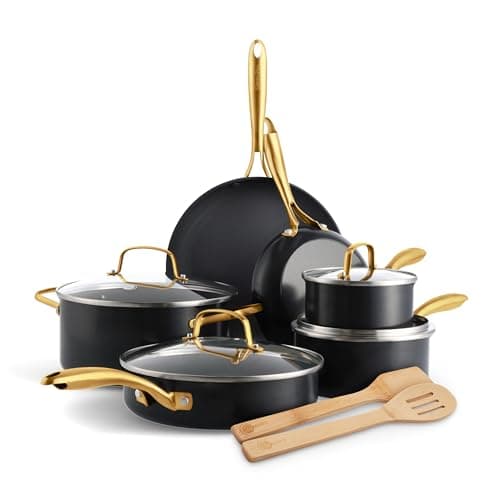
Published specifications for the GreenPan Ceramic Nonstick Cookware Set
Coating
Thermolon, from sand-derived Silicon Dioxide (SiO2), sprayed
Coating chemistry
PFAS-free, PFOA-free, free of lead and cadmium (GreenPan published)
Coating heat resistance
850F / 450C for the coating itself (GreenPan published)
Body oven maximum
Varies by line and is lower than the coating figure - check the specific line
Coating lifespan
Not published. No ceramic maker publishes one
Good
GreenPan publishes what the coating is made of in plain terms, which most ceramic brands do not
The coating will not release fumes if you overheat it the way PTFE can
Genuinely good release when new
Not good
Release degrades and nobody will tell you how fast
The 850F figure is for the coating, not the pan, and gets quoted as if it were the pan
Ceramic dislikes high heat and dishwashers, which is most of what a set gets used for
The trade-off. Ceramic nonstick loses release with use and no maker publishes a lifespan, GreenPan included. Treat it as a consumable, not a lifetime purchase.
Skip this if. You are buying a set expecting it to last as long as clad stainless. It will not, and the honest move is to buy one ceramic pan alongside a stainless set.
Usually not. Most saucepan work happens in liquid, and nothing sticks in liquid, so a coating is a wear surface doing very little. It genuinely helps for dairy, starchy foods like oatmeal, and soft scrambled eggs.
›What size nonstick saucepan should I buy?
One to two quarts. The jobs a coating helps with - milk, oatmeal, soft eggs - are all small-volume, so buy the specialist size. At three quarts and up you are boiling and simmering, which needs no coating at all.
›Why does milk stick to a stainless saucepan?
Milk proteins denature and bond to hot metal, which is why scorched milk pans are a cliché. A coating prevents it, and so does lower heat with more attention. It is one of the three jobs where a coated saucepan genuinely earns its place.
›Is a clad stainless saucepan better than nonstick?
For almost everything a saucepan does, yes. It has no coating to fail, is non-reactive so acidic sauces are fine, takes any heat, and works on induction. Fully clad also heats the sidewalls, which matters most in this shape.
›How long does a nonstick saucepan last?
No manufacturer publishes a coating lifespan, in this shape or any other. That is the central problem with buying a coated pan for a job that rarely needs one - you are adding an unquantified replacement cycle for little benefit.
Sources
Every figure on this page came from one of these. Follow them and check our arithmetic — that is the point.