Heads up: some links on this page earn us a commission at no extra cost to you. It does not change what we recommend or the order. How we are funded.
The short answer
Buy a light-colored aluminum half sheet pan and use it for cookies. A true cookie sheet - rimless on one or more sides - slides cookies off more easily and lets air move across the tray, but it warps more readily, holds nothing that runs, and cannot do the dozen other jobs a rimmed pan does. Unless you bake cookies in high volume and slide them onto racks by the sheet, the rimmed pan is the better buy.
Quick picks
The whole answer, on one screen. Tap a row to jump to the full write-up. Every pick below carries a stated trade-off further down — including the one at the top.
#
Product
Best for
Price
1
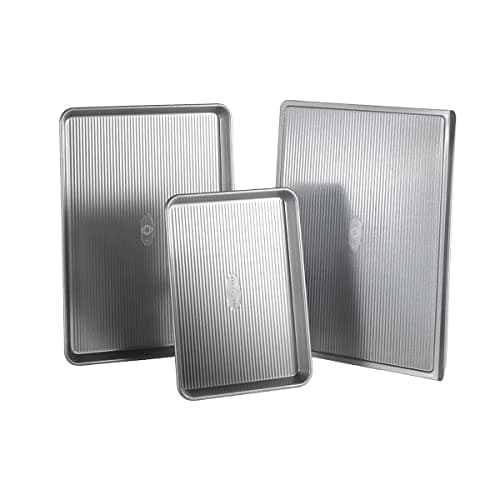
Nordic Ware Naturals Half Sheet, 18 x 13 in
Light bare aluminum with a low rim - the pan professional bakeries use for cookies, and it does everything else too.
Prices last checked September 27, 2026. Prices move constantly — the number on Amazon when you click is the real one.
What a cookie sheet actually is
A cookie sheet is a flat baking tray with no rim, or a rim on only one or two sides. A sheet pan has a rim all the way around, usually about an inch high. That is the entire difference in the products, and everything else follows from it.
The terms get used interchangeably in retail listings, which is why people buy one thinking they bought the other - how to read a cookware listing. If a listing says "rimmed" or gives a rim height, it is a sheet pan.
The genuine case for rimless
You can slide a whole batch off. With no rim in the way, a spatula or the parchment itself slides cookies straight onto a cooling rack in one movement. In a bakery doing dozens of trays this matters a great deal.
Marginally better air movement across the surface, because there is no wall creating a pocket of still air at the edges. The effect is small in a domestic oven and larger in a convection one - cookware for convection ovens.
Slightly more usable surface for the same footprint.
Easier to store, since flat trays stack completely flat.
The case against, which is stronger for most kitchens
Problem
Why it matters
It warps more readily
The rim is a structural flange. Remove it and a thin sheet has much less stiffness.
Nothing wet can go on it
No roasting vegetables, no bacon, no anything that renders fat or releases juice.
It is a single-purpose pan
A rimmed half sheet does cookies plus roasting, resting, marinating and organizing.
Spills go into the oven
A cookie that spreads off the edge, or butter that runs, lands on the oven floor.
Harder to carry loaded
Nothing stops items sliding off as you move it.
Warping deserves the emphasis, because it is the complaint that dominates reviews of cheap cookie sheets. A thin rimless tray flexes and pops in a hot oven, and once it has taken a set it will never sit flat again - why pans warp.
Material and color, which matter more than the rim
For cookies, the surface the dough sits on decides the result far more than whether there is a wall at the edge.
Light bare aluminum — the right default
Conducts heat extremely well and reflects radiant heat rather than absorbing it, so bases brown evenly rather than scorching. This is what commercial bakeries use, and it is the correct surface for cookies specifically - sheet pan materials.
Aluminized steel — nearly as good, stiffer
A steel core faced with aluminum: the conduction of aluminum with the rigidity of steel, which means less warping. Corrugated versions reduce contact area and improve airflow under the bake.
Dark coated steel — the one to avoid for cookies
Dark surfaces absorb radiant heat and run hotter, which burns cookie bases before the tops set. Good for roasting, wrong here - dark versus light baking pans.
Insulated or air-cushioned sheets
Two layers with an air gap, sold to prevent burnt bottoms. They work, and they do it by slowing heat transfer so much that cookies often end up pale and cakey rather than crisp at the edge. They also take longer and cannot be used for anything else. A light aluminum pan plus correct oven temperature solves the same problem better - oven temperature accuracy.
If your cookies burn on the bottom, the pan is usually not the cause. In order of likelihood: the oven runs hot, the pan is dark, the rack is too low, or the sheet went into the oven still hot from the previous batch.
What actually solves sticking
People buy cookie sheets for easier release, and the honest answer is that the liner does more than the pan.
Parchment — cheapest, works perfectly, and lets you lift a whole batch off by the paper regardless of the rim.
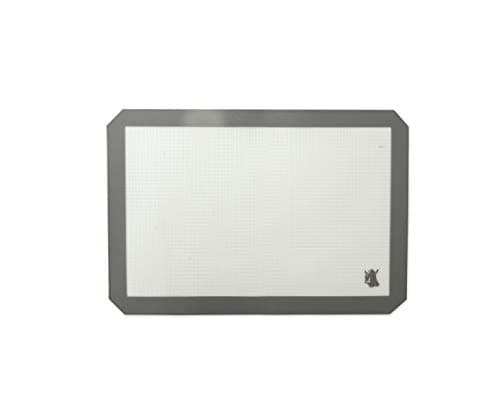
A silicone mat — reusable, grips the pan, and gives slightly softer bottoms than parchment - best silicone baking mats.
Nothing at all, on a well-used bare aluminum pan with a fatty dough. This works better than people expect.
With parchment in the equation, the rim stops mattering for release, which removes most of the argument for a rimless pan in a home kitchen.
For cookies this choice matters far more than the rim. Light reflects, dark absorbs, and dark burns bases.
Sizing, and why two
A half sheet - roughly 13 by 18 inches - is the standard and fits a domestic oven with clearance. Buy two: cookies bake in batches and a hot pan is the most common cause of a second tray spreading badly. Quarter sheets suit toaster and countertop ovens - sheet pan sizes explained and bakeware for toaster ovens.
Keeping them flat and usable
Never put a hot pan into water - the fastest way to warp one.
Hand wash bare and aluminized aluminum. Dishwasher detergent is alkaline and corrodes it dull gray - is bakeware dishwasher safe.
Let it cool between batches, or use the second pan.
Accept the darkening. Bare aluminum goes brown with use and bakes better for it - that is seasoning, not damage - bakeware care and cleaning.
You bake cookies constantly: add a silicone mat before you consider a rimless sheet.
You genuinely want rimless and slide batches by the tray: buy heavy gauge, because thin rimless trays warp.
The pans that actually bake better cookies
Rimless cookie sheets themselves are recommended as a category via a tagged search - our audited ledger contains rimmed pans, which are what we would buy.
Nordic Ware Naturals Half Sheet, 18 x 13 in
Roasting vegetables, sheet-pan dinners, cookies - the pan you use most weeks
Each write-up below gives the published specs, what the pan is genuinely good at, what it costs you, and who should skip it. The trade-off line is there on the top pick too — a recommendation with no downside is an advertisement.
Top pick · Best pan for cookiesSpecs read September 3, 2026
Nordic Ware Naturals Half Sheet, 18 x 13 in
Light bare aluminum with a low rim - the pan professional bakeries use for cookies, and it does everything else too.
Best for: Roasting vegetables, sheet-pan dinners, cookies - the pan you use most weeks
Published specifications for the Nordic Ware Naturals Half Sheet, 18 x 13 in
Exterior dimensions
17.9 x 12.9 x 1 in
Material
Aluminum
Rim
Encapsulated steel rim
Gauge
Not published by Nordic Ware
Warranty
Lifetime
Dishwasher
Hand wash recommended. Automatic dishwasher use is not advised
Made in
America of domestic and imported materials
Good
Aluminum conducts at 237 W/m-K, which is why it browns evenly and a steel pan does not
The encapsulated steel rim is the reason it does not warp in a hot oven
Lifetime warranty on a pan this cheap
Not good
Nordic Ware does not publish a gauge figure, so thickness cannot be compared like for like
Bare aluminum stains and reacts with acid
Not dishwasher safe by the maker's own advice
The trade-off. Bare aluminum discolors and reacts with acid. It will look used within a month and Nordic Ware advises against the dishwasher.
Skip this if. You want a pan that stays looking new, or you will not hand wash. Buy an aluminized-steel coated pan instead and accept the coating as a wear item.
›What is the difference between a cookie sheet and a baking sheet?
A cookie sheet is rimless, or rimmed on only one or two sides. A baking or sheet pan has a rim all the way around, usually about an inch high. Retail listings use the terms interchangeably, so check for the word rimmed or a stated rim height.
›Do you need a cookie sheet for cookies?
No. A light-colored rimmed half sheet pan bakes cookies just as well and does a dozen other jobs a rimless tray cannot. The rimless advantage is sliding whole batches off quickly, which matters in a bakery and rarely at home, especially if you use parchment.
›Why do my cookies burn on the bottom?
Usually not the pan. In order of likelihood: the oven runs hotter than the dial says, the pan is dark rather than light, the rack is set too low, or the sheet was still hot from the previous batch. Light aluminum and a verified oven temperature fix most cases.
›Are insulated cookie sheets worth it?
They do prevent burnt bottoms, by slowing heat transfer so much that cookies often come out pale and cakey instead of crisp at the edges. They also bake slower and cannot be used for anything else. A light aluminum pan at the correct temperature is the better fix.
›What material is best for cookie sheets?
Light bare aluminum, which conducts heat well and reflects radiant heat rather than absorbing it, so bases brown evenly. Aluminized steel is nearly as good and warps less. Dark coated steel is the wrong choice for cookies because it runs hotter and burns bases.
Sources
Every figure on this page came from one of these. Follow them and check our arithmetic — that is the point.