A company that built its name on handles, applied to a category where nobody else seems to think about them. The trade is an oven ceiling capped by that handle.
Heads up: some links on this page earn us a commission at no extra cost to you. It does not change what we recommend or the order. How we are funded.
The short answer
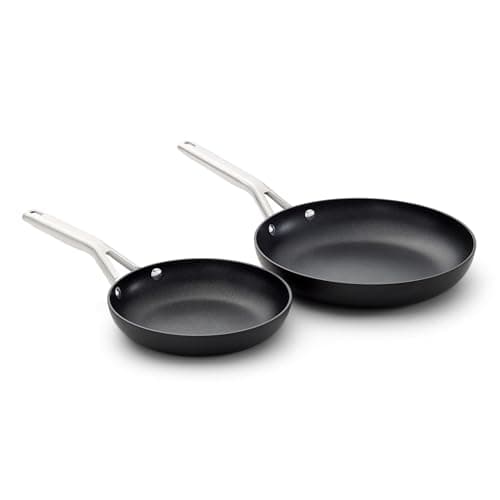
OXO publishes a hard-anodized aluminum body, a three-layer PTFE coating stated as PFOA-free, a 430F oven maximum, dishwasher safety and a rolled pour edge. The standard hard-anodized line is not induction compatible. What you are buying is ergonomics: the handle and the pour edge are genuinely better than the category standard and you notice both daily. What caps the pan is the same handle - the 430F ceiling comes from a stainless-and-silicone assembly rather than from the body.
What this review checks
The same points as every brand review here: published construction, coating chemistry, oven ceiling, induction compatibility, dishwasher and utensil guidance, warranty terms, country of manufacture, and what the brand declines to state. We have not cooked in any of it. The method is here.
Construction
A hard-anodized aluminum body under a three-layer PTFE coating that OXO publishes as PFOA-free. Hard-anodizing thickens the natural oxide layer on aluminum electrochemically, producing a body harder and less reactive than the stamped aluminum most cheap coated pans use.
It is worth being precise about what that buys, because the category oversells it. Anodizing improves the body, not the cooking surface - there is a separate coating on top, and that coating is the part that wears out. The distinction is drawn in best hard-anodized cookware and against clad stainless in stainless steel versus hard-anodized.
What OXO publishes
Specification
Published figure
Comment
Body
Hard-anodized aluminum
Harder and less reactive than bare aluminum
Coating
Three-layer PTFE, published PFOA-free
A specific layer count, which is more than most state
Oven maximum
430F published for the line
Capped by the handle assembly, not by the body
Induction
No on the standard hard-anodized line
Published plainly
Dishwasher
Dishwasher safe
Published
Edge
Rolled, for pouring without dripping
A genuine daily improvement
Coating lifespan
Not published
As with every nonstick maker
Recorded from OXO's published cookware specifications. The blank row is the industry's silence rather than an omission here.
The handle, which is the reason to buy it
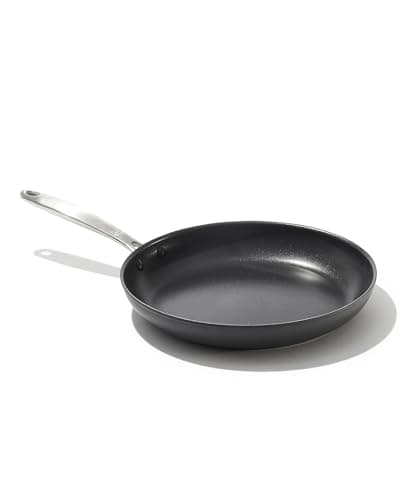
OXO built its reputation on handles across an entire housewares catalog, and this is the one category where that translates into a genuine buying reason. The handle is a stainless core with a silicone overmold, shaped rather than merely padded, and it does three things the category standard does not.
It stays cool on a gas ring, where bare riveted stainless does not.
It does not rotate. Riveted plastic handles eventually work loose and turn; this assembly does not.
It is shaped for a grip rather than being a flat bar with a curve.
That matters most on the pan you use every morning. If you cook eggs daily, the handle is the specification you interact with most - which is why this pan appears in best nonstick pans for eggs.
The rolled pour edge
A small feature that is easy to dismiss and hard to give up. The rim is rolled so liquid leaves the pan in a stream rather than running back down the outside wall.
Anyone who has poured a pan sauce from a square-rimmed skillet onto a countertop knows why this exists. It is not a performance claim and it will not appear in any comparison table; it is the sort of detail that separates a pan designed by people who cook from a pan designed to a price.
The 430F ceiling, and where it comes from
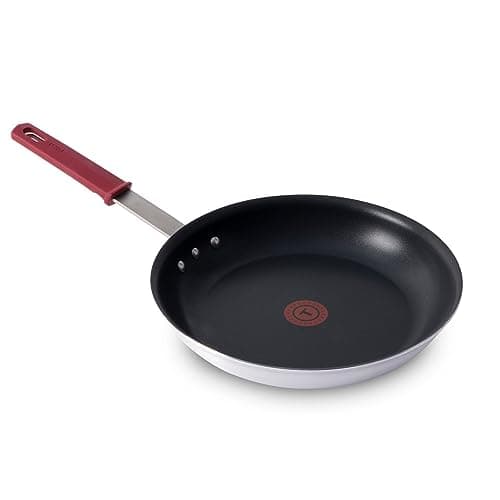
Four hundred and thirty degrees sits between T-fal's 400F and Calphalon's 450F, and the limiting component is the handle rather than the coating or the body. A stainless-and-silicone assembly cannot go where bare metal can.
That is the trade this pan makes explicit: the thing that makes it comfortable is the thing that caps it. If you need a higher ceiling, you need a pan with nothing softer than steel on it - which means clad stainless at 500F to 600F, or cast iron. Every published figure is collected in oven-safe cookware temperatures.
It is also not broiler safe, like every coated pan in our ledger. Nothing with a fluoropolymer coating on it should go under a broiler.
Utensils and the claim OXO does not make
OXO does not publish metal-utensil safety for this coating, which means silicone, nylon or wood. Calphalon does publish that claim for its Premier line, and it is one of the few genuinely checkable differentiators in coated cookware - our Calphalon review covers it.
If your kitchen will not police the utensil drawer, that is a real reason to prefer Calphalon over OXO despite the handle. Which surface takes which tool is set out in utensils for every cookware surface.
The induction gap
The standard hard-anodized line is not induction compatible, because anodized aluminum is not ferromagnetic. OXO publishes this, which is more than some brands do.
If your hob is induction, this rules the pan out and narrows the coated category sharply - nonstick cookware for induction covers what is actually available and why bare metal is often the better answer there.
What it gets right
The best handle in the coated category, and it does not rotate loose
A rolled pour edge you notice every time you use it
Hard-anodized body resists the denting that ruins cheap aluminum pans
Publishes a specific three-layer coating and a PFOA-free claim
Published dishwasher safe
What it costs you
The oven ceiling is capped by the handle at 430F, and it is not broiler safe
No published metal-utensil claim, unlike Calphalon Premier
Not induction compatible in the standard line
No published coating lifespan, so cost per year is unknowable
Priced above pans that will need replacing on a similar schedule
Who should buy it
Buy OXO if you cook on a coated pan most days and care how it feels in the hand. The 10-inch fry pan is the size most kitchens want.
Buy Calphalon instead if metal utensils will end up in the pan, or if you want the higher 450F ceiling.
Buy T-fal or Tramontina instead if you accept nonstick as a consumable and would rather spend less more often.
Do not buy it for induction, and do not buy it expecting to put it under a broiler.
OXO against the rest of the coated category
Four coated pans, four published ceilings from 400F to 450F, and not one published coating lifespan between them.
OXO Good Grips Pro Hard-Anodized Nonstick Fry Pan, 10 in
Someone who cooks daily and cares how a pan feels in the hand
These are the products this page's reasoning actually points at. Same rules as everywhere else on the site: published specs, a stated trade-off, and a live price only where one exists.
Top pick · The pan to buySpecs read September 3, 2026
OXO Good Grips Pro Hard-Anodized Nonstick Fry Pan, 10 in
A hard-anodized body, a rolled edge that actually pours, and the best handle in the coated category by a distance.
Best for: Someone who cooks daily and cares how a pan feels in the hand
Published specifications for the OXO Good Grips Pro Hard-Anodized Nonstick Fry Pan, 10 in
Body
Hard-anodized aluminum
Coating
Three-layer PTFE nonstick, published PFOA-free
Oven maximum
430F published for the line
Induction
No on the standard hard-anodized line
Dishwasher
Dishwasher safe
Edge
Rolled, for pouring without dripping down the side
Coating lifespan
Not published
Good
The rolled pour edge is a small thing you notice every single time you use it
The hard-anodized body resists the denting that ruins cheap aluminum pans
Handle stays cool and does not rotate the way riveted plastic ones eventually do
Not good
Not induction compatible
Oven ceiling capped by the handle, not the pan
Still a coating, still a consumable, still no published lifespan
The trade-off. The handle that makes it comfortable is a stainless-and-silicone assembly, and that is what caps the oven rating below the body's own limit.
Skip this if. You need induction. The standard hard-anodized body is not ferrous.
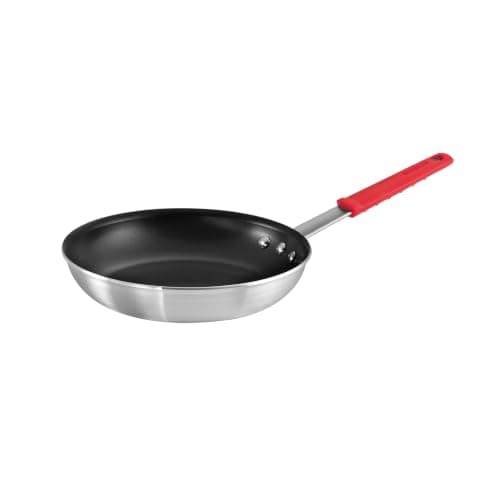
Published specifications for the Tramontina Professional Restaurant Fry Pan, 10 in
Body
Heavy-gauge aluminum
Coating
PTFE nonstick
Induction
No - aluminum body is not ferrous
Coating lifespan
Not published, by this or any nonstick maker
Good
Cheap enough that replacing it every couple of years is a real plan rather than a failure
Heavy gauge for a nonstick pan, so it does not warp on the first hot burner
Silicone handle sleeve that actually stays cool
Not good
Not induction compatible
PTFE, which some buyers will rule out on principle
No published coating lifespan, so the value case is unverifiable by design
The trade-off. It is PTFE. That is fine at normal cooking temperatures, and it is not a pan to preheat empty on high.
Skip this if. You want to avoid PTFE entirely. Buy ceramic instead and accept the shorter release life rather than pretending either one lasts forever.
The handle and the rolled pour edge are genuinely better than the category standard, and the hard-anodized body resists denting. It is still a coated pan with no published lifespan, so buy it for the ergonomics rather than for longevity.
›How hot can OXO pans go in the oven?
OXO publishes 430F for the Good Grips Pro line, capped by the stainless-and-silicone handle assembly rather than by the body or the coating. It is not broiler safe.
›Can you use metal utensils on OXO nonstick?
No - OXO does not publish metal-utensil safety for this coating, so use silicone, nylon or wood. Calphalon publishes that claim for its Premier line, which is a real reason to prefer it in a household where the utensil drawer is not policed.
›Is OXO cookware induction compatible?
The standard hard-anodized line is not, because anodized aluminum is not ferromagnetic, and OXO publishes this. If your hob is induction you want clad stainless, carbon steel or cast iron instead.
›Is OXO nonstick PFOA-free?
OXO publishes the three-layer coating as PFOA-free. Note that PFOA-free is true of essentially every pan sold today and is not the same as PFAS-free - PTFE is itself a PFAS material.
Sources
Every figure on this page came from one of these. Follow them and check our arithmetic — that is the point.