Heads up: some links on this page earn us a commission at no extra cost to you. It does not change what we recommend or the order. How we are funded.
The short answer
Buy clad stainless for anything permanent. Hard-anodized aluminum is a genuinely better body than the thin stamped aluminum in cheap coated pans - harder, less reactive, more dent-resistant - but almost every hard-anodized pan sold has a nonstick coating on top, and that coating is the part that fails. Stainless has no wear surface at all. Buy hard-anodized when you want a well-built coated pan, and understand you are buying a consumable.
What hard-anodizing actually is
Anodizing is an electrochemical process that thickens the natural oxide layer on aluminum. Hard-anodizing takes it further, producing a surface substantially harder than the aluminum underneath and much less reactive.
That is a real engineering improvement over the thin stamped aluminum most budget coated pans use: it resists denting, it does not react with acidic food the way bare aluminum does, and it will not discolor in the same way. Calphalon built its reputation on it, and the audit is in our Calphalon review.
What it is not is a cooking surface. Almost every hard-anodized pan on the domestic market has a nonstick coating applied on top of the anodized body, and that coating - not the anodizing - is what you cook on and what eventually fails. The distinction is drawn out in best hard-anodized cookware.
The comparison people think they are making
Because both pans look like gray-and-silver metal objects with riveted handles, the comparison gets framed as two finishes on the same idea. It is not. One is a bare metal surface you cook on directly and can scratch without consequence; the other is a manufactured film with a lifespan nobody publishes.
Clad stainless
Hard-anodized (coated)
What you cook on
The steel itself
A PTFE or ceramic coating
Wear surface
None - the passive layer self-repairs
The coating, and it is the only part that fails
Published lifespan
Not applicable
Not published by any maker
Oven maximum
500F to 600F depending on brand
430F to 450F on the pans here
Broiler
All-Clad publishes yes
No
Induction
Yes - magnetic exterior
Standard lines are not; separate ranges exist
Metal utensils
Yes, scratches are cosmetic
Only where published - Calphalon Premier does
Dishwasher
Varies by brand
Usually published safe; it shortens release life
Release when new
Requires technique
Excellent
Warranty on the wear part
No wear part
Coating wear is excluded everywhere
Every figure is the maker's own published number. The blank in the lifespan row is the industry's, not ours.
Heat is where they separate hardest
Aluminum conducts heat at roughly 237 watts per meter-kelvin against stainless steel's 15 to 16, which is why every clad stainless pan has an aluminum core in the first place. So on raw conductivity, an anodized aluminum body is excellent.
The ceiling is the problem. A coated hard-anodized pan is rated 430F to 450F because of the coating, and none of them are broiler safe. A clad stainless pan publishes 500F to 600F depending on brand. If you sear and finish in the oven, that gap decides it - the full table is in oven-safe cookware temperatures.
There is one situation where hard-anodized wins on heat: the body heats faster and more evenly than clad stainless of similar weight, because there is more aluminum and less steel in the sandwich. For pancakes and eggs on moderate heat, that is a genuine advantage.
The induction gap
Anodized aluminum is not ferromagnetic, so standard hard-anodized lines do not work on induction. Calphalon and OXO both publish this plainly, and Calphalon sells a separate induction-compatible range with a magnetic base layer.
Clad stainless has a magnetic exterior by design and works everywhere. If your kitchen is induction, that alone narrows the choice sharply - best cookware sets for induction covers the sets, and the magnet test settles any listing in five seconds.
Is uncoated hard-anodized a thing?
It exists, mostly in commercial supply and in bakeware. Fat Daddio's cake pans in our ledger are anodized aluminum with no coating, and they are excellent for exactly the reason this page keeps returning to: there is nothing on them to fail.
In stovetop cookware it is rare in domestic ranges, and where it exists it behaves like bare aluminum with better hardness and less reactivity - which means food sticks readily and you use fat and technique, exactly as with stainless. If you want that, you may as well buy stainless, which is easier to clean and cheaper to replace nothing on.
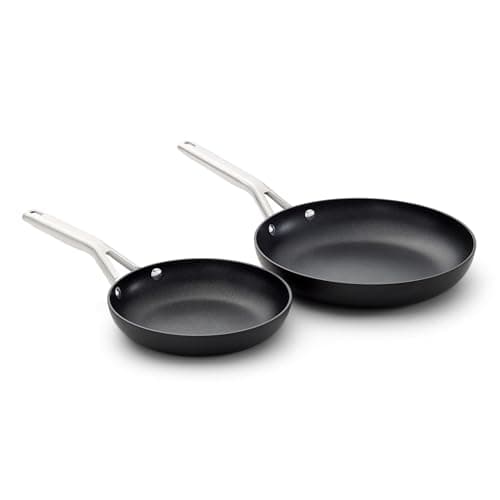
The dark gray finish is the anodized body. On almost every domestic pan there is a separate nonstick coating on top of it, and that is the surface you actually cook on.
Which for which job
Job
Buy
Why
Searing, browning, pan sauces
Clad stainless
Higher ceiling, fond you can see and deglaze
Eggs, pancakes, delicate fish
Hard-anodized coated
Release, and moderate heat is all it needs
Oven finishing and broiling
Clad stainless
430F to 450F is not enough; 600F is
Induction hobs
Clad stainless
Standard hard-anodized lines are not compatible
A pan you will own for decades
Clad stainless
No wear surface at all
A pan you accept replacing
Hard-anodized coated
Better body than cheap coated pans, same coating lifespan question
Most kitchens want both, in that proportion: clad stainless as the backbone and one coated pan for the two or three jobs it does better.
The verdict
Build the kitchen from clad stainless. It has no wear surface, the highest oven ceilings and it works on every stove.
Add one hard-anodized coated pan for eggs and delicate fish, chosen on handle and build rather than on longevity claims.
Do not pay a premium for a hard-anodized set on the strength of the anodizing. The anodizing is not the surface you cook on.
Check induction compatibility before buying anything hard-anodized.
Both sides of this comparison
One bare surface with no lifespan question, two well-built coated pans with the usual one, and a clad set as the alternative to a hard-anodized set.
All-Clad D3 Stainless 10 in Fry Pan
One good open-stock stainless pan bought instead of a cheap full set
We do not make or sell clad stainless cookware or hard-anodized cookware. Both link to the same retailer, both pay us the same commission rate, and we earn exactly the same whichever one you buy — or nothing at all if you buy neither, which is sometimes the right answer. Most of the comparison pages that rank for this question are published by companies that sell one of the two. How we are funded.
What to buy, if you are buying
These are the products this page's reasoning actually points at. Same rules as everywhere else on the site: published specs, a stated trade-off, and a live price only where one exists.
Top pick · The permanent surfaceSpecs read September 3, 2026
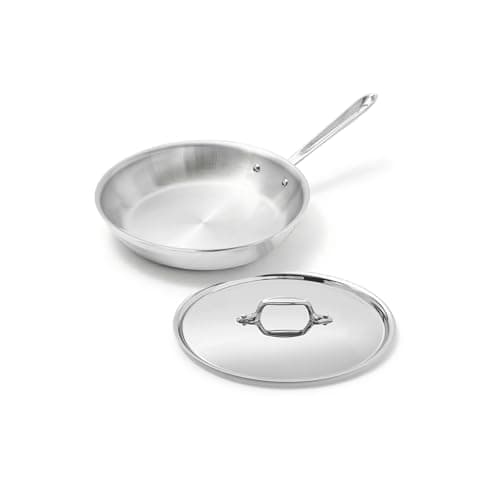
All-Clad D3 Stainless 10 in Fry Pan
Fully bonded clad stainless with nothing on it to wear out and a 600F oven and broiler rating.
Best for: One good open-stock stainless pan bought instead of a cheap full set
Published specifications for the All-Clad D3 Stainless 10 in Fry Pan
Construction
Fully bonded tri-ply, aluminum core
Oven maximum
600F, oven and broiler safe
Induction
Yes - compatible with any stovetop
Dishwasher
Handwash only (All-Clad published)
Handle
Double-riveted stainless
Weight
3.0 lb (model 4110)
Warranty
Limited lifetime
Made in
Bonded, engineered and assembled in Canonsburg, PA
Good
600F is the highest oven ceiling of any stainless pan on this site
The one pan here whose manufacturing location is published down to the town
Genuinely repairable-adjacent: rivets are the only failure point and the warranty covers them
Not good
Hand wash only
The flared rim makes it a poor pan for anything with liquid
Costs several times what a Tramontina or Cuisinart pan of the same construction costs
The trade-off. Hand wash only. All-Clad publishes that plainly, and it is a real daily cost on a pan you will use every day.
Skip this if. You want a dishwasher-safe pan, or you are buying a whole kitchen on a fixed budget - one D3 skillet costs what a full clad set can cost.
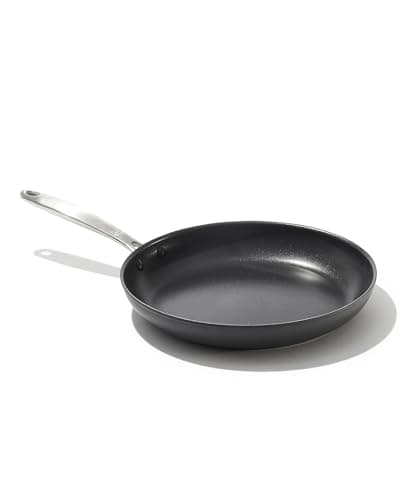
Published specifications for the OXO Good Grips Pro Hard-Anodized Nonstick Fry Pan, 10 in
Body
Hard-anodized aluminum
Coating
Three-layer PTFE nonstick, published PFOA-free
Oven maximum
430F published for the line
Induction
No on the standard hard-anodized line
Dishwasher
Dishwasher safe
Edge
Rolled, for pouring without dripping down the side
Coating lifespan
Not published
Good
The rolled pour edge is a small thing you notice every single time you use it
The hard-anodized body resists the denting that ruins cheap aluminum pans
Handle stays cool and does not rotate the way riveted plastic ones eventually do
Not good
Not induction compatible
Oven ceiling capped by the handle, not the pan
Still a coating, still a consumable, still no published lifespan
The trade-off. The handle that makes it comfortable is a stainless-and-silicone assembly, and that is what caps the oven rating below the body's own limit.
Skip this if. You need induction. The standard hard-anodized body is not ferrous.
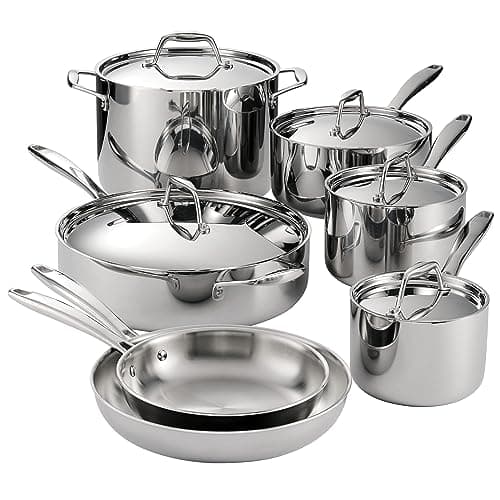
Published specifications for the Tramontina Signature Tri-Ply Clad 12-Piece Set
Construction
Tri-ply: 18/10 stainless, aluminum core, magnetic stainless exterior
Pieces
8 in and 10 in fry pans; 1.5, 2 and 3 qt covered saucepans; 5 qt covered deep saute; 8 qt covered stockpot
Oven maximum
500F on the 80116-249DS listing; other SKUs in the line are listed at 350F
Induction
Yes - magnetic stainless exterior
Dishwasher
Listed dishwasher safe
Handles
Precision cast, riveted
Certification
NSF-certified on the 80116-249DS line
Country of origin
Not asserted - retail listings disagree across SKUs (Brazil and China both appear)
Good
Fully clad, not disc-bottom: the aluminum runs up the sidewalls, so sauces do not scorch in a ring at the base
NSF certification on the flagship SKU is a real, checkable third-party mark rather than a marketing badge
Induction-ready without paying an induction premium
Not good
Retail listings disagree on the oven maximum across SKUs in the same line, which is a documentation problem, not a cooking one
Handles run hot on gas
The 12-piece count includes lids; the useful-item count is seven
The trade-off. Handles are the weak point. They are riveted and sturdy, but they get hot on a gas ring in a way the more expensive clad brands' do not.
Skip this if. You want a set you can leave in the oven above 500F, or you cook mostly eggs and pancakes and would rather spend the money on one good nonstick pan.
They are not the same kind of product. Clad stainless is a bare surface with nothing on it to wear out; almost every hard-anodized pan carries a nonstick coating that is the part that fails. Buy stainless for permanence, hard-anodized for a well-built coated pan.
›What does hard-anodizing actually do?
It thickens the natural oxide layer on aluminum electrochemically, producing a body much harder and less reactive than bare aluminum. It improves the body, not the cooking surface - on domestic pans there is a separate coating on top.
›Is hard-anodized cookware induction compatible?
Standard lines are not, because anodized aluminum is not ferromagnetic. Calphalon and OXO both publish this. Some brands sell separate induction ranges with a magnetic base layer - check the specific line and test with a magnet.
›Which gets hotter, stainless or hard-anodized?
Clad stainless goes higher: 500F to 600F published across the brands here, against 430F to 450F for the coated hard-anodized pans, none of which are broiler safe. The limit on the coated pans is the coating, not the aluminum.
›Can you use metal utensils on hard-anodized pans?
Only where the maker publishes it. Calphalon publishes its Premier coating as metal-utensil safe, which almost nothing else in the category does. On stainless, metal utensils are always fine - scratches there are cosmetic.
Sources
Every figure on this page came from one of these. Follow them and check our arithmetic — that is the point.