Heads up: some links on this page earn us a commission at no extra cost to you. It does not change what we recommend or the order. How we are funded.
The short answer
Symptom
Cause
Fixable?
Food suddenly sticks
Invisible polymerized oil film on the coating
Yes - strip it
Chalky gray or white film
Dishwasher detergent attacking the finish
No - cosmetic and permanent
Release fades gradually
Coating genuinely worn out
No - replace the pan
Rainbow or dark patches
Heat discoloration of the anodized layer
No, and harmless
Pan will not heat on induction
No magnetic base - aluminum is not ferrous
No - wrong pan for the hob
Scratches in the coating
Metal utensils on a coating not rated for them
No - but not a hazard
Warped or rocking base
Thermal shock, usually cold water on a hot pan
Rarely
Food suddenly sticks, on a pan that used to be fine
This is the single most common complaint, and it is usually not a worn coating. It is a layer of polymerized oil residue sitting on top of the coating, and food is sticking to the residue rather than to the pan.
The giveaway is that it happened relatively suddenly and the surface feels faintly tacky or looks slightly hazy brown. The causes are aerosol cooking spray, which leaves lecithin and propellant residue behind, and heating oil past its smoke point repeatedly.
It comes off. A paste of baking soda and water, or a simmer of water with a little vinegar, then a gentle scrub with a soft sponge - how to clean nonstick pans has the method. Adding more oil makes it worse, which is why the instinct to "season" a sticking coated pan usually backfires - do nonstick pans need seasoning.
If release returns after stripping the film, the coating was never the problem. If it does not, the coating is worn and the pan is finished. That test is the whole diagnosis.
A chalky gray or white film after the dishwasher
Dishwasher detergent is strongly alkaline, and alkaline attacks aluminum. On a hard-anodized pan it dulls the finish and can leave a chalky gray bloom, particularly on the exterior and the rim where the anodized surface is exposed rather than coated.
It is corrosion, not a deposit, so it does not wash off and it does not come back to the original finish. It is cosmetic and the pan still cooks. The lesson is preventive: hand wash anodized aluminum even when a listing claims dishwasher safe, because "dishwasher safe" is a claim about survival rather than about appearance or longevity - dishwasher-safe cookware, and is bakeware dishwasher safe covers the same chemistry on baking pans.
Release fading gradually over months
This is the coating genuinely wearing out, and it is the normal end of life. It is not a defect and it is not covered - every warranty in the coated category excludes coating wear, and no maker publishes how long the coating should last.
Hard anodizing does not help here at all. It hardens the body underneath; the coating is a separate layer wearing on its own schedule - is hard-anodized cookware worth it works through what the premium does and does not buy.
What shortens it: high heat, aerosol sprays, metal utensils on a coating not rated for them, dishwasher cycles, and stacking pans so the base of one grinds on the surface of the next - how to store pots and pans.
Discoloration, darkening and rainbow patches
Anodized aluminum changes color with heat. You will see darkening around the base, and sometimes faint iridescence. It is a change in the oxide layer, it is cosmetic, it is permanent, and it does not affect cooking or safety.
Do not try to scour it off. Abrasives will cut through the coating on the inside and through the anodized layer on the outside, which turns a cosmetic issue into a functional one. Bar Keepers Friend and similar oxalic acid cleaners are right for stainless and wrong here - cleaning burnt stainless is the page for pans where those do work.
It will not heat on an induction hob
Not a fault. Aluminum is not ferrous, so a hard-anodized pan only works on induction if the maker bonded a magnetic disc to the base, and many lines do not. The hob is behaving correctly by ignoring it.
There is no fix short of an interface disc, which is slow and largely defeats the point. Test with a magnet before buying - nonstick cookware for induction.
Scratches
A scratch through the coating exposes anodized aluminum, which is stable and not a hazard - the flakes of PTFE are inert and pass through the body. The problem is functional: the scratch is a place food will stick and a place the coating will keep lifting from.
The prevention is utensil discipline, and it depends on what the maker publishes. Calphalon publishes its coating as metal-utensil safe. OXO does not publish that for its three-layer coating, so silicone, nylon or wood - utensils for every cookware surface.
The one repair that genuinely works on a coated pan is removing what has built up on it. Everything else is prevention or replacement.
Three things that are not problems
A darker cooking surface than when new. Normal, and it often comes with slightly better release rather than worse.
Slight oil smoking at medium-high. That is the oil's smoke point, not the pan failing. Use an oil with a higher one, or less heat.
Water beading oddly on a cold pan. Surface energy, not damage.
When to stop nursing it
You stripped the film and release did not return.
The coating is lifting or flaking rather than merely scratched.
The base rocks, spins or no longer sits flat on the hob.
You are using more oil than you would in a bare pan to get the same result.
At that point the honest question is not which hard-anodized pan to buy next, but whether to keep buying a wear surface at all - what to replace nonstick pans with.
Replacements, in order of how you answered the last question
The published metal-utensil claim and the published ceiling are the two specifications that prevent most problems on this page.
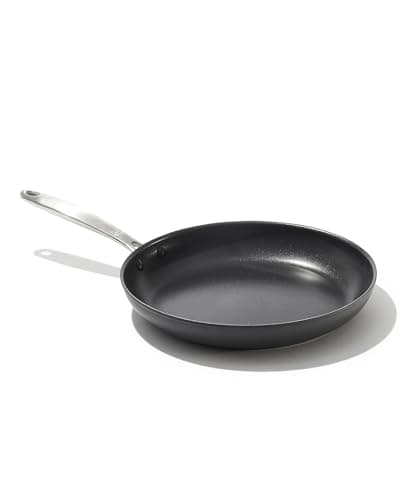
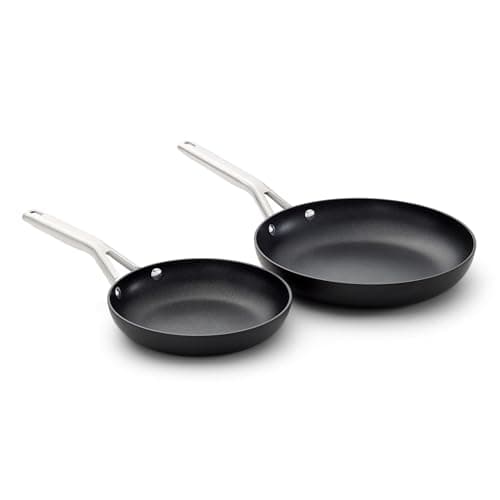
Calphalon Premier Hard-Anodized Nonstick Fry Pan, 10 in
A nonstick pan in a kitchen where the utensil drawer is not going to be policed
These are the products this page's reasoning actually points at. Same rules as everywhere else on the site: published specs, a stated trade-off, and a live price only where one exists.
Top pick · The replacement worth buyingSpecs read September 3, 2026
Calphalon Premier Hard-Anodized Nonstick Fry Pan, 10 in
450F published and metal-utensil safety published - the two specifications that prevent most of the problems on this page.
Best for: A nonstick pan in a kitchen where the utensil drawer is not going to be policed
Published specifications for the OXO Good Grips Pro Hard-Anodized Nonstick Fry Pan, 10 in
Body
Hard-anodized aluminum
Coating
Three-layer PTFE nonstick, published PFOA-free
Oven maximum
430F published for the line
Induction
No on the standard hard-anodized line
Dishwasher
Dishwasher safe
Edge
Rolled, for pouring without dripping down the side
Coating lifespan
Not published
Good
The rolled pour edge is a small thing you notice every single time you use it
The hard-anodized body resists the denting that ruins cheap aluminum pans
Handle stays cool and does not rotate the way riveted plastic ones eventually do
Not good
Not induction compatible
Oven ceiling capped by the handle, not the pan
Still a coating, still a consumable, still no published lifespan
The trade-off. The handle that makes it comfortable is a stainless-and-silicone assembly, and that is what caps the oven rating below the body's own limit.
Skip this if. You need induction. The standard hard-anodized body is not ferrous.
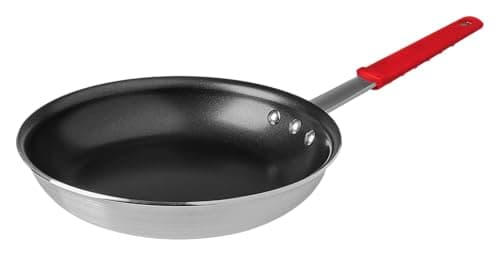
Published specifications for the Tramontina Professional Restaurant Fry Pan, 10 in
Body
Heavy-gauge aluminum
Coating
PTFE nonstick
Induction
No - aluminum body is not ferrous
Coating lifespan
Not published, by this or any nonstick maker
Good
Cheap enough that replacing it every couple of years is a real plan rather than a failure
Heavy gauge for a nonstick pan, so it does not warp on the first hot burner
Silicone handle sleeve that actually stays cool
Not good
Not induction compatible
PTFE, which some buyers will rule out on principle
No published coating lifespan, so the value case is unverifiable by design
The trade-off. It is PTFE. That is fine at normal cooking temperatures, and it is not a pan to preheat empty on high.
Skip this if. You want to avoid PTFE entirely. Buy ceramic instead and accept the shorter release life rather than pretending either one lasts forever.
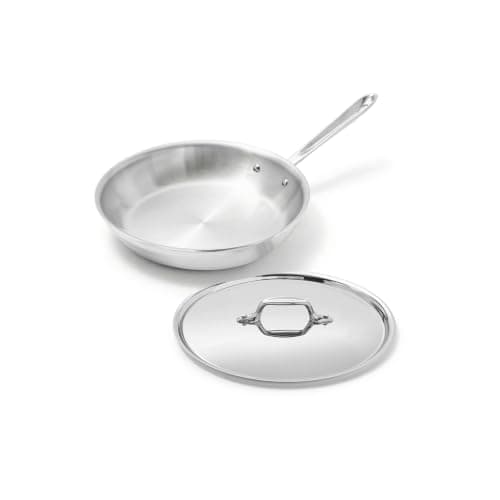
Published specifications for the All-Clad D3 Stainless 10 in Fry Pan
Construction
Fully bonded tri-ply, aluminum core
Oven maximum
600F, oven and broiler safe
Induction
Yes - compatible with any stovetop
Dishwasher
Handwash only (All-Clad published)
Handle
Double-riveted stainless
Weight
3.0 lb (model 4110)
Warranty
Limited lifetime
Made in
Bonded, engineered and assembled in Canonsburg, PA
Good
600F is the highest oven ceiling of any stainless pan on this site
The one pan here whose manufacturing location is published down to the town
Genuinely repairable-adjacent: rivets are the only failure point and the warranty covers them
Not good
Hand wash only
The flared rim makes it a poor pan for anything with liquid
Costs several times what a Tramontina or Cuisinart pan of the same construction costs
The trade-off. Hand wash only. All-Clad publishes that plainly, and it is a real daily cost on a pan you will use every day.
Skip this if. You want a dishwasher-safe pan, or you are buying a whole kitchen on a fixed budget - one D3 skillet costs what a full clad set can cost.
Usually a layer of polymerized oil residue on top of the coating, from aerosol cooking spray or repeatedly overheated oil. Food is sticking to the residue, not the pan. Strip it with a baking soda paste or a water and vinegar simmer, and release generally returns.
›Why did my hard-anodized pan go chalky in the dishwasher?
Dishwasher detergent is strongly alkaline and alkaline corrodes aluminum, dulling the anodized finish and leaving a chalky gray bloom. It is corrosion rather than a deposit, so it will not wash off. The pan still cooks; hand wash anodized aluminum from now on.
›Can hard-anodized cookware be repaired or re-coated?
Not practically at home, and home re-coating products do not bond reliably. The only genuine repair is removing built-up residue from the surface. Once the coating itself is worn or lifting, the pan is finished and no warranty covers coating wear.
›Is discoloration on hard-anodized cookware a problem?
No. Anodized aluminum darkens and can show faint iridescence with heat, which is a change in the oxide layer rather than damage. Do not scour it - abrasives cut through the coating inside and the anodized layer outside, turning a cosmetic issue into a functional one.
›Why will my hard-anodized pan not work on induction?
Aluminum is not magnetic, so the pan only works on induction if the maker bonded a steel disc to the base, and many lines have none. The hob is working correctly by ignoring it. Check with a refrigerator magnet before buying.
Sources
Every figure on this page came from one of these. Follow them and check our arithmetic — that is the point.