The wok that solved the Western stove problem decades ago, and has been the default answer since. The specification it does not publish is the one everyone wants.
Heads up: some links on this page earn us a commission at no extra cost to you. It does not change what we recommend or the order. How we are funded.
The short answer
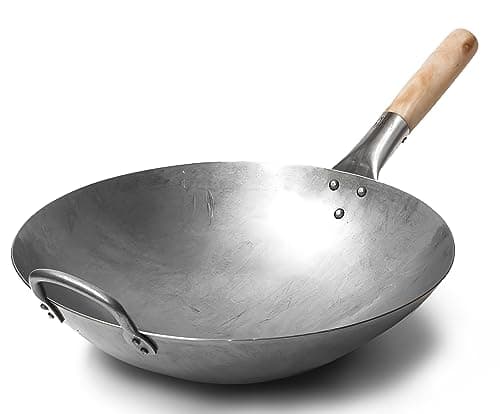
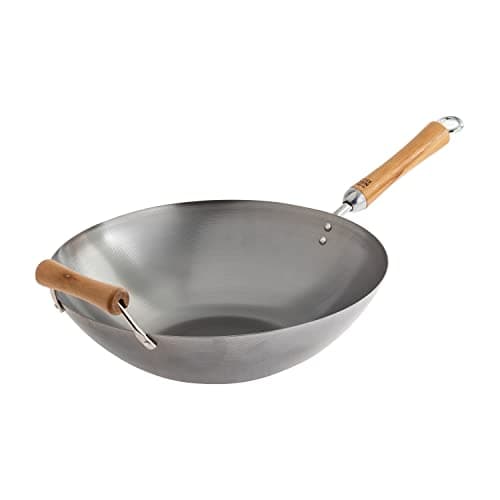
Joyce Chen publishes a flat-bottom carbon steel wok with a wooden main handle and a helper handle, sold bare so it seasons with use, and not dishwasher safe. The flat base is the whole point: a round-bottom wok on a domestic cooktop touches the element across a patch the size of a coin, and a flat one sits still and makes contact. What it does not publish is gauge - and nobody else in the wok category does either.
What this review checks
Published construction, base shape, handle materials, seasoning state on arrival, care guidance, and what the company declines to state. We have not cooked in any of it. The method is here.
The flat bottom, which is the entire product
A traditional wok has a round bottom, designed to sit in a ring above a restaurant wok burner whose flame licks up the sides. On a domestic cooktop none of that geometry exists. A round-bottom wok on a flat electric or induction surface makes contact across a patch the size of a coin and never gets properly hot.
The flat-bottom wok is the adaptation, and the Joyce Chen Classic has been the standard answer for decades. The base sits flat on a burner, the pan does not wobble, and the contact area is real. It is the reason this is the wok recommended in best carbon steel woks.
What Joyce Chen publishes
Specification
Published figure
Comment
Material
Carbon steel, bare
Seasons with use like any bare pan
Base
Flat bottom
The design decision that makes it work on a domestic stove
Diameter, our reference
14 in
The size that gives room to move food
Main handle
Wooden
Stays cool; rules out the oven
Helper handle
Yes
Necessary at this diameter when full
Dishwasher
No - bare steel rusts
True of every bare pan
Gauge
Not published
Nobody in the wok category publishes one
Recorded from Joyce Chen's published product specifications. The gauge row is a category-wide absence rather than a fault specific to this brand.
Handles, and what the wood decides
The main handle is wood, which is the correct choice for a pan designed to sit in a flame - a steel handle on a wok would be unusable. It stays cool and it is comfortable.
It also rules out the oven entirely. That is not a real limitation, because a wok is a stovetop tool, but it is worth stating plainly since almost every other pan on this site carries an oven rating.
The helper handle on the far rim is not optional at 14 inches. A wok full of food is several pounds at the end of a long lever, and every wok in our ledger has one.
A wooden handle also means the pan cannot be put through the seasoning routine some people use for skillets, where the pan goes into a hot oven. A wok is seasoned dry on the burner, working the heat up the sides - the method is in seasoning carbon steel and the wok-specific version is in the wok roundup.
Sold bare, which is a real step
The wok arrives with a factory anti-rust coating that must be scrubbed off before you cook, and then it needs seasoning. That step is where a lot of woks fail - they get bought, the first attempt sticks badly, and the pan goes into a cupboard.
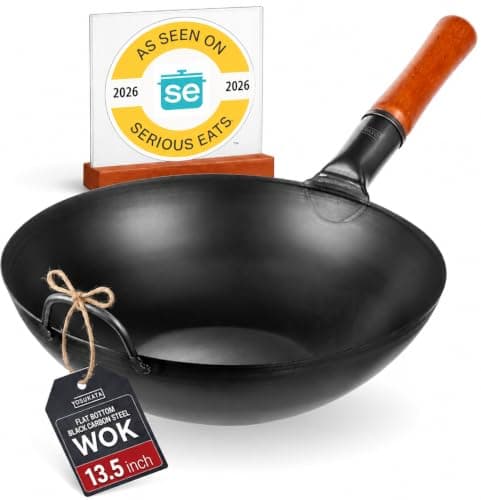
If that sounds like your household, a pre-seasoned wok removes the barrier entirely, which is why Yosukata appears as an alternative. If you are willing to do the work, bare steel seasons into a better surface over time, and the wok-specific seasoning routine is genuinely different from a skillet's - it is done dry and hot, working up the sides.
The gauge nobody publishes
Thickness is the specification that would let you compare woks meaningfully, and not one maker in this category publishes it - not Joyce Chen, not Craft Wok, not Yosukata. Our product cards say "Not published" rather than estimating, which is the same standard applied to Nordic Ware's missing gauge in that review.
The usable proxy is weight in the hand: a wok that feels flimsy is flimsy. What can be compared across the category is base shape, seasoning state, handle material, diameter and stated origin, and those cover most of what separates them in a kitchen.
The honest caveat about woks at home
A wok assumes a heat source most domestic kitchens do not have. Even with a flat bottom, the walls rise away from the burner and do very little, so what you get is a bowl-shaped skillet with a small hot zone.
On a weak electric ring, a flat 12-inch carbon steel skillet will out-sear this wok, because its whole base contacts the element. That case is made in full in stir frying without a wok, and it is the reason a skillet appears among the picks on a wok review.
What the wok still gives you on a domestic stove: volume in a small footprint, room to toss, somewhere to park cooked food up the sides, and deep frying with less oil than a pot of the same depth.
What it gets right
A flat base that sits still and makes real contact on a domestic burner
Wooden handle stays cool on a pan designed to sit in heat
Helper handle, which is necessary at 14 inches
Bare steel that seasons into a better surface with use
The long-standing default answer for Western stoves, and widely available
What it costs you
No published gauge - a category-wide absence, but an absence
Sold bare, so it needs stripping and seasoning before first use
The wooden handle rules out the oven entirely
On a weak burner a flat skillet will out-sear it
Not dishwasher safe, like every bare steel pan
Who should buy it
Buy the Joyce Chen if you have a normal Western stove and want the default answer. The flat-bottom 14-inch is the one.
Buy Craft Wok instead if you want the traditional hand-hammered object and will season it yourself.
Buy Yosukata instead if the seasoning step is what would stop you using it.
Buy a skillet instead if your burner is weak - a 12-inch carbon steel skillet will sear better on the stove you actually have.
The wok, its two alternatives, and the honest skillet
Base shape first, seasoning state second, everything else third. Nobody in this category publishes a gauge, so weight in the hand is the proxy.
Joyce Chen Classic Series Carbon Steel Wok, 14 in
A first wok on a gas or electric range that has no wok ring
These are the products this page's reasoning actually points at. Same rules as everywhere else on the site: published specs, a stated trade-off, and a live price only where one exists.
Top pick · The wok to buySpecs read September 3, 2026
Joyce Chen Classic Series Carbon Steel Wok, 14 in
A flat base that sits still on a normal burner, a wooden handle that stays cool, and bare steel that improves with use.
Best for: A first wok on a gas or electric range that has no wok ring
Published specifications for the Craft Wok Traditional Hand Hammered Carbon Steel Wok, 14 in
Material
Hand hammered carbon steel
Diameter
14 in
Base
Sold in both flat-bottom and round-bottom versions
Handles
Wooden main handle, steel helper handle
Seasoning
Ships with a protective coating that must be removed, then seasoned
Gauge
Not published
Made in
Guangzhou, China
Good
The hammered dimples give food somewhere to sit off the hottest part of the base
Both bottom shapes are sold, so you can match it to the burner you actually have
Nothing on it can wear out - there is no coating to fail
Not good
Requires stripping and seasoning before first use
Wooden handle is not oven safe
Rusts overnight if it is put away damp
The trade-off. It arrives coated in factory oil that has to be scrubbed off and seasoned before the first cook, and it will rust if you leave it wet once.
Skip this if. You want a pan you can put in the dishwasher and forget about. This is the least forgiving object on this site.
Published specifications for the Yosukata Black Carbon Steel Wok, 13.5 in
Material
Black carbon steel
Diameter
13.5 in
Seasoning
Pre-seasoned at the factory - usable on arrival
Base
Sold flat-bottom and round-bottom
Handles
Wooden handle, steel helper handle
Gauge
Not published
Dishwasher
No
Good
Cook in it the day it arrives, which is the single biggest reason woks get used rather than stored
Lighter than the hand-hammered pans, so the tossing motion is realistic for most arms
Sold in both base shapes
Not good
Factory seasoning can flake early and needs rebuilding anyway
No published gauge
Wooden handle, so no oven finishing
The trade-off. Pre-seasoning is a starting layer, not a finished surface. It still needs building up, and the factory layer can flake in patches early on.
Skip this if. You want a lifetime object rather than a good working pan. The hand-hammered woks are built heavier.
It is the long-standing default for Western stoves, and the reason is the flat bottom - it sits still and makes real contact with a domestic burner, where a round-bottom wok touches across a patch the size of a coin.
›Does a Joyce Chen wok need seasoning?
Yes. It is sold bare with a factory anti-rust coating that must be scrubbed off, then seasoned. A wok is seasoned dry on the burner, working the heat up the sides, rather than in an oven - the wooden handle rules that out.
›How thick is a Joyce Chen wok?
Joyce Chen does not publish a gauge, and neither does any other wok maker in our ledger. Weight in the hand is the usable proxy - a wok that feels flimsy is flimsy.
›Can a Joyce Chen wok go in the oven?
No. The main handle is wooden, which is the correct choice for a pan designed to sit in a flame and which rules out the oven entirely. A wok is a stovetop tool.
›Is a wok better than a skillet for stir frying at home?
Not necessarily. A wok assumes a restaurant burner, and on a weak domestic ring a flat 12-inch carbon steel skillet contacts the element across its whole base and will out-sear it. The wok still wins on volume, tossing room and deep frying with less oil.
Sources
Every figure on this page came from one of these. Follow them and check our arithmetic — that is the point.