Heads up: some links on this page earn us a commission at no extra cost to you. It does not change what we recommend or the order. How we are funded.
The short answer
Worth owning: a crepe pan if you make crepes often, and a paella pan if you cook paella - both are shapes a skillet genuinely cannot replicate.
Sometimes worth owning: a carbon steel roasting pan, which browns better than enamelware and is far lighter than cast iron.
Rarely worth owning: oval fish pans, blini pans and omelette pans - a skillet covers all three.
Buy the 12-inch skillet first. It replaces most of this category by itself.
Why carbon steel has so many shapes
Carbon steel is rolled sheet, so it can be pressed, spun or hammered into almost any form cheaply. Cast iron has to be cast, clad stainless has to be bonded then formed, and both processes limit what shapes are economic. That is why this material has a specialist pan for nearly every regional dish.
It also means the category is full of shapes that exist because they can rather than because they need to. The honest test for any of them: is there a job a 12-inch skillet cannot do? For most of these there is not.
Crepe pans: genuinely different
A crepe pan is 9 to 11 inches with walls barely half an inch high and a light gauge. Both features are functional: the low wall lets you reach in with an offset spatula and turn something the thickness of paper, and the light weight lets you lift and swirl the pan to spread the batter.
A skillet cannot do the second of those comfortably. Sloped walls get in a spatula's way at the rim, and a 3 mm skillet is heavy to rotate repeatedly. If you make crepes more than occasionally, this is a real purchase.
It is not, however, a pan for anything else - too shallow to fry in and too thin to sear with. Buy it as a single-purpose tool or not at all. The technique is covered in best pans for pancakes and crepes.
Paella pans: also genuinely different
A paella pan is very wide, very shallow, flat-based and flared, usually 13 to 18 inches for domestic sizes. The shape exists to spread rice in a thin layer so that liquid evaporates fast and the base develops the crust that is the entire point of the dish.
No skillet is wide enough or shallow enough. A 12-inch skillet with 2-inch walls makes rice, not paella - the layer is too deep and the evaporation too slow.
Size
Serves
Fits
13 in
2 to 3
One large domestic burner, just about
15 in
4 to 5
Overhangs most burners; better on a grill or two rings
18 in and up
6 plus
Outdoor burner or a wide grill only
Burner size is the real constraint. A paella pan wider than your burner heats in a ring, which is the opposite of what the dish needs.
This is the one shape where the burner mismatch is unavoidable. Traditional paella is cooked over a wide gas ring or an open fire for exactly this reason, and a domestic hob will give you an uneven base. A grill or an outdoor burner solves it.
Which pan to actually buy at each of those sizes, and the induction limit the traditional pressed-steel pans do not advertise, is in best paella pans.
Carbon steel roasting pans: the underrated one
Less common than the two above and arguably more useful. A carbon steel roasting pan is light, browns superbly because bare steel radiates well, and takes any oven temperature - and it costs a fraction of an enameled cast iron roaster while weighing far less.
Two caveats. It rusts, so it needs the same drying and oiling routine as a skillet. And acidic pan juices - wine, tomato, citrus in a marinade - will strip seasoning, which is exactly the case covered in is carbon steel cookware safe.
For most people a bare aluminum sheet pan does the same job with no maintenance, which is the argument in best roasting pans. Buy carbon steel here only if you want the browning and accept the upkeep.
Woks, which are the specialty pan worth owning
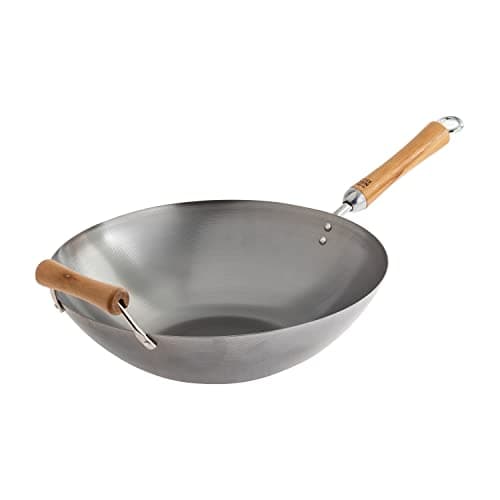
A wok is the one specialist carbon steel shape with a broad domestic case, and it does three things a skillet does not: it holds a large volume with a small footprint, it lets you park food up the sides away from the hottest metal, and it deep fries with significantly less oil than a pot of the same depth because of its taper.
The rules are unchanged from best carbon steel woks: flat bottom unless you have a gas ring and a wok ring, 14 inches, carbon steel, never nonstick. And the honest caveat is that on a weak domestic burner a wide flat skillet often out-performs it - stir frying without a wok covers that case.
Shapes to skip
Omelette pans. A carbon steel omelette pan is a small skillet with slightly steeper walls. An 8 to 10 inch skillet does it.
Oval fish pans. Beautiful, and they overhang the burner at both ends so the middle is hot and the ends are not. A 12-inch round skillet cooks fish better - best pans for fish.
Blini and poffertjes pans. Genuinely single-purpose, and the purpose comes up once a year.
Carbon steel saucepans. Rare, and they should be: liquid cooking is frequently acidic and bare steel minds that.
Carbon steel woks with nonstick coatings. The technique needs heat the coating cannot survive.
One care routine covers all of them
Everything in this category is bare steel, so the routine is identical whatever the shape: strip the factory coating on arrival, season in thin coats, dry on the burner after washing, keep long acidic cooking out, and never use a dishwasher.
The methods are in seasoning carbon steel, and the troubleshooting for when it goes wrong is in carbon steel problems and fixes. A thin light pan - a crepe pan especially - warps more readily than a 3 mm skillet, so the thermal-shock rule matters more on specialty shapes than on a heavy one.
Before buying any specialist shape, check whether the skillet you own already covers it. Most of this category is a skillet with a different rim.
The carbon steel worth owning before any specialist shape
Two skillets and two woks. Crepe and paella pans are real purchases and we have not audited specific models, so the searches below are the honest pointer.
de Buyer MINERAL B PRO Carbon Steel Fry Pan, 11 in
Someone who wants cast-iron searing without cast-iron weight
These are the products this page's reasoning actually points at. Same rules as everywhere else on the site: published specs, a stated trade-off, and a live price only where one exists.
Top pick · The pan that replaces most specialty shapesSpecs read September 3, 2026
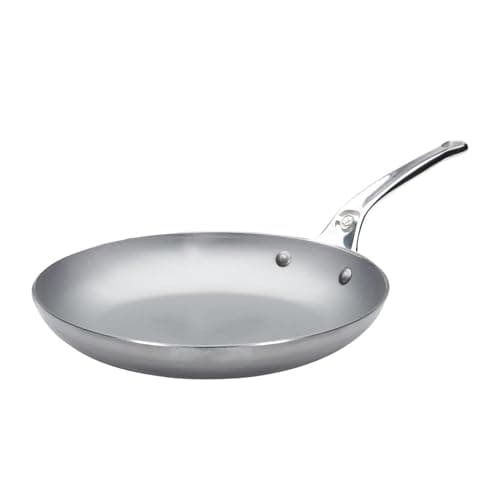
de Buyer MINERAL B PRO Carbon Steel Fry Pan, 11 in
An 11-inch carbon steel skillet with published 3 mm thickness does crepes, omelettes and shallow roasting well enough that most specialists are redundant.
Best for: Someone who wants cast-iron searing without cast-iron weight
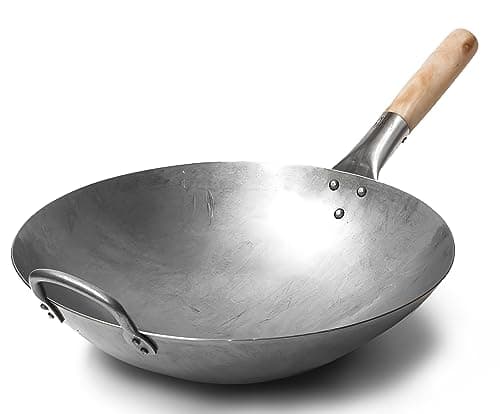
Published specifications for the Craft Wok Traditional Hand Hammered Carbon Steel Wok, 14 in
Material
Hand hammered carbon steel
Diameter
14 in
Base
Sold in both flat-bottom and round-bottom versions
Handles
Wooden main handle, steel helper handle
Seasoning
Ships with a protective coating that must be removed, then seasoned
Gauge
Not published
Made in
Guangzhou, China
Good
The hammered dimples give food somewhere to sit off the hottest part of the base
Both bottom shapes are sold, so you can match it to the burner you actually have
Nothing on it can wear out - there is no coating to fail
Not good
Requires stripping and seasoning before first use
Wooden handle is not oven safe
Rusts overnight if it is put away damp
The trade-off. It arrives coated in factory oil that has to be scrubbed off and seasoned before the first cook, and it will rust if you leave it wet once.
Skip this if. You want a pan you can put in the dishwasher and forget about. This is the least forgiving object on this site.
Only if you make crepes often. The low walls and light weight are genuinely functional - a spatula can reach in and the pan is easy to lift and swirl - and a skillet does neither comfortably. It is a single-purpose tool with no second use.
›Can you make paella in a regular skillet?
Not really. A paella pan is very wide and very shallow so the rice sits in a thin layer and the base crusts. A 12-inch skillet with 2-inch walls makes rice rather than paella, because the layer is too deep and evaporation too slow.
›Are carbon steel roasting pans worth buying?
They brown superbly, weigh far less than enameled cast iron and take any oven temperature, but they rust and need the same drying and oiling as a skillet. For most people a bare aluminum sheet pan does the job with no maintenance at all.
›Which carbon steel specialty pan is most useful?
A flat-bottom 14-inch wok. It holds a large volume in a small footprint, lets you move food away from the hottest metal, and deep fries with less oil than a pot of similar depth. On a weak burner, though, a wide flat skillet often beats it.
›Do specialty carbon steel pans need different care?
No - the routine is identical: strip the factory coating on arrival, season in thin coats, dry on the burner, keep long acidic cooking out, and never use a dishwasher. Thin shapes like crepe pans warp more readily, so avoid thermal shock especially.
Sources
Every figure on this page came from one of these. Follow them and check our arithmetic — that is the point.