Heads up: some links on this page earn us a commission at no extra cost to you. It does not change what we recommend or the order. How we are funded.
The short answer
For American pancakes, a flat cast iron griddle or a large coated skillet on medium to medium-low. Batter records exactly where a pan is hot, so evenness matters more than peak temperature, and a heavy flat surface is what evens it out. For crepes, use a light, low-sided pan you can tilt and swirl - carbon steel is the traditional answer and a coated crepe pan is the forgiving one. In both cases the pan should be moderately hot, not hot.
Quick picks
The whole answer, on one screen. Tap a row to jump to the full write-up. Every pick below carries a stated trade-off further down — including the one at the top.
#
Product
Best for
Price
1
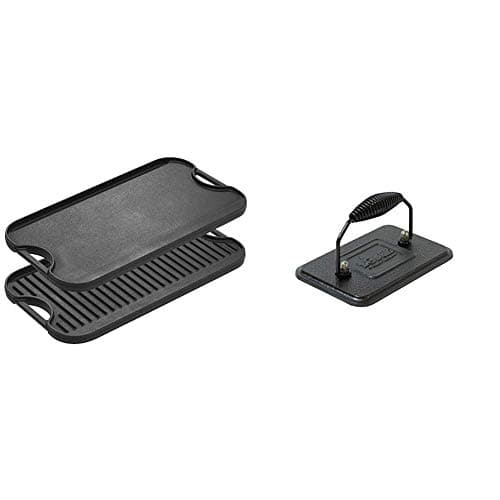
Lodge Cast Iron Reversible Grill/Griddle, 20 x 10.44 in
A flat cast iron surface across two burners cooks four or six at once, and the mass evens out a domestic stove's hot ring.
Prices last checked October 22, 2026. Prices move constantly — the number on Amazon when you click is the real one.
Batter records your pan's hot spots
A pancake is a thin, uniform layer of wet starch sitting still on a surface for two minutes. Whatever the pan does, the pancake photographs. A dark ring the diameter of your burner with pale edges outside it is not a cooking error - it is a picture of a thin pan on a small element.
That makes evenness the priority, and evenness comes from mass and from a flat base. A heavy cast iron griddle smooths the burner's pattern out; a thin aluminum pan transmits it. This is one of the few cooking jobs where cast iron's poor conductivity is genuinely irrelevant, because nothing is moving and there is time for the heat to spread.
Flat matters more than you expect
A warped base is invisible until batter goes in, at which point the batter runs downhill and you get a crescent-shaped pancake with a thick edge. Thin coated pans warp most readily, usually from thermal shock or a burner wider than the base - it is the terminal fault described in when to replace your cookware.
Test a suspect pan by putting a tablespoon of water in the cold pan and watching where it settles. If it runs to one side, that pan will never make round pancakes.
Moderate heat, and how to find it
Pancakes want medium to medium-low. Too hot and the outside sets before the inside cooks, giving a dark pancake that is raw in the middle; too cool and it dries out before it browns. The classic test is a drop of water that skitters rather than either sitting still or vanishing instantly.
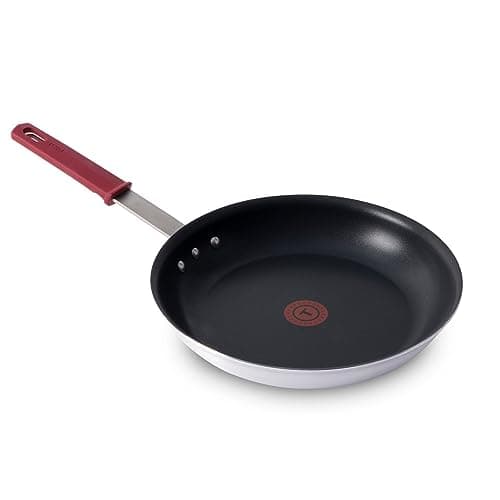
T-fal's Thermo-Spot indicator is the one cookware feature on this site that solves a real technique problem: it turns solid at cooking temperature, which removes the guesswork entirely. It is covered in our T-fal review, and the pan's 400F published ceiling is irrelevant here because pancakes never approach it.
The first pancake is always worse. That is a temperature-stabilization artifact, not a fault in the pan or the batter, and every cook accepts it.
Griddle or skillet
Flat griddle
Skillet
Pancakes at once
Four to six on a two-burner griddle
Two on a 10 in, three on a 12 in
Edges
No walls - a spatula reaches from any side
Sloped walls get in the way at the rim
Even heat
Better, if it is heavy
Depends entirely on base and material
Smooth-top stoves
Avoid two-burner griddles entirely
Fine, with the usual cast iron rules
Storage
Awkward, heavy, needs a deep cupboard
It is a pan you already own
Other uses
Grilled cheese, bacon, smash burgers
Everything
A two-burner griddle is the right tool and the worst object to store. On a glass cooktop it is not an option at all - see cast iron on glass top stoves.
The smooth-top caveat is real and worth repeating: a griddle bridging two elements covers glass that was never designed to sit under a pan, which is set out in cast iron on glass top stoves.
Crepes are a different pan
A crepe pan is low-sided, light and around 9 to 11 inches, because the technique is to pour a small amount of thin batter and immediately tilt and swirl the pan to spread it. A heavy pan makes that motion tiring and a high-sided pan makes it impossible.
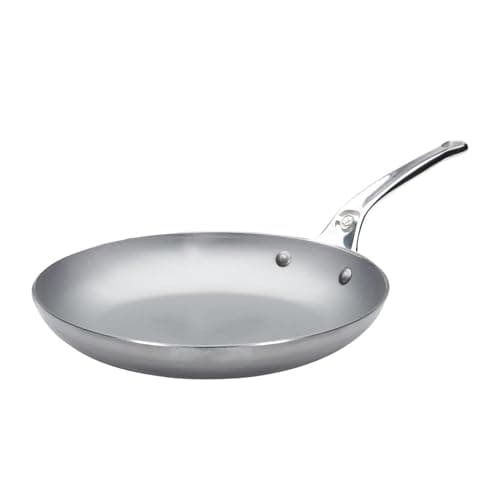
Carbon steel is the traditional answer: light, bare, and it seasons into a release surface. It needs the seasoning routine in seasoning carbon steel.
A coated pan is the forgiving answer and needs no technique at all.
Cast iron is the wrong answer here, purely on weight - you are lifting and rotating the pan repeatedly.
Dedicated crepe pans exist and are one of the shapes covered in carbon steel specialty pans. A regular low-sided skillet does the job if you are not making crepes weekly.
Each write-up below gives the published specs, what the pan is genuinely good at, what it costs you, and who should skip it. The trade-off line is there on the top pick too — a recommendation with no downside is an advertisement.
Top pick · Best pan for pancakesSpecs read September 3, 2026
Lodge Cast Iron Reversible Grill/Griddle, 20 x 10.44 in
A flat cast iron surface across two burners cooks four or six at once, and the mass evens out a domestic stove's hot ring.
Best for: Cooking breakfast for four at once instead of in three rounds
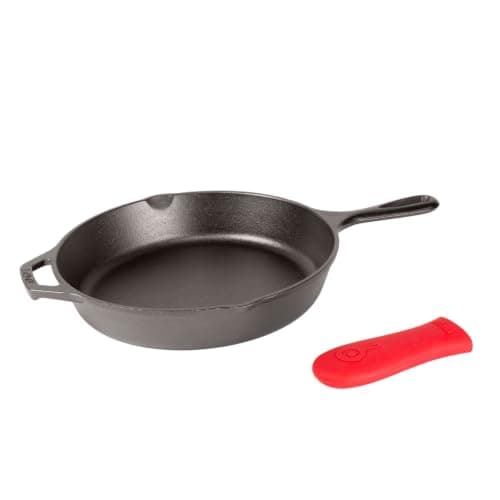
Published specifications for the Lodge Seasoned Cast Iron Skillet, 10.25 in (L8SK3)
Diameter
10.25 in
Weight
5.66 lb
Oven maximum
550F
Induction
Yes - bare iron is ferrous
Seasoning
Pre-seasoned with soy-based vegetable oil, no synthetic chemicals
Warranty
Lifetime
Made in
USA
Care
Hand wash. Lodge's own instructions permit warm soapy water
Good
Effectively unbreakable and fully restorable - a rusted one can be stripped and re-seasoned
Holds heat better than anything else at the price, which is what a sear needs
Lodge publishes its seasoning method openly, so the maintenance is not a mystery
Not good
Heavy
Heats unevenly on a small burner: cast iron conducts at roughly 50 W/m-K, so it is slow to spread and slow to react
Bare iron is reactive; long tomato braises will taste of it
The trade-off. It weighs 5.66 lb empty. You will feel that every time you move it full, and it is the single most common reason a cast iron skillet ends up in a cupboard.
Skip this if. You have wrist or shoulder trouble, or you cook mostly acidic braises. Carbon steel does most of the same jobs at roughly half the weight.
A flat, heavy surface on moderate heat - a cast iron griddle if you cook for several people, or a large coated skillet if you do not. Batter records a pan's hot spots exactly, so evenness matters far more than how hot the pan can get.
›Why are my pancakes dark in the middle and pale at the edges?
That is a picture of your burner, not a cooking mistake. A thin pan transmits the element's pattern straight into the batter. A heavier flat pan, or a griddle, spreads the heat out before it reaches the food.
›Do you need a special pan for crepes?
Not strictly. A crepe pan is low-sided and light so you can tilt and swirl it, and a regular low-sided skillet does the same job. Carbon steel is the traditional material; a coated pan is the forgiving one. Cast iron is too heavy for the motion.
›What temperature should a pancake pan be?
Medium to medium-low. Too hot and the surface sets before the middle cooks; too cool and the pancake dries out before it browns. A drop of water should skitter across the surface rather than sit still or vanish instantly.
›Can you use a cast iron griddle on a glass cooktop?
A two-burner griddle should be avoided - it bridges elements and covers glass that is not designed to sit under a pan. A single cast iron skillet is fine on a smooth top provided you lift rather than slide it.
Sources
Every figure on this page came from one of these. Follow them and check our arithmetic — that is the point.