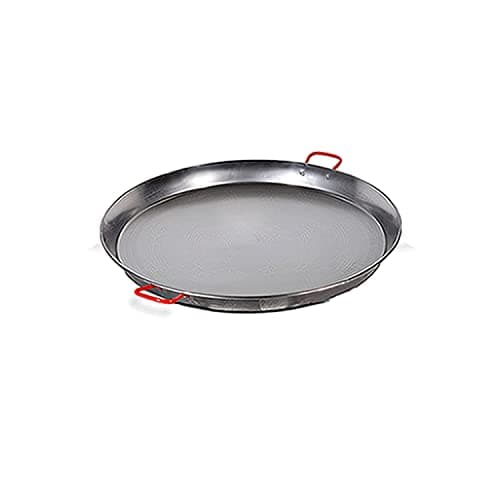
Price is the second question in this category. The first is what you are cooking on, because the classic pressed-steel pans are published as unsuitable for induction and for ovens.
Heads up: some links on this page earn us a commission at no extra cost to you. It does not change what we recommend or the order. How we are funded.
The short answer
If you cook on gas or over a fire, buy a traditional Spanish pressed steel pan and buy it in the size your burner can actually heat: the Garcima 13-inch / 32 cm is the only size that sits honestly on one domestic ring, and the Garcima 15-inch / 38 cm is the one to take outdoors to a grill or a wide burner. If you cook on induction or a smooth top, those pans are out - their retailers publish the polished line as not suitable for induction and not oven suitable - so the answer is the All-Clad D3 stainless 14-inch, which is published induction compatible and oven and broiler safe to 600F, or the Matfer Bourgeat black carbon steel 15.5-inch, whose line Matfer publishes as induction compatible. The honest summary of the whole category: a thirty-dollar pressed steel pan cooks this dish better than a two-hundred-dollar clad one, provided you have the right heat under it.
Quick picks
The whole answer, on one screen. Tap a row to jump to the full write-up. Every pick below carries a stated trade-off further down — including the one at the top.
#
Product
Best for
Price
1
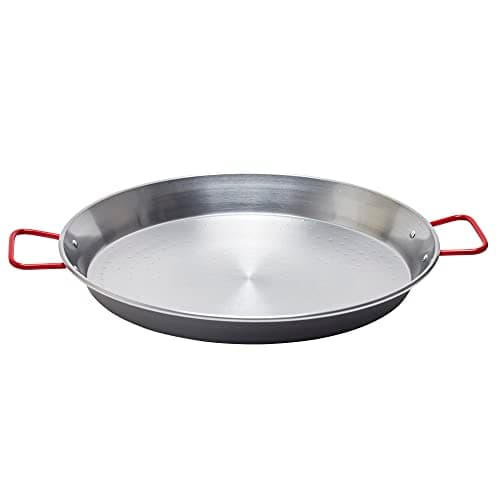
Garcima Carbon Steel Paella Pan, 13 in / 32 cm
13 in / 32 cm of traditional pressed polished steel, serving two to three. The only size that does not overhang a single gas ring, which is the constraint that ruins most home paella. Published as not suitable for induction or the oven, and it rusts if put away damp.
15 in / 38 cm, serving four to five - the size the recipes assume. Cheap enough to treat as an outdoor pan. It overhangs essentially every domestic hob ring, and like the 13 in it is published as neither induction nor oven suitable.
The only pick here published as induction compatible and oven and broiler safe, at 600F, with a limited lifetime warranty and a named Pennsylvania factory. It also costs several times the traditional pans and its clad base holds heat where this dish wants to dump it.
Matfer Bourgeat Black Carbon Steel Paella Pan, 15.5 in
Commercial-gauge black carbon steel at 15.5 in from a brand whose documentation we have already audited, and whose black steel line Matfer publishes as induction compatible. No published oven maximum, no published thickness for this SKU, and the riveted steel handle is hot whenever the pan is.
Prices last checked October 19, 2026. Prices move constantly — the number on Amazon when you click is the real one.
What we ranked on, and why heat source comes first
Most roundups in this category rank on size and price. Both are downstream of a question that rules out the majority of paella pans for a large share of kitchens, so we put it first.
Will it work on your heat source? Traditional polished pressed steel is published by its retailers as not suitable for induction cooktops. On an induction kitchen that is not a compromise, it is a pan that will not heat properly. This is the filter, and it is the one nobody puts on the box.
Can your burner heat the whole base? Paella is a thin layer of rice over a wide flat floor, and a ring of heat under a wide pan produces a ring of cooked rice. Width is therefore limited by your heat, not by how many people you want to feed.
What does the material ask of you? Pressed steel needs seasoning before first use and oiling after every wash, and it rusts if neglected. Stainless asks nothing and will not rust.
Is anything published at all? Thickness, weight, oven ceiling and warranty are mostly absent across this category, and we say so per pick rather than filling the gaps.
We have not cooked paella in any of these. This site compiles what makers and retailers publish and links every source - how we work.
The finding: the classic pans are gas and fire only
This is the part worth knowing before you spend anything, and it is not advertised on the pans themselves.
Garcima is the default Spanish maker and its standard polished pressed-steel line - which is what almost every inexpensive paella pan on sale is - is published by retailers carrying it as not suitable for induction cooktops and not oven suitable, made in Valencia, at around 1 mm in the smaller sizes and 1.2 mm in the larger ones. Its separate restaurant-grade Pata Negra line is described as induction compatible by one retailer, while another seller's own answer about a 40 cm Pata Negra says its slightly rounded base may not work with most induction cooktops.
So within one brand you have a line published as induction-unsuitable and a line whose induction status retailers disagree about. That is the state of documentation here, and it is why the stainless and the Matfer pans are on this page at all.
Carbon steel is ferrous, so a carbon steel pan will couple with an induction coil in principle. The reasons a wide thin pressed pan is still published as unsuitable are practical: a base that is not perfectly flat loses contact, and a pan far wider than the coil gets a hot circle rather than a hot floor. The published guidance and the physics agree.
Size: we are not going to repeat ourselves
Sizing for this shape is already set out in full, with the size-to-servings-to-burner table and the reason the mismatch matters, in carbon steel specialty pans. The short version, because it determines which of the picks below applies to you: 13 inches serves two to three and just about fits one large domestic burner, 15 inches serves four to five and wants a grill or a wide ring, and anything at 18 inches or more is an outdoor pan.
The practical consequence is counter-intuitive and worth stating plainly: buy for your burner, not for your guest list. A 15-inch pan on a single domestic ring feeds four people worse paella than a 13-inch pan does, because the outer third of the rice never gets the heat the dish is built on.
The four, side by side
Garcima 13 in
Garcima 15 in
All-Clad D3 14 in
Matfer 15.5 in
Material
Pressed polished carbon steel
Pressed polished carbon steel
Tri-ply clad stainless, aluminum core
Black carbon steel
Diameter
13 in / 32 cm
15 in / 38 cm
14 in
15.5 in
Serves
2 to 3
4 to 5
4 to 5
4 to 6
Induction
No - published not suitable
No - published not suitable
Yes (D3 line)
Yes (Matfer black steel line)
Oven
No - published not suitable
No - published not suitable
Yes, 600F, broiler safe
Not published; bare steel, limit is the seasoning
Seasoning
Required before first use
Required before first use
None
Required
Rusts if neglected
Yes
Yes
No
Yes
Thickness
Not published for this ASIN; line listed at 1 mm
Not published for this ASIN; line listed at 1 to 1.2 mm
Not published
Not published for this SKU; line listed at 3 mm
Made in
Valencia, Spain
Valencia, Spain
Made in the USA; D3 assembled in Canonsburg, PA
France
Warranty
Not published
Not published
Limited lifetime
Not published
Dishwasher
No
No
Hand wash only (All-Clad published)
No
Price band
Lowest here
Low
Highest here, by several times
Mid to high
Read from each maker's and retailer's published material on the date stamped on this page. Where a figure is not published the cell says so rather than guessing.
Why the cheap pan is the better pan, on gas
It is unusual for this site to recommend the least documented product in a category, so the reasoning deserves to be explicit.
Paella wants a thin pan. The dish is a short, hard cook: liquid has to evaporate fast so the rice stops cooking at the right moment and the base develops its crust. A thin pressed steel floor dumps heat into the rice and then stops the instant you pull it off the flame, which is exactly the behavior the technique assumes.
A clad stainless pan does the opposite. Thermal mass is a virtue in a braise and a liability here - it keeps driving evaporation after you want it to stop, and it takes longer to respond when you adjust the flame. That is why the All-Clad is on this page as the induction answer rather than as the best answer. The same mass-versus-response trade runs through the whole site - cookware materials compared.
The cost of the thin pan is everything you would expect: it dents, it rusts if stored damp, and it needs the same routine as any bare steel pan - seasoning carbon steel applies to these unchanged.
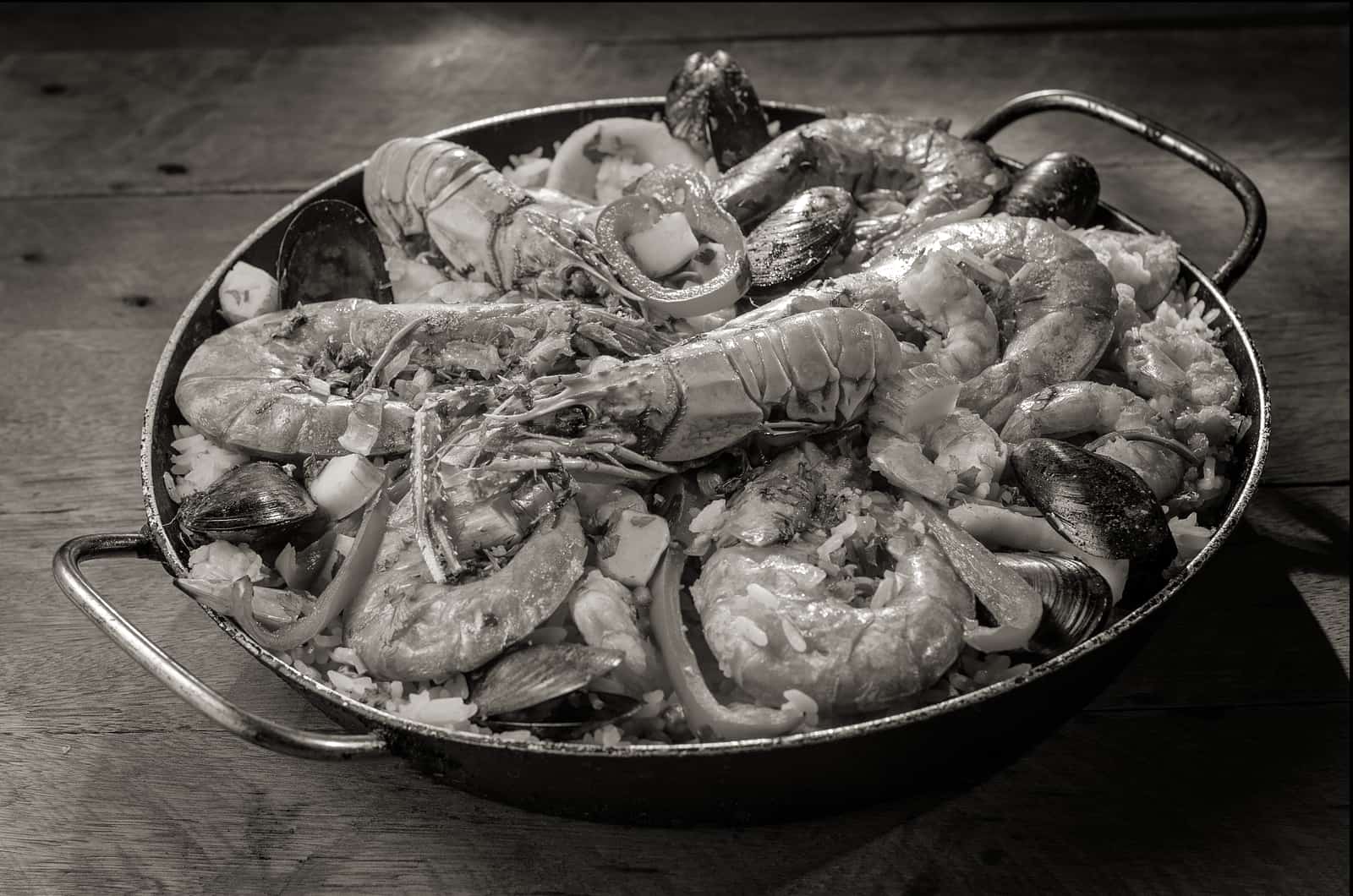
Wide, shallow, flat-based and flared. The shape is the recipe, which is why no skillet substitutes for it.
If you cook on induction
You have two honest options and one bad one.
The All-Clad D3 stainless. Published induction compatible, oven and broiler safe to 600F, limited lifetime warranty, hand wash only per All-Clad. You are paying a lot and accepting clad behavior in a dish that does not want it, but it will work and it will last.
The Matfer black carbon steel. Matfer publishes its black steel line as compatible with gas, electric, ceramic, halogen and induction, and the line is listed at 3 mm in commercial catalogs. Closer to traditional behavior than the clad pan, at a price between the two.
Not a wide polished pressed pan. Its own retailers publish it as unsuitable, and the width-versus-coil problem is worse on induction than on gas because induction only heats the metal directly above the coil - induction cookware problems and fixes covers the hot-ring symptom in detail.
A third option worth naming because it is free: cook it outdoors. A grill or an outdoor gas burner solves the width problem completely and lets you buy the traditional pan, which is what the dish was developed on.
First use, and the one habit that destroys these pans
The three carbon steel pans here all arrive bare and all need the same treatment. None of them is nonstick and none of them pretends to be.
Season before first use. The retailer guidance for the Garcima polished line is a thin film of vegetable oil heated until it just smokes. That is the same method the rest of this site gives for carbon steel.
Hand wash in warm water, avoiding heavy detergent, and if rust appears, an abrasive clean and a re-season fixes it. Rust is a surface problem on bare steel, not the end of the pan.
Dry it immediately and completely, then wipe a light film of oil over the floor before it goes away. This is the step people skip and it is the one that matters: a wide thin pan put away damp will show rust within a day.
Never put one in a dishwasher. It strips seasoning and the pan comes out wet, which is both failure modes at once.
If that routine sounds like more than you want, the stainless pan is the one that asks nothing - and that is a legitimate reason to buy it even on gas.
If you are not sure you will make it twice
Worth saying, since this is a single-dish pan and the site's standing position is that single-purpose pans mostly get used twice and stored forever.
There is no good substitute - a 12-inch skillet with two-inch walls makes rice, not paella, because the layer is too deep and the evaporation too slow. So the honest advice is to make the dish once in the widest shallow pan you own, decide whether you like it enough to repeat it, and then buy the 13-inch. It costs little and it is the size that will actually work on your hob - the pots and pans you do not need is the general version of that test, and cookware substitutions explains why this particular shape has no stand-in.
What we cannot tell you
How thick any of these pans actually is. Garcima does not publish a gauge for the individual ASINs we link - the 1 mm and 1.2 mm figures come from a retailer selling the line by thickness - and Matfer publishes no thickness for this SKU, so the 3 mm figure is from its fry pan catalog rather than from this pan. All-Clad publishes neither a weight nor a base thickness for its paella pan.
We also have not cooked in them, run no heat-distribution testing, and cannot tell you whether a given pan will sit flat on your particular hob - which, in this category, is the variable that decides the result - our editorial policy.
Which to buy
Gas, one burner, cooking for two or three:the Garcima 13-inch. The size that fits the heat you have.
A grill, an outdoor burner or a wide ring:the Garcima 15-inch. The standard size, and cheap enough to live outside.
Induction or a smooth top, and you want it to last:the All-Clad D3 14-inch. Published induction compatible and 600F, hand wash only.
Induction, but you want traditional steel behavior:the Matfer Bourgeat 15.5-inch. Expect a hot handle and no published oven figure.
All four, with live prices
Two traditional pressed-steel pans published as gas-and-fire only, and two published as induction compatible. Prices move constantly - the number on each button is the current one, and the stamp below says when it was last checked.
Garcima Carbon Steel Paella Pan, 13 in / 32 cm
Paella for two or three on a single large gas ring, or over a fire
Prices last checked October 19, 2026. Prices move constantly — the number on Amazon when you click is the real one.
Every pick, in full
Each write-up below gives the published specs, what the pan is genuinely good at, what it costs you, and who should skip it. The trade-off line is there on the top pick too — a recommendation with no downside is an advertisement.
Top pick · Best for one domestic burnerSpecs read October 14, 2026
Garcima Carbon Steel Paella Pan, 13 in / 32 cm
13 in / 32 cm of traditional pressed polished steel, serving two to three. The only size that does not overhang a single gas ring, which is the constraint that ruins most home paella. Published as not suitable for induction or the oven, and it rusts if put away damp.
Best for: Paella for two or three on a single large gas ring, or over a fire
Published specifications for the Garcima Carbon Steel Paella Pan, 13 in / 32 cm
Diameter
13 in / 32 cm
Serves
2 to 3 (Garcima's size-to-servings convention for this diameter)
Material
Pressed polished carbon steel
Thickness
Not published for this ASIN. Retailers list the polished line at 1 mm in the smaller sizes and 1.2 mm in the larger ones
Induction
NO - the polished line is published by retailers as not suitable for induction cooktops
Oven
NO - the same listings publish it as not oven suitable
Made in
Valencia, Spain (retailer-published for the polished line)
First use and care
Season before first use with a thin film of vegetable oil heated until it just smokes. Hand wash in warm water, dry thoroughly, wipe with light oil
Weight
Not published
Warranty
Not published
Good
The one size that fits a single domestic burner, which is the constraint that ruins most paella attempts
Traditional pressed steel is what the dish and its crust were developed on
Cheapest route into the shape by a wide margin
Not good
Published as not suitable for induction and not suitable for the oven
Thin pressed steel dents and will rust the moment it is put away damp
Needs seasoning before first use, and oiling after every wash
No published thickness for this ASIN, no weight and no warranty
The trade-off. Pressed steel at around a millimeter is thin and light, so it dents, it will rust if left wet, and it needs seasoning before first use and oiling after every wash.
Skip this if. You cook on induction or want to finish the pan in the oven. The polished line is published as suitable for neither.
#2 · Best for a grill or outdoor burnerSpecs read October 14, 2026
Garcima Carbon Steel Paella Pan, 15 in / 38 cm
15 in / 38 cm, serving four to five - the size the recipes assume. Cheap enough to treat as an outdoor pan. It overhangs essentially every domestic hob ring, and like the 13 in it is published as neither induction nor oven suitable.
Best for: Paella for four or five over a grill, a wide gas ring or an outdoor burner
Published specifications for the Garcima Carbon Steel Paella Pan, 15 in / 38 cm
Diameter
15 in / 38 cm
Serves
4 to 5 (Garcima's size-to-servings convention for this diameter)
Material
Pressed polished carbon steel
Thickness
Not published for this ASIN. Retailers list the polished line at 1 mm in the smaller sizes and 1.2 mm in the larger ones
Induction
NO - the polished line is published by retailers as not suitable for induction cooktops
Oven
NO - the same listings publish it as not oven suitable
Made in
Valencia, Spain (retailer-published for the polished line)
First use and care
Season before first use with a thin film of vegetable oil heated until it just smokes. Hand wash in warm water, dry thoroughly, wipe with light oil
Weight
Not published
Warranty
Not published
Good
The size most paella recipes are written for, and the one that feeds a table
Cheap enough to treat as an outdoor pan without worrying about it
Pressed steel heats fast, which suits the short hard cook the dish wants
Not good
Overhangs essentially every domestic burner, and a ring of heat is the one thing paella cannot tolerate
Published as not suitable for induction and not suitable for the oven
Rusts if stored damp, and needs seasoning and oiling
No published thickness for this ASIN, no weight and no warranty
The trade-off. At 15 inches it overhangs almost every domestic burner, which heats it in a ring - the opposite of what the dish needs. Outdoors it is the right pan; on one hob ring it is not.
Skip this if. A single domestic burner is your only heat source, or you cook on induction. Take the 13 in instead, or a stainless pan.
#3 · Best for inductionSpecs read October 14, 2026
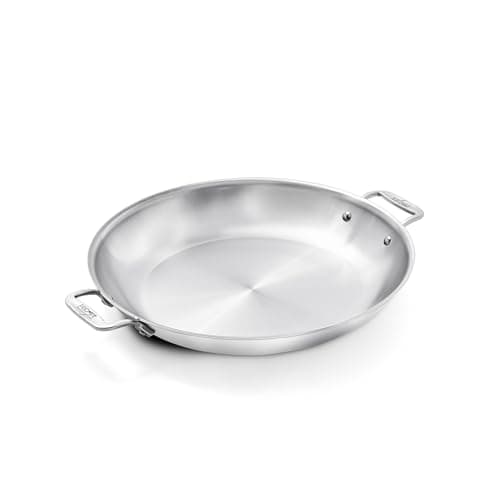
All-Clad D3 Stainless Paella Pan, 14 in
The only pick here published as induction compatible and oven and broiler safe, at 600F, with a limited lifetime warranty and a named Pennsylvania factory. It also costs several times the traditional pans and its clad base holds heat where this dish wants to dump it.
Best for: Anyone on induction or a smooth top who wants a wide pan with no seasoning to maintain
Published specifications for the All-Clad D3 Stainless Paella Pan, 14 in
Diameter
14 in (per the listing title)
Construction
Fully bonded tri-ply with an aluminum core (All-Clad D3 line)
Induction
Yes - compatible with any stovetop (All-Clad D3 line)
Oven maximum
600F, oven and broiler safe (All-Clad D3 line)
Dishwasher
Hand wash only (All-Clad published for D3)
Seasoning
None - stainless needs no seasoning and will not rust
Made in
Made in the USA per the listing; D3 is bonded, engineered and assembled in Canonsburg, PA
Warranty
Limited lifetime (All-Clad D3 line)
Weight
Not published on the listing we read
Base thickness
Not published
Good
The only pick here published as induction compatible and oven safe, at 600F
No seasoning, no rust risk, and it survives being put away wet
A real warranty and a named US factory, which nothing else in this category offers
Not good
Several times the price of a traditional pan that cooks the dish more authentically
Clad construction holds heat rather than dumping it, which works against the fast evaporation the crust needs
Hand wash only, per All-Clad's own published guidance
No published weight or base thickness for this SKU, and 14 in still overhangs most single burners
The trade-off. It costs several times the traditional pans and the clad base is the opposite of what tradition calls for - heavier, slower, and better at holding heat than at the fast hard evaporation the crust depends on.
Skip this if. You cook paella once a year on a gas ring. The Garcima does that job for a fraction of the money.
#4 · Traditional steel, published for inductionSpecs read October 14, 2026
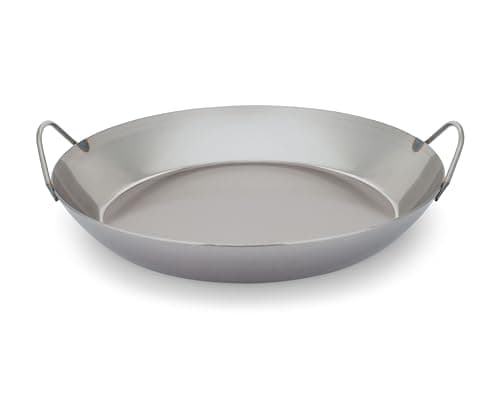
Matfer Bourgeat Black Carbon Steel Paella Pan, 15.5 in
Commercial-gauge black carbon steel at 15.5 in from a brand whose documentation we have already audited, and whose black steel line Matfer publishes as induction compatible. No published oven maximum, no published thickness for this SKU, and the riveted steel handle is hot whenever the pan is.
Best for: A cook who wants pressed-steel behavior with real thickness, on gas or induction
Published specifications for the Matfer Bourgeat Black Carbon Steel Paella Pan, 15.5 in
Diameter
15.5 in (per the listing title)
Material
Black carbon steel
Thickness
Not published for this SKU. Matfer's black steel fry pans are listed at 3 mm in commercial catalogs
Compatibility
Gas, electric, ceramic, halogen, induction (Matfer black steel line)
Oven maximum
Not published. The pan is bare steel throughout; the practical limit is the seasoning
Handle
Riveted steel - conducts heat fully, so it gets hot with the pan
Made in
France (Matfer black steel line)
Seasoning
Required. Bare steel, no coating
Weight
Not published
Warranty
Not published
Good
Published induction compatible, which the traditional polished pans are not
Commercial-gauge black steel from a brand whose documentation we have already audited
Bare metal throughout - nothing to wear out, and seasoning rebuilds from scratch
Not good
No published oven maximum, no published thickness for this SKU, no weight and no warranty
The riveted steel handle is hot whenever the pan is - there is no stay-cool anything here
Three to four times the price of the Garcima it most resembles in use
Still 15.5 in, so the burner-overhang problem is unchanged
The trade-off. Matfer publishes no oven maximum for its black steel - the pan is bare metal throughout and the practical limit is the seasoning - and the riveted steel handle conducts heat fully, so it is hot whenever the pan is.
Skip this if. You want a pan you can neglect. This is bare steel: season it, dry it, oil it, or it rusts like any other.
Buy for your burner rather than your guest list. Thirteen inches serves two to three and just about fits one large domestic gas ring. Fifteen inches serves four to five but overhangs essentially every domestic hob, so it wants a grill or an outdoor burner. Eighteen inches and up is outdoor-only. A pan wider than its heat source cooks the rice in a ring.
›Can you use a paella pan on an induction cooktop?
Not the traditional polished pressed-steel pans - their retailers publish them as not suitable for induction cooktops and not oven suitable. Carbon steel is ferrous so it couples in principle, but a wide thin pan with a base that is not perfectly flat loses contact, and induction only heats the metal directly above the coil. For induction, use a clad stainless paella pan or a brand that publishes induction compatibility, such as Matfer's black steel line.
›Is an expensive paella pan better?
For this dish, usually not. Paella is a short hard cook where liquid has to evaporate fast, and a thin pressed-steel floor dumps heat into the rice and stops the moment you pull it off the flame. Clad stainless holds heat instead, which keeps driving evaporation after you want it to stop. The expensive pan earns its place on induction, where the cheap one will not work, rather than on performance.
›Can I make paella in a regular skillet?
You will make rice, not paella. The shape is the recipe: a paella pan is very wide, very shallow and flared so the rice sits in a thin layer and the base can develop its crust. A 12-inch skillet with two-inch walls gives you a layer that is too deep and evaporation that is too slow. There is no good substitute for this shape.
›Do paella pans rust?
The traditional carbon steel ones do, readily, if they are put away damp. They arrive bare and need seasoning before first use - a thin film of vegetable oil heated until it just smokes - then hand washing, immediate and complete drying, and a light wipe of oil before storage. Rust is a surface problem: clean it off and re-season. A stainless paella pan avoids the whole routine.
›Can a paella pan go in the oven?
It depends entirely on which one. The Garcima polished line is published as not oven suitable. All-Clad's D3 line is published oven and broiler safe to 600F. Matfer publishes no oven maximum for its black carbon steel at all - the pan is bare metal throughout, so the practical limit is the seasoning rather than the steel.
Sources
Every figure on this page came from one of these. Follow them and check our arithmetic — that is the point.