Heads up: some links on this page earn us a commission at no extra cost to you. It does not change what we recommend or the order. How we are funded.
The short answer
Victoria publishes seasoned cast iron construction, induction compatibility, hand-wash care and manufacture in Colombia. Two things distinguish it from the American default: a noticeably longer handle, which keeps your hand further from the heat and gives better leverage on a heavy pan, and a lighter casting for the same diameter. It is cast iron, so it behaves like cast iron - the differences are ergonomic rather than thermal, and they are real.
What this review checks
Published material, seasoning, handle design, induction compatibility, care guidance, country of manufacture, and what the company declines to state. We have not cooked in any of it. The method is here.
What Victoria publishes
Specification
Published figure
Comment
Material
Seasoned cast iron
The same material as every other cast iron pan
Diameter, our reference pan
12 in
The large everyday size
Induction
Yes
True of all cast iron - it is strongly ferrous
Dishwasher
No
The one absolute rule for any seasoned pan
Made in
Colombia
Stated, which is more than several competitors manage
Handle
Longer than the American standard
The genuine design difference
Recorded from Victoria Cookware's published product specifications.
The handle, which is the design difference
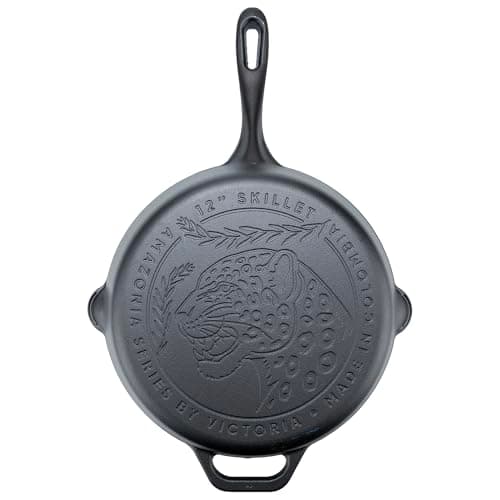
Victoria's handles are longer than the American standard, and that is not a styling choice. It does two things.
It keeps your hand further from the heat. On a gas ring, a short cast iron handle sits closer to the flame and heats faster.
It gives leverage. A 12-inch cast iron skillet is heavy, and a longer handle makes lifting and tilting easier - though it also puts more load at the end of a longer lever, so a helper handle still matters.
There is a cost: a longer handle needs more space, both on the hob and in a cupboard. In a small kitchen that is a real consideration - how to store pots and pans covers it, and a long handle over a campfire is actively a liability, as noted in cast iron in the oven and on the grill.
The lighter casting
Victoria's pans are lighter for their diameter than the American default. That is the same quality vintage cast iron hunters look for, and it is a genuine advantage for anyone who finds a 12-inch cast iron pan hard to lift.
It also means slightly less thermal mass, which means slightly less heat stored for searing - the property that makes cast iron good at that job in the first place, explained in best pans for searing steak. In practice the difference is small and the weight difference is noticeable, which is a trade most domestic cooks will take.
If lifting is the real issue, dropping a size does more than changing brand. An 8 or 10-inch pan is dramatically easier to handle than a 12-inch one of any make - what size cast iron skillet has the sizing.
What does not differ
It is worth being clear about this, because cast iron marketing invites people to believe otherwise. Victoria and Lodge are both seasoned cast iron, and the material behaves identically:
Both work on induction and both are effectively unlimited in an oven.
Neither should ever see a dishwasher.
Nobody in this category publishes a surface roughness figure or a gauge, so "smoother casting" claims across brands are not checkable from published data. We record that rather than repeating it.
Origin
Victoria publishes Colombia. That is a stated country of manufacture, which is more disclosure than a good deal of the cookware market offers - Lodge publishes South Pittsburg, Tennessee for its cast iron and, notably, publishes no country for its carbon steel line, a gap we record in our Lodge review.
What it gets right
A longer handle that keeps your hand further from the heat and adds leverage
Lighter for its diameter than the American default
Publishes a country of manufacture
Arrives seasoned and works on induction like all cast iron
Cheaper than premium cast iron with no meaningful material difference
What it costs you
Less thermal mass than a heavier pan, so marginally less searing performance
A long handle needs more hob and cupboard space, and is a liability over a fire
No published gauge or surface figure, so smoothness claims cannot be checked
Not dishwasher safe, like every seasoned pan
Less widely stocked than the American default, so replacements are harder to find
Who should buy it
Buy Victoria if a 12-inch cast iron skillet is at the edge of what you can comfortably lift, or if you cook on gas and want your hand further from the flame. The 12-inch skillet is the piece to get.
Buy Lodge instead if you want the most heat retention per dollar and the widest availability - the 12-inch Lodge.
Buy a smaller pan instead if weight is the real problem - 10 inches or 8 inches.
Do not buy either expecting a material difference. It is cast iron in both cases.
Victoria against the American default, at three sizes
The brand difference is handle length and casting weight. The size difference matters more than the brand difference for almost everyone.
Victoria Cast Iron Skillet, 12 in
Anyone who has burned a knuckle on a short cast iron handle
These are the products this page's reasoning actually points at. Same rules as everywhere else on the site: published specs, a stated trade-off, and a live price only where one exists.
Top pick · The pan to buySpecs read September 3, 2026
Victoria Cast Iron Skillet, 12 in
Twelve inches of seasoned cast iron with a longer handle and a lighter casting than the American default.
Best for: Anyone who has burned a knuckle on a short cast iron handle
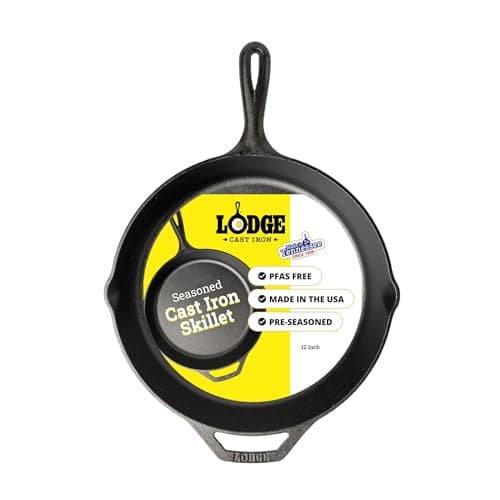
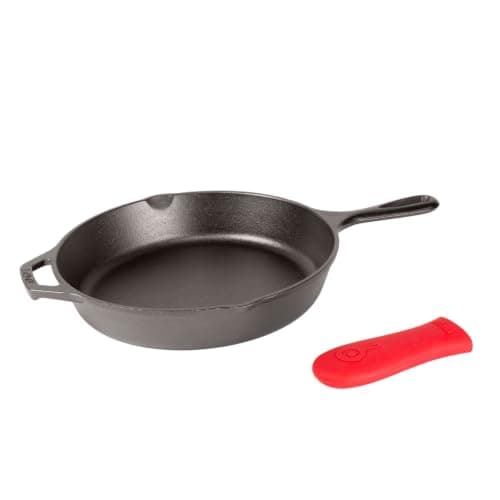
Published specifications for the Lodge Seasoned Cast Iron Skillet, 10.25 in (L8SK3)
Diameter
10.25 in
Weight
5.66 lb
Oven maximum
550F
Induction
Yes - bare iron is ferrous
Seasoning
Pre-seasoned with soy-based vegetable oil, no synthetic chemicals
Warranty
Lifetime
Made in
USA
Care
Hand wash. Lodge's own instructions permit warm soapy water
Good
Effectively unbreakable and fully restorable - a rusted one can be stripped and re-seasoned
Holds heat better than anything else at the price, which is what a sear needs
Lodge publishes its seasoning method openly, so the maintenance is not a mystery
Not good
Heavy
Heats unevenly on a small burner: cast iron conducts at roughly 50 W/m-K, so it is slow to spread and slow to react
Bare iron is reactive; long tomato braises will taste of it
The trade-off. It weighs 5.66 lb empty. You will feel that every time you move it full, and it is the single most common reason a cast iron skillet ends up in a cupboard.
Skip this if. You have wrist or shoulder trouble, or you cook mostly acidic braises. Carbon steel does most of the same jobs at roughly half the weight.
It is the same material and behaves identically. The differences are ergonomic: Victoria's handles are longer, which keeps your hand further from the heat and adds leverage, and the castings are lighter for their diameter.
›Is a lighter cast iron pan worse?
Marginally, for searing - less mass means less stored heat when cold food lands in it. It is also easier to lift, which is why vintage pans are sought after for the same quality. Most domestic cooks will take that trade.
›Where is Victoria cookware made?
Victoria publishes Colombia as its country of manufacture. A stated origin is more disclosure than much of the cookware market offers - Lodge publishes South Pittsburg, Tennessee for its cast iron but no country for its carbon steel line.
›Does Victoria cast iron work on induction?
Yes. All cast iron is strongly ferrous, so it couples very well with an induction hob. The usual smooth-top handling rules apply - lift the pan rather than sliding it.
›Are Victoria pans smoother than Lodge pans?
Nobody in this category publishes a surface roughness figure, so we cannot verify comparative smoothness claims from published data. Modern castings smooth out with use as seasoning fills the texture, whatever brand they are.
Sources
Every figure on this page came from one of these. Follow them and check our arithmetic — that is the point.