Heads up: some links on this page earn us a commission at no extra cost to you. It does not change what we recommend or the order. How we are funded.
The short answer
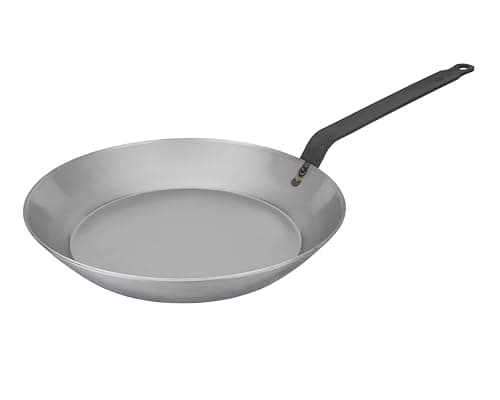
Matfer Bourgeat publishes bare black carbon steel construction with a welded handle and French manufacture. It does not publish an oven maximum - the pan is bare steel throughout, so the practical limit is the seasoning rather than the metal. What you are buying is the commercial standard: no coating, no rivets inside the pan, nothing to loosen, and a pan a restaurant can strip and re-season indefinitely. The welded handle gets hot, which is the trade.
What this review checks
Published construction, thickness where stated, handle design, oven guidance, care instructions, country of manufacture, and what the company declines to state. We have not cooked in any of it. The method is here.
Construction
Bare black carbon steel throughout, formed from sheet, with a handle welded to the body. There is no coating, no cladding, no core and no rivet - and that list of absences is the entire product description.
The cooking surface is whatever seasoning you build on it, exactly as with cast iron. The chemistry of that surface, and what it means for safety, is in is carbon steel cookware safe.
What Matfer publishes
Specification
Published figure
Comment
Material
Black carbon steel, bare throughout
No coating anywhere on the pan
Handle
Welded steel
No rivets inside the pan; it conducts heat
Made in
France
Stated, which most of this category does not
Oven maximum
Not published
The pan is bare steel; the practical limit is the seasoning
Thickness
Not published
de Buyer publishes 3 mm; Matfer does not
Dishwasher
No - bare steel rusts
True of every bare pan
Recorded from the commercial listing in our ledger. Two of these rows are absences, and we record them rather than estimating.
The welded handle
This is the design decision that defines the pan, and it cuts both ways.
What it gets right
No rivets inside the pan. Nothing protruding into the cooking surface and nothing to clean around.
Nothing to loosen. Riveted handles eventually work loose; a weld does not.
Nothing to fail in an oven. There is no sleeve, no knob and no composite grip, so nothing caps the pan's temperature.
What it costs
The handle is steel welded to steel, so it conducts heat directly from the pan. On a gas ring it becomes too hot to hold within minutes. Professional kitchens solve this with a side towel and never think about it; a domestic cook who reaches for the handle out of habit will not enjoy the lesson.
If that sounds like a dealbreaker, de Buyer's riveted, shaped handles are the alternative - the comparison is in best carbon steel pans.
A welded handle is also not repairable. If it ever fails, the pan is finished - which is one of the few things that genuinely ends a carbon steel pan, as listed in carbon steel problems and fixes.
What it does not publish
Two absences worth naming, because they are the specifications a buyer most wants.
Thickness. Gauge predicts heat retention and warping resistance better than any other figure, and Matfer does not publish one. de Buyer does - 3 mm at 11 inches - which is why that brand appears wherever this site needs a thickness reference.
Oven maximum. Not published, and in fairness the pan is bare steel with a steel handle, so there is no component with a lower rating. The practical limit is the seasoning, in the same way Lodge publishes 550F for seasoned cookware rather than for the iron - collected in oven-safe cookware temperatures.
First use, which Matfer leaves to you
Bare carbon steel ships with a factory anti-rust coating that must be scrubbed off before cooking. de Buyer publishes step-by-step instructions for this; Matfer's commercial positioning assumes you already know.
The process is the same either way: scrub the protective film off with hot water and an abrasive pad, dry immediately on a burner, then season in thin coats. Seasoning carbon steel is the method, and skipping the first step is where a large share of first-week complaints originate.
Why restaurants buy these
Worth stating because it explains the whole design. In a commercial kitchen a pan is equipment, not an heirloom.
Cheap enough to buy in quantity and replace without ceremony.
Nothing on it to fail. No coating to scratch, no rivet to loosen, no sleeve to melt.
Takes any heat a commercial range produces, which is far more than a domestic hob.
Recoverable. A pan stripped in service is re-seasoned rather than binned.
Those are good properties in a domestic kitchen too, with the handle as the one genuine adjustment.
What it gets right
Bare steel throughout - no coating, no cladding, nothing to fail
Welded handle means no rivets inside the pan and nothing to loosen
Publishes France as the country of manufacture
No component with a lower temperature rating than the steel itself
The commercial standard, and stripping and re-seasoning is routine
What it costs you
The welded handle conducts heat and needs a towel
No published thickness, which is the specification that matters most here
No published oven maximum
No first-use instructions published, unlike de Buyer
A failed weld ends the pan, and it cannot be re-riveted
Who should buy it
Buy Matfer if you want the restaurant object and a towel in your hand is normal. The 11-inch black steel pan is the size most kitchens want.
Buy de Buyer instead if you want a published thickness and printed first-use instructions - Mineral B Pro at 3 mm.
Buy Lodge carbon steel instead if you would rather not strip and season a new pan.
Buy cast iron instead if searing is the main job and weight is not a problem.
Matfer and the three pans it competes with
One publishes nothing and is the professional default, one publishes a thickness, one arrives pre-seasoned, and one is heavier and cheaper.
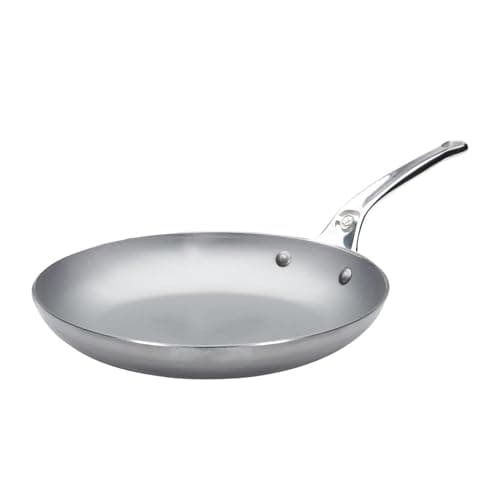
Matfer Bourgeat Black Carbon Steel Fry Pan, 11 in (062004)
Someone who would rather buy the pan a commercial kitchen buys
These are the products this page's reasoning actually points at. Same rules as everywhere else on the site: published specs, a stated trade-off, and a live price only where one exists.
Top pick · The pan to buySpecs read September 3, 2026
Matfer Bourgeat Black Carbon Steel Fry Pan, 11 in (062004)
Bare black steel with a welded handle and nothing on the interior - the simplest object in the category.
Best for: Someone who would rather buy the pan a commercial kitchen buys
If you want the commercial standard, yes - bare black steel with a welded handle, nothing on it to fail, and French manufacture. The trade is a handle that conducts heat and needs a towel, and no published thickness or oven rating.
›Why does the Matfer handle get so hot?
It is steel welded directly to steel, so it conducts heat straight from the pan. Professional kitchens solve this with a side towel. If that sounds like a dealbreaker, de Buyer's riveted shaped handles are the alternative.
›Do you need to season a new Matfer pan?
Yes, and you must first scrub off the factory anti-rust coating that bare carbon steel ships with. Matfer does not publish step-by-step first-use instructions the way de Buyer does, and skipping that step causes most first-week problems.
›How thick is a Matfer black steel pan?
Matfer does not publish a thickness, which is the specification that most predicts heat retention and warping resistance. de Buyer publishes 3 mm at 11 inches, which is why that brand is our thickness reference.
›How hot can a Matfer pan go in the oven?
Matfer does not publish a figure. The pan is bare steel with a welded steel handle, so there is no component rated lower than the metal - the practical limit is the seasoning rather than the pan.
Sources
Every figure on this page came from one of these. Follow them and check our arithmetic — that is the point.