Heads up: some links on this page earn us a commission at no extra cost to you. It does not change what we recommend or the order. How we are funded.
The short answer
Buy individual hard-anodized pans rather than a set. The anodized body is genuinely better than the stamped aluminum in cheap coated cookware, but every piece still carries a nonstick coating with a lifespan no maker publishes - so a set means replacing the whole box on a schedule nobody will state. Calphalon publishes the highest ceiling here at 450F and a metal-utensil-safe claim; OXO publishes 430F and the best handle. Neither standard line works on induction.
Quick picks
The whole answer, on one screen. Tap a row to jump to the full write-up. Every pick below carries a stated trade-off further down — including the one at the top.
#
Product
Best for
Price
1
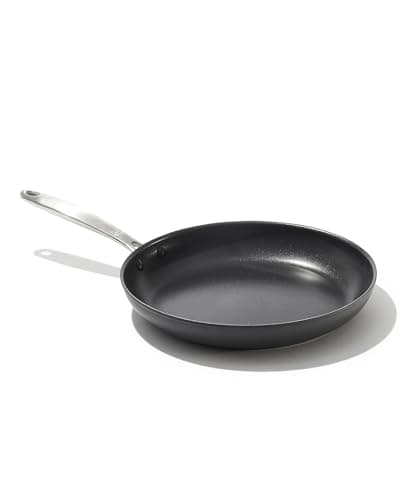
Calphalon Premier Hard-Anodized Nonstick Fry Pan, 10 in
The line to build from: 450F published, multi-layer PTFE published metal-utensil safe, and a lifetime warranty that excludes coating wear.
Prices last checked October 24, 2026. Prices move constantly — the number on Amazon when you click is the real one.
How we chose these
We have not cooked in them. This page compares published body construction, coating chemistry, oven ceilings, induction compatibility, dishwasher and utensil guidance and warranty exclusions. The method is here.
Our ledger contains Calphalon and OXO as individual pans rather than boxed sets, which is also the recommendation this page arrives at. Boxed hard-anodized sets are pointed at with a tagged search rather than a product card.
What you are buying, precisely
Hard-anodizing is an electrochemical process that thickens aluminum's natural oxide layer, producing a body harder and less reactive than bare aluminum. It resists denting and warping in a way stamped aluminum does not.
It is not a cooking surface. Every domestic hard-anodized pan has a separate nonstick coating on top, and that coating is what you cook on and what eventually fails. The distinction matters enough that it has its own page — stainless steel versus hard-anodized — and its own comparison against ceramic in ceramic versus hard-anodized.
This is why a hard-anodized set is a strange purchase. You are paying a premium for a body that will outlast the coating on it, across every piece at once.
What the brands publish
Calphalon Premier
OXO Good Grips Pro
T-fal Professional
Body
Hard-anodized aluminum
Hard-anodized aluminum
Aluminum
Coating
Multi-layer PTFE
Three-layer PTFE, published PFOA-free
PTFE
Oven maximum
450F
430F
400F
Metal utensils
Published safe
Not published
Not published
Induction
No on the standard line
No on the standard line
No on the standard line
Dishwasher
Dishwasher safe
Dishwasher safe
Dishwasher safe
Coating lifespan
Not published
Not published
Not published
Warranty
Lifetime, excluding coating wear
Not published in our ledger
Not published in our ledger
The bottom-but-one row is identical across the category and it is the row that decides how to buy: as a consumable.
Why a set is the wrong shape for this
A clad stainless set is worth buying because every piece is permanent — you buy once. A hard-anodized set inverts that: every piece has a wear surface, so the box has a shared expiry date that nobody will quote you.
The pieces wear at different rates. The skillet you use daily fails long before the saucepan you use monthly, so you end up replacing pieces individually anyway.
The saucepans barely need a coating. Nothing sticks in simmering liquid, so a coated saucepan is a wear surface bought for no benefit — best nonstick saucepans covers that case.
The warranty covers the wrong part. Calphalon publishes lifetime coverage excluding coating wear — honest wording, and it means the warranty applies to the parts that were never going to fail — cookware warranties explained.
Clad stainless for everything permanent, plus one or two hard-anodized coated skillets for eggs and delicate fish. Same coverage, independent replacement, and the money goes into the pieces that last.
That is the argument in mixed-material cookware sets, and it applies with particular force here because hard-anodized sets are priced close to clad sets while containing nothing permanent.
If you buy a set anyway
Check induction first, with a magnet, on arrival.
Check the published oven ceiling, which is set by the handle as often as the coating.
Prefer a set with fewer, larger pieces. Coated saucepans are the least useful items in the box.
Look for a published metal-utensil claim, which only Calphalon makes among our ledger brands.
Do not pay a premium for the warranty. It excludes the coating.
Each write-up below gives the published specs, what the pan is genuinely good at, what it costs you, and who should skip it. The trade-off line is there on the top pick too — a recommendation with no downside is an advertisement.
Top pick · Best hard-anodized setSpecs read September 3, 2026
Calphalon Premier Hard-Anodized Nonstick Fry Pan, 10 in
The line to build from: 450F published, multi-layer PTFE published metal-utensil safe, and a lifetime warranty that excludes coating wear.
Best for: A nonstick pan in a kitchen where the utensil drawer is not going to be policed
Published specifications for the OXO Good Grips Pro Hard-Anodized Nonstick Fry Pan, 10 in
Body
Hard-anodized aluminum
Coating
Three-layer PTFE nonstick, published PFOA-free
Oven maximum
430F published for the line
Induction
No on the standard hard-anodized line
Dishwasher
Dishwasher safe
Edge
Rolled, for pouring without dripping down the side
Coating lifespan
Not published
Good
The rolled pour edge is a small thing you notice every single time you use it
The hard-anodized body resists the denting that ruins cheap aluminum pans
Handle stays cool and does not rotate the way riveted plastic ones eventually do
Not good
Not induction compatible
Oven ceiling capped by the handle, not the pan
Still a coating, still a consumable, still no published lifespan
The trade-off. The handle that makes it comfortable is a stainless-and-silicone assembly, and that is what caps the oven rating below the body's own limit.
Skip this if. You need induction. The standard hard-anodized body is not ferrous.
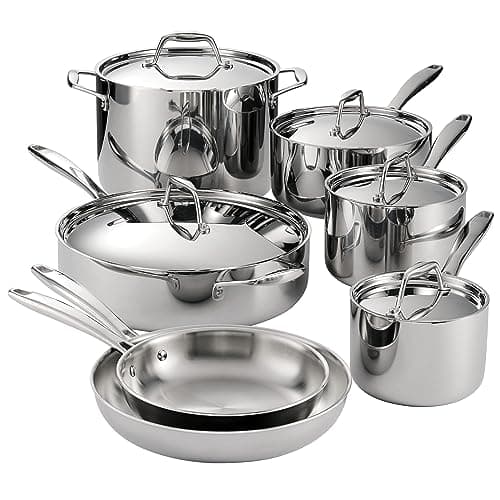
Published specifications for the Tramontina Signature Tri-Ply Clad 12-Piece Set
Construction
Tri-ply: 18/10 stainless, aluminum core, magnetic stainless exterior
Pieces
8 in and 10 in fry pans; 1.5, 2 and 3 qt covered saucepans; 5 qt covered deep saute; 8 qt covered stockpot
Oven maximum
500F on the 80116-249DS listing; other SKUs in the line are listed at 350F
Induction
Yes - magnetic stainless exterior
Dishwasher
Listed dishwasher safe
Handles
Precision cast, riveted
Certification
NSF-certified on the 80116-249DS line
Country of origin
Not asserted - retail listings disagree across SKUs (Brazil and China both appear)
Good
Fully clad, not disc-bottom: the aluminum runs up the sidewalls, so sauces do not scorch in a ring at the base
NSF certification on the flagship SKU is a real, checkable third-party mark rather than a marketing badge
Induction-ready without paying an induction premium
Not good
Retail listings disagree on the oven maximum across SKUs in the same line, which is a documentation problem, not a cooking one
Handles run hot on gas
The 12-piece count includes lids; the useful-item count is seven
The trade-off. Handles are the weak point. They are riveted and sturdy, but they get hot on a gas ring in a way the more expensive clad brands' do not.
Skip this if. You want a set you can leave in the oven above 500F, or you cook mostly eggs and pancakes and would rather spend the money on one good nonstick pan.
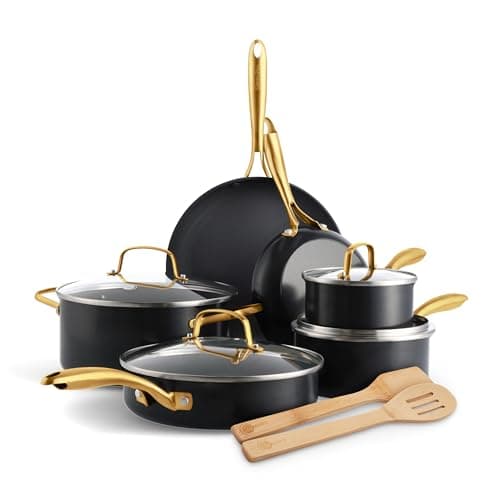
Published specifications for the GreenPan Ceramic Nonstick Cookware Set
Coating
Thermolon, from sand-derived Silicon Dioxide (SiO2), sprayed
Coating chemistry
PFAS-free, PFOA-free, free of lead and cadmium (GreenPan published)
Coating heat resistance
850F / 450C for the coating itself (GreenPan published)
Body oven maximum
Varies by line and is lower than the coating figure - check the specific line
Coating lifespan
Not published. No ceramic maker publishes one
Good
GreenPan publishes what the coating is made of in plain terms, which most ceramic brands do not
The coating will not release fumes if you overheat it the way PTFE can
Genuinely good release when new
Not good
Release degrades and nobody will tell you how fast
The 850F figure is for the coating, not the pan, and gets quoted as if it were the pan
Ceramic dislikes high heat and dishwashers, which is most of what a set gets used for
The trade-off. Ceramic nonstick loses release with use and no maker publishes a lifespan, GreenPan included. Treat it as a consumable, not a lifetime purchase.
Skip this if. You are buying a set expecting it to last as long as clad stainless. It will not, and the honest move is to buy one ceramic pan alongside a stainless set.
Rarely as a set. The anodized body is genuinely better than stamped aluminum, but every piece carries a coating with a lifespan no maker publishes, so a box has a shared expiry date. Buy individual hard-anodized skillets alongside a clad stainless set instead.
›What is the best hard-anodized cookware brand?
Calphalon publishes the highest ceiling in our ledger at 450F and a metal-utensil-safe claim almost nobody else makes. OXO publishes 430F, a three-layer PFOA-free coating and the best handle in the category.
›Is hard-anodized cookware induction compatible?
Standard lines are not, because anodized aluminum is not ferromagnetic. Calphalon and OXO both publish this. Some brands sell separate induction ranges with a magnetic base layer - check the specific line and test with a magnet.
›How long does hard-anodized nonstick last?
No manufacturer publishes a figure - not Calphalon, OXO or T-fal. The anodized body itself does not wear out; the coating on top does, on a schedule the industry declines to state.
›Does hard-anodized mean nonstick?
No. Hard-anodizing is a treatment of the aluminum body. Almost every domestic hard-anodized pan has a separate nonstick coating applied on top, and that coating is the surface you actually cook on.
Sources
Every figure on this page came from one of these. Follow them and check our arithmetic — that is the point.