Heads up: some links on this page earn us a commission at no extra cost to you. It does not change what we recommend or the order. How we are funded.
The short answer
For one or two people, buy three or four pieces open stock rather than a small set: a 10-inch skillet, a 2 qt saucepan and a 4 to 6 qt pot cover almost everything. Small sets exist, but the piece count is padded with lids, and a seven-piece box is usually four pans. If you do want one box, a full clad set is often barely more expensive than a small one and the extra pieces store flat - the constraint in a small kitchen is lids and cupboard depth, not pan count.
Quick picks
The whole answer, on one screen. Tap a row to jump to the full write-up. Every pick below carries a stated trade-off further down — including the one at the top.
#
Product
Best for
Price
1
Tramontina Tri-Ply Clad Covered Saucepan, 2 qt
The 2 qt clad saucepan is the piece a small household uses most, and buying it alone costs a fraction of any set.
Prices last checked October 22, 2026. Prices move constantly — the number on Amazon when you click is the real one.
How we chose these
We have not cooked in any of them. This page compares published piece lists, construction, oven ceilings, induction compatibility and dishwasher guidance, and it counts useful items rather than pieces. The method is here.
The counting matters more in this category than anywhere else, because a small set is where padding does the most damage. Removing four pans from a twelve-piece set and calling it an eight-piece set leaves you with three pans and five lids.
What a small set actually contains
Advertised
Typical contents
Useful items
5 piece
2 pans, 2 lids, 1 utensil
2
7 piece
3 pans, 3 lids, 1 steamer or utensil
3 to 4
8 piece
4 pans, 4 lids
4
10 piece
5 pans, 4 lids, 1 insert
5
12 piece (full set)
7 pans, 5 lids
7
Lids are counted as pieces throughout the industry. It is not deception so much as convention, and it is why the number on the box is roughly double the number of pans.
The consequence is a pricing oddity worth checking before you buy: a seven-piece set and a twelve-piece set from the same line are often much closer in price than the piece counts suggest, because the difference is three pans and two lids rather than five pieces. The full argument on counting is in what piece count you need.
What one or two people actually need
Four items, and none of them have to arrive in the same box.
A 10-inch skillet. The pan that does most of the cooking. Eight inches is enough for one person; ten is more flexible.
A 2 qt saucepan. Rice, sauces, reheating, a single portion of pasta. This is the piece small-set buyers underestimate.
A 4 to 6 qt pot. Pasta for two, soup, and enough capacity that you can cook a batch when you want to.
One coated skillet for eggs, bought cheap and replaced when it stops releasing.
The 8 qt stockpot that comes in every full set is the piece a one-person household genuinely does not need. It is also the piece that takes the most cupboard space, which is why a small kitchen is often better served by open stock than by a box.
The real small-kitchen constraint is lids
People buy small sets to save space and then discover the space problem was never the pans. Pans nest. Lids do not, and a lid sitting on its pan is what stops a set nesting at all.
Store lids on edge in a rack or a divider and a twelve-piece set collapses into one stack of pans plus a lid file. That single change usually makes a full set fit a cupboard that a small set was bought to fit. The detail is in how to store pots and pans and cookware for small kitchens.
Clad stainless nests freely because there is no coating to protect. It is the one material where a bigger set costs almost no extra storage.
Material, for a small kitchen
Fully clad stainless remains the right backbone even at small scale, and the reason is the same as at large scale: no coating to wear out, no seasoning to maintain, and the aluminum runs up the sidewalls so a small saucepan does not scorch a sauce in a ring. The construction difference is in disc bottom versus fully clad.
Small coated sets are tempting because they are cheap and light. The catch is the one that applies to all coated cookware: no manufacturer publishes a coating lifespan, so you are buying a set with an unknown replacement interval - how long nonstick lasts covers that silence, and best nonstick cookware sets argues the case for buying them as a consumable.
What to avoid in small sets
Utensils counted as pieces. A nylon spoon is not cookware.
Two saucepans and no skillet, which several small sets do because saucepans are cheaper to make.
A 1 qt saucepan as the only small pot. It is a milk pan; it will not cook rice for two.
Disc-bottom construction dressed up as tri-ply base.
Small sets from a line with no open stock, so you cannot add a piece later.
Each write-up below gives the published specs, what the pan is genuinely good at, what it costs you, and who should skip it. The trade-off line is there on the top pick too — a recommendation with no downside is an advertisement.
Top pick · Best small setSpecs read September 3, 2026
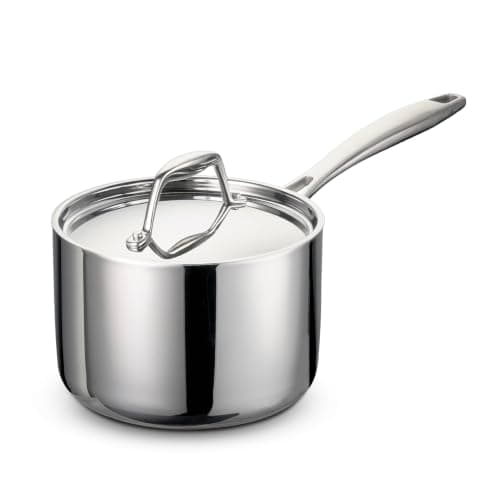
Tramontina Tri-Ply Clad Covered Saucepan, 2 qt
The 2 qt clad saucepan is the piece a small household uses most, and buying it alone costs a fraction of any set.
Best for: Sauces, grains and reheating, in the size a kitchen actually uses daily
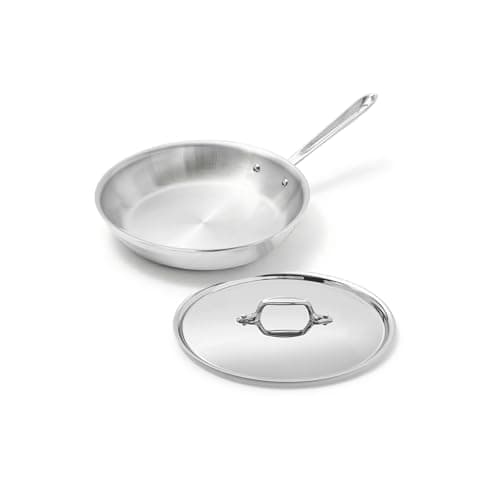
Published specifications for the All-Clad D3 Stainless 10 in Fry Pan
Construction
Fully bonded tri-ply, aluminum core
Oven maximum
600F, oven and broiler safe
Induction
Yes - compatible with any stovetop
Dishwasher
Handwash only (All-Clad published)
Handle
Double-riveted stainless
Weight
3.0 lb (model 4110)
Warranty
Limited lifetime
Made in
Bonded, engineered and assembled in Canonsburg, PA
Good
600F is the highest oven ceiling of any stainless pan on this site
The one pan here whose manufacturing location is published down to the town
Genuinely repairable-adjacent: rivets are the only failure point and the warranty covers them
Not good
Hand wash only
The flared rim makes it a poor pan for anything with liquid
Costs several times what a Tramontina or Cuisinart pan of the same construction costs
The trade-off. Hand wash only. All-Clad publishes that plainly, and it is a real daily cost on a pan you will use every day.
Skip this if. You want a dishwasher-safe pan, or you are buying a whole kitchen on a fixed budget - one D3 skillet costs what a full clad set can cost.
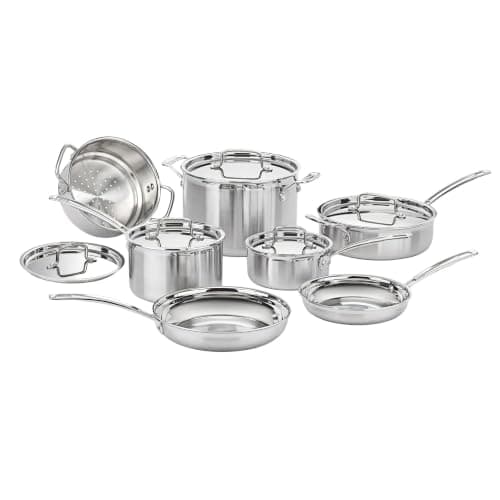
Published specifications for the Cuisinart MultiClad Pro MCP-12N 12-Piece Set
Construction
Tri-ply: 18/10 stainless interior, pure aluminum core, brushed stainless exterior
Pieces
1.5 and 3 qt covered saucepans; 8 in and 10 in skillets; 3.5 qt covered saute; 8 qt covered stockpot; steamer insert
Oven maximum
500F per the Cuisinart use-and-care manual, which the Amazon listing we cite now matches. Major retail listings still advertise 550F; Cuisinart has confirmed the manual figure
Induction
Yes
Dishwasher
Dishwasher safe
Handles
Riveted solid stainless, cool-grip profile
Warranty
Lifetime
Good
Heat runs up the sidewalls, not just across the base
Genuinely dishwasher safe, which the pricier clad brands often are not
Lifetime warranty on a set at this price
Not good
Published oven maximum contradicts the retail listing for the same product
Handle spine is divisive
No 12-inch skillet in the box, which is the pan most people reach for second
The trade-off. The cool-grip handles have a sharp spine that some people find uncomfortable on a full 8-quart stockpot.
Skip this if. You want the higher oven ceiling that major retail listings advertise. The manual says 500F and Cuisinart has confirmed the manual is correct.
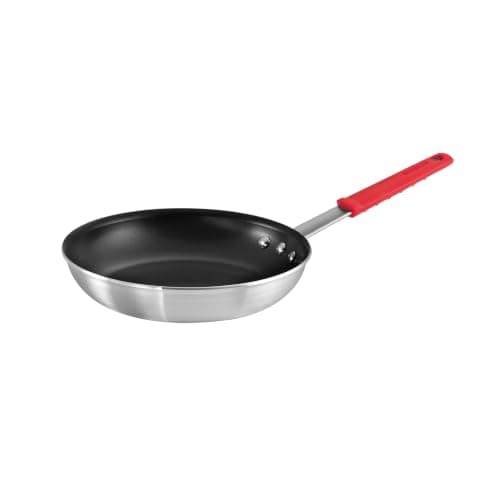
Published specifications for the Tramontina Professional Restaurant Fry Pan, 10 in
Body
Heavy-gauge aluminum
Coating
PTFE nonstick
Induction
No - aluminum body is not ferrous
Coating lifespan
Not published, by this or any nonstick maker
Good
Cheap enough that replacing it every couple of years is a real plan rather than a failure
Heavy gauge for a nonstick pan, so it does not warp on the first hot burner
Silicone handle sleeve that actually stays cool
Not good
Not induction compatible
PTFE, which some buyers will rule out on principle
No published coating lifespan, so the value case is unverifiable by design
The trade-off. It is PTFE. That is fine at normal cooking temperatures, and it is not a pan to preheat empty on high.
Skip this if. You want to avoid PTFE entirely. Buy ceramic instead and accept the shorter release life rather than pretending either one lasts forever.
For one or two people, three open-stock pieces usually beat any small set: a 10-inch skillet, a 2 qt saucepan and a 4 to 6 qt pot. Small sets pad their piece counts with lids, and a full clad set often costs little more.
›How many pieces does a small cookware set have?
Advertised counts of five to eight typically mean two to four actual pans, because lids count as pieces throughout the industry. Count useful items rather than pieces when comparing.
›Is a small cookware set better for a small kitchen?
Often not. Pans nest; lids do not, and a lid left on its pan is what stops a set nesting. Storing lids separately on edge usually makes a full set fit a cupboard that a small set was bought for.
›What size saucepan does one person need?
Two quarts. A 1 qt pan is a milk pan and will not cook rice or a portion of pasta comfortably. The 2 qt saucepan is the piece small-household buyers most often under-buy.
›Should a small set be nonstick or stainless?
Clad stainless as the backbone, plus one cheap coated skillet for eggs. A coated set has an unknown replacement interval, because no manufacturer publishes a coating lifespan - so it is better bought one pan at a time.
Sources
Every figure on this page came from one of these. Follow them and check our arithmetic — that is the point.