Heads up: some links on this page earn us a commission at no extra cost to you. It does not change what we recommend or the order. How we are funded.
The short answer
Check the warranty first. Loose handles and delaminating bases are exactly what cookware warranties cover, and several of these sets carry lifetime terms.
Buy the piece open stock, from the same line if it still exists. Every brand here sells individual pieces.
If the line is discontinued, mix brands. Matching finishes is cosmetic; nothing about cooking requires it.
Do not replace the set unless three or more pieces have failed the same way, which usually means the set was the problem.
Before you buy anything
Four checks, in order. Most of the time one of them ends the exercise.
Is the piece actually finished? Discoloration, rainbow staining and burnt-on residue are cosmetic and reversible. When to replace your cookware separates the structural faults from the cosmetic ones.
Is it a warranty claim? A loose handle, weeping rivets or a delaminating base are exactly what these terms cover, and Tramontina, Cuisinart and Lodge all carry lifetime warranties on the relevant lines. What is covered and what is excluded is in cookware warranties explained.
Do you actually use it? A large share of failed set pieces are failed because they were the wrong size, not because they wore out. Replacing a 10-inch skillet with a 12-inch one is often the better move.
Is this the third piece to go? If so, the set is the problem rather than the piece, and the replacement should probably not be the same kind of set.
Open stock is the answer
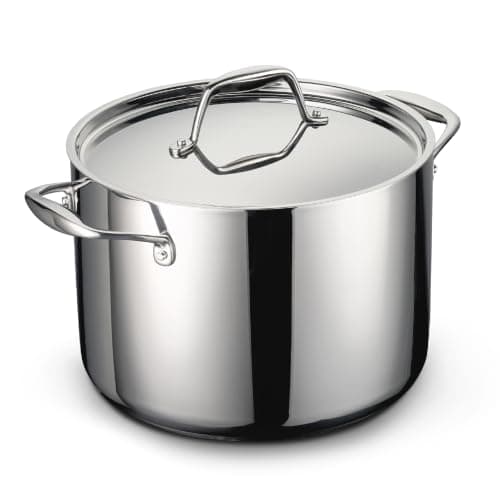
Every clad line worth owning sells its pieces individually - saucepans, skillets, stockpots, lids. Buying one piece costs a fraction of a set and gets you exactly the item you need, which is most of the argument in set versus open stock.
Search by the specific piece and size rather than by the set name. A "3 quart clad stainless saucepan with lid" is a much more productive search than the model number of a set that may have been renamed twice.
Lids are sold separately too, and a lost or broken lid does not require a new pan. Lid diameters are standard enough that a lid from one brand often fits another pan of the same rim size - measure the rim rather than trusting the quart rating.
When the line is discontinued
Cookware lines get renamed, restyled and retired constantly, and a set bought eight years ago may have no current equivalent. Three options, in order of how well they work:
Find the current equivalent from the same brand. The construction is usually unchanged even when the name and the handle styling are not.
Buy the piece secondhand. Clad stainless has no wear surface, so a used piece is genuinely as good as a new one. Check only for a flat base and sound rivets.
Buy a different brand. Which is the point below.
Mixing brands is fine
This is the anxiety that keeps people buying whole sets, and it is unfounded. A Tramontina saucepan next to a Cuisinart skillet cooks exactly as well as either brand next to itself. Nothing about cooking requires a matching finish, and both are fully clad tri-ply with an 18/10 interior - the same construction, as cookware set brands compared shows in a single table.
The three things that genuinely differ across brands are worth checking before you mix:
Check
Why it matters
Example
Oven ceiling
Your new piece may be rated lower than the rest of the set
T-fal 400F against All-Clad 600F
Dishwasher guidance
One piece that must be hand washed changes the household rule
All-Clad publishes handwash only
Induction compatibility
A replacement coated pan may not work on your hob
Calphalon and OXO standard lines are not compatible
Handle style
Purely cosmetic, and the only one people worry about
Nothing cooks differently
Three of these four are real. The fourth is the one that stops people mixing, and it does not matter.
Replacing is the moment to upgrade
The piece that failed is usually the piece you use most, which makes it the one worth spending on. If a set's skillet has gone and everything else is fine, replacing it with a better skillet rather than an identical one is the cheapest upgrade available - you are buying the piece that does most of the work, once.
The same logic runs the other way for coated pans. If it is the nonstick skillet that died, replace it cheaply, because it will die again on an interval nobody publishes - how long nonstick lasts covers that, and best nonstick pans for eggs covers what to buy.
Filling the gaps sets leave
Two pieces are missing from almost every set on this site, and replacement time is the natural moment to add them:
A 12-inch skillet. Both clad sets we recommend stop at 10 inches.
A Dutch oven. No stainless set includes one, and it does jobs a stockpot cannot - what size Dutch oven.
Open-stock pieces, bought one at a time
Nothing here needs to match anything else in your cupboard. Check the oven ceiling and the dishwasher guidance; ignore the handle styling.
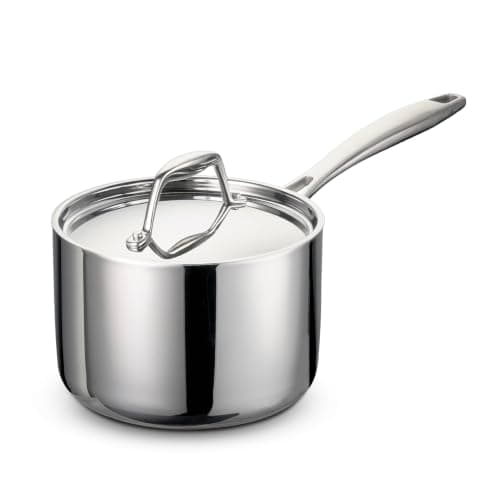
Tramontina Tri-Ply Clad Covered Saucepan, 2 qt
Sauces, grains and reheating, in the size a kitchen actually uses daily
These are the products this page's reasoning actually points at. Same rules as everywhere else on the site: published specs, a stated trade-off, and a live price only where one exists.
Top pick · The most-replaced pieceSpecs read September 3, 2026
Tramontina Tri-Ply Clad Covered Saucepan, 2 qt
The small saucepan gets used daily and is the first piece most households want a second of, let alone a replacement for.
Best for: Sauces, grains and reheating, in the size a kitchen actually uses daily
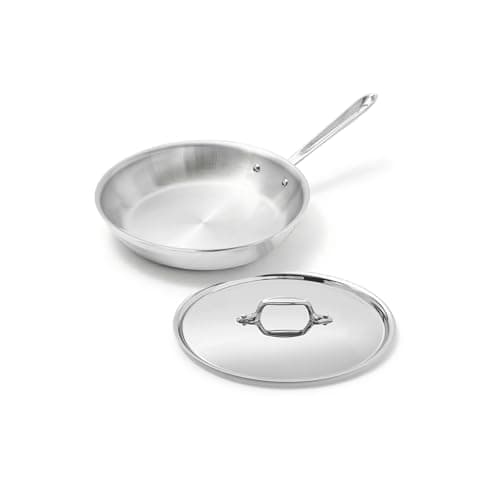
Published specifications for the All-Clad D3 Stainless 10 in Fry Pan
Construction
Fully bonded tri-ply, aluminum core
Oven maximum
600F, oven and broiler safe
Induction
Yes - compatible with any stovetop
Dishwasher
Handwash only (All-Clad published)
Handle
Double-riveted stainless
Weight
3.0 lb (model 4110)
Warranty
Limited lifetime
Made in
Bonded, engineered and assembled in Canonsburg, PA
Good
600F is the highest oven ceiling of any stainless pan on this site
The one pan here whose manufacturing location is published down to the town
Genuinely repairable-adjacent: rivets are the only failure point and the warranty covers them
Not good
Hand wash only
The flared rim makes it a poor pan for anything with liquid
Costs several times what a Tramontina or Cuisinart pan of the same construction costs
The trade-off. Hand wash only. All-Clad publishes that plainly, and it is a real daily cost on a pan you will use every day.
Skip this if. You want a dishwasher-safe pan, or you are buying a whole kitchen on a fixed budget - one D3 skillet costs what a full clad set can cost.
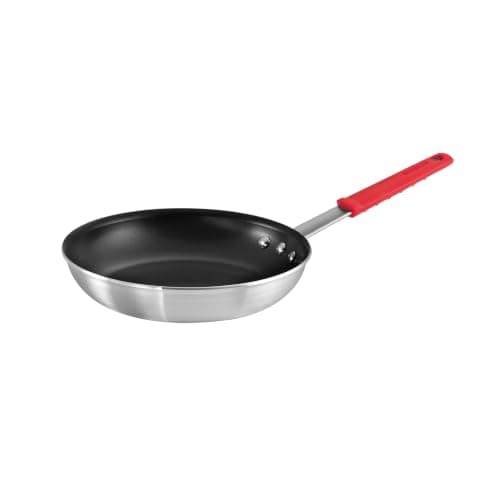
Published specifications for the Tramontina Professional Restaurant Fry Pan, 10 in
Body
Heavy-gauge aluminum
Coating
PTFE nonstick
Induction
No - aluminum body is not ferrous
Coating lifespan
Not published, by this or any nonstick maker
Good
Cheap enough that replacing it every couple of years is a real plan rather than a failure
Heavy gauge for a nonstick pan, so it does not warp on the first hot burner
Silicone handle sleeve that actually stays cool
Not good
Not induction compatible
PTFE, which some buyers will rule out on principle
No published coating lifespan, so the value case is unverifiable by design
The trade-off. It is PTFE. That is fine at normal cooking temperatures, and it is not a pan to preheat empty on high.
Skip this if. You want to avoid PTFE entirely. Buy ceramic instead and accept the shorter release life rather than pretending either one lasts forever.
›Can you buy a single replacement pan for a cookware set?
Yes. Every clad line worth owning sells open stock - saucepans, skillets, stockpots and lids individually. Search by the piece and size rather than by the set name, which may have been renamed since you bought it.
›Does replacement cookware have to match the rest of the set?
No. Matching finishes is cosmetic and nothing about cooking requires it. What is worth checking when mixing brands is the oven ceiling, the dishwasher guidance and induction compatibility - not the handle styling.
›What if my cookware line has been discontinued?
Look for the current equivalent from the same brand, since construction usually survives a rename. Otherwise buy the piece secondhand - clad stainless has no wear surface, so a used piece is genuinely as good - or buy a different brand.
›Should you replace a whole cookware set when one pan fails?
Almost never. Sets fail one piece at a time, and open stock exists for exactly this. Replace the whole set only if three or more pieces have failed the same way, which usually means the set was the wrong purchase.
›Can you buy a replacement lid on its own?
Yes, and lid diameters are standard enough that a lid from one brand often fits another pan of the same rim size. Measure the rim rather than trusting the quart rating, which varies between makers.
Sources
Every figure on this page came from one of these. Follow them and check our arithmetic — that is the point.