Heads up: some links on this page earn us a commission at no extra cost to you. It does not change what we recommend or the order. How we are funded.
The short answer
Buy clad stainless for the pieces that must survive, and cheap coated pans for the ones guests will ruin, then plan to replace the coated pans on a schedule. Everything should be induction compatible so the cookware outlives a stove replacement, dishwasher tolerant because it will go in the machine regardless of what you ask, and available as open stock so a single lost piece does not orphan a set. Skip cast iron entirely.
Why the usual advice does not apply
Every other buying guide on this site assumes you are the cook. You will preheat properly, you will not put the coated pan in the dishwasher, you will notice when a handle loosens. None of that is true in a rental.
The person using these pans has no stake in their survival, may never have used the stove type you have, and will not read a note asking them to hand wash. Design for that and the criteria reorder completely:
Normal priority
Rental priority
Cooking performance
Survivability under misuse
Buy once, keep forever
Replace cheaply on a schedule
Matched set looks good
Open stock, so one loss is not a crisis
Suits my stove
Suits any stove, including the next one
Hand wash for longevity
Dishwasher safe, because it is going in
The right piece for each job
Fewest pieces that cover the most jobs
Nonstick for eggs
Nonstick as a consumable
Buy induction compatible, always
This is the single most valuable rule on the page, and it costs nothing. Induction compatibility means a magnetic base, and a magnetic base works on gas, electric coil, glass radiant and induction alike. Buying anything else ties your cookware to the stove currently in the property.
Stoves get replaced, properties get bought and sold, and induction is where new installations are heading. A set that is not induction compatible becomes landfill the day the range is swapped - cookware for induction. The check is a refrigerator magnet against the base: if it grabs firmly, it works everywhere.
This also covers the guest who brings a portable induction hob, and the increasingly common case of a short-let with an induction cooktop the owner never uses themselves.
What to buy, by material
Clad stainless: the backbone
Nothing to wear out, nothing to scratch through, tolerant of metal utensils, dishwasher survivable, works on every stove, and it looks presentable for years. It is the only material that answers all the rental constraints at once. Buy the saucepans, the stockpot and at least one skillet in clad stainless - best stainless steel cookware sets.
Coated nonstick: a consumable, budgeted as one
Guests want a pan that releases eggs, and they will destroy it - metal utensils, high heat, dishwasher, stacked wet. Accept this. Buy inexpensive coated skillets, replace them annually or when they stop releasing, and never buy an expensive one. An expensive coated pan in a rental is money set on fire - how long nonstick lasts.
Cast iron: do not
It is the wrong choice for a property you do not live in, for four separate reasons. It rusts within days if left wet, which is exactly what happens. It scratches glass cooktops. It is heavy enough to be a genuine hazard for a guest who is not expecting it. And it needs maintenance nobody will do - is cast iron worth it makes the general case, and none of it survives contact with a short-let.
Enameled cast iron: only for a premium listing
Genuinely lovely and genuinely fragile - enamel chips, and a dropped lid is an expensive morning. Reasonable in a high-end property where it is part of the appeal, wrong in a workhorse rental - enameled cast iron care.
The list
Guests cook simply. The usual failure is over-provisioning a rental kitchen with pieces nobody uses while missing something basic.
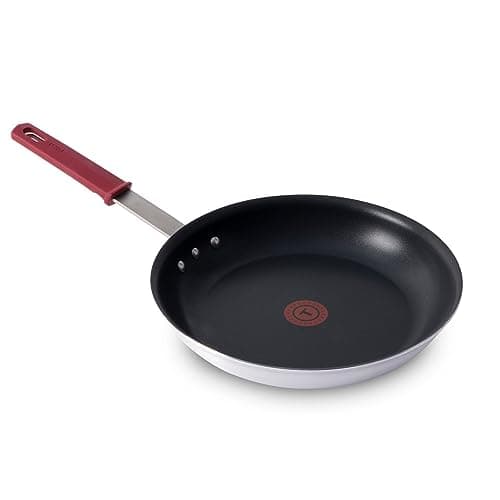
A 10 inch coated skillet. The most-used pan, and the consumable.
A 10 or 12 inch clad stainless skillet. The one that survives.
A 2 qt and a 3 qt saucepan with lids. Clad, and the workhorses.
An 8 qt stockpot. Pasta, and the single most requested missing item in review complaints.
Two half sheet pans. Cheap, indestructible, endlessly useful.
A 9 by 13 baking dish. Glass, dishwasher safe, no caveats.
A colander, a couple of mixing bowls, and a cutting board.
That is roughly what a well-equipped small kitchen needs - what you actually need - with the piece count kept deliberately low so there is less to lose, less to store and less to replace.
Set or open stock?
Buy a set for the initial outfit, because the cost per piece is lower and matched cookware photographs better for a listing. Then buy replacements as open stock.
What matters is choosing a line that is available as open stock. The failure mode in a rental is losing or destroying one piece from a discontinued set and being left with an orphaned, mismatched kitchen - replacing a piece of your cookware set and set versus open stock.
Count what is actually in the set before buying. A twelve-piece set is frequently seven pans and five lids, which is a different kitchen from the one the number implies - cookware set buying mistakes.
For a rental, the specification that matters most is whether individual pieces can still be bought in three years.
Guest-proofing
Provide the right utensils. If you supply coated pans and a metal spatula, you have chosen the outcome. Silicone and wood only - utensils for every cookware surface.
Provide pan protectors or store pans unstacked. Stacking is the fastest way to kill a coating - how to store pots and pans.
Do not rely on a laminated care card. Nobody reads it. Buy things that do not need one.
Skip anything with a wooden handle, which will go in the dishwasher and split.
Choose glass lids with metal rims over all-glass, and expect to replace one eventually.
Label nothing. A kitchen covered in instructions reads as distrust in a review.
Running it as a replacement cycle
The useful mental shift is from buying cookware to budgeting for it. Split the kitchen into two categories and treat them differently.
Category
Examples
Expected life
Approach
Permanent
Clad skillets, saucepans, stockpot
Ten years plus
Buy well once
Consumable
Coated skillets
One to two years
Buy cheap, replace on schedule
Semi-consumable
Sheet pans, glass dishes, lids
Three to five years
Cheap, keep a spare
Do not stock
Cast iron, enameled iron, wooden handles
n/a
Wrong tool for the setting
Inspect between guests as a matter of routine: a loose handle rivet is a safety issue and a scratched coated pan is a complaint waiting to happen - when to replace your cookware.
Several properties
Standardize on one line across every unit. It means one replacement order, interchangeable lids, spares that fit anywhere, and no thinking about which kitchen needs what. The saving in attention is larger than the saving on the pans.
Keep one spare coated skillet and one spare lid in storage. The point is not the cost - it is that a pan failing on a Friday changeover becomes a five-minute problem instead of a two-day one.
Clad sets on Amazon — check the magnet test and the open-stock availability before buying in quantity.
What to buy, if you are buying
These are the products this page's reasoning actually points at. Same rules as everywhere else on the site: published specs, a stated trade-off, and a live price only where one exists.
Top pick · Best rental cookware setSpecs read September 3, 2026
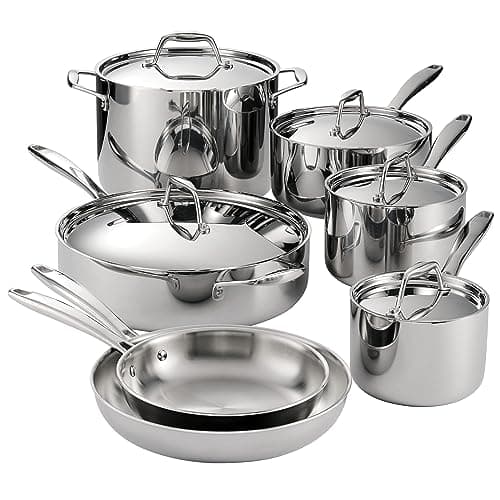
Tramontina Signature Tri-Ply Clad 12-Piece Set
Fully clad stainless with nothing to wear out, at a price that survives the arithmetic of outfitting several properties.
Best for: A first kitchen that should not need replacing
Published specifications for the Tramontina Signature Tri-Ply Clad 12-Piece Set
Construction
Tri-ply: 18/10 stainless, aluminum core, magnetic stainless exterior
Pieces
8 in and 10 in fry pans; 1.5, 2 and 3 qt covered saucepans; 5 qt covered deep saute; 8 qt covered stockpot
Oven maximum
500F on the 80116-249DS listing; other SKUs in the line are listed at 350F
Induction
Yes - magnetic stainless exterior
Dishwasher
Listed dishwasher safe
Handles
Precision cast, riveted
Certification
NSF-certified on the 80116-249DS line
Country of origin
Not asserted - retail listings disagree across SKUs (Brazil and China both appear)
Good
Fully clad, not disc-bottom: the aluminum runs up the sidewalls, so sauces do not scorch in a ring at the base
NSF certification on the flagship SKU is a real, checkable third-party mark rather than a marketing badge
Induction-ready without paying an induction premium
Not good
Retail listings disagree on the oven maximum across SKUs in the same line, which is a documentation problem, not a cooking one
Handles run hot on gas
The 12-piece count includes lids; the useful-item count is seven
The trade-off. Handles are the weak point. They are riveted and sturdy, but they get hot on a gas ring in a way the more expensive clad brands' do not.
Skip this if. You want a set you can leave in the oven above 500F, or you cook mostly eggs and pancakes and would rather spend the money on one good nonstick pan.
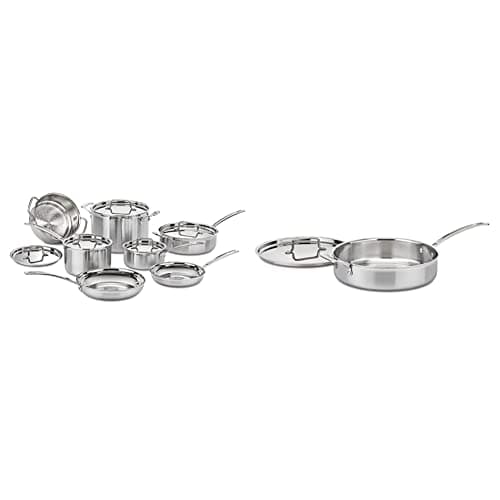
Published specifications for the Cuisinart MultiClad Pro MCP-12N 12-Piece Set
Construction
Tri-ply: 18/10 stainless interior, pure aluminum core, brushed stainless exterior
Pieces
1.5 and 3 qt covered saucepans; 8 in and 10 in skillets; 3.5 qt covered saute; 8 qt covered stockpot; steamer insert
Oven maximum
500F per the Cuisinart use-and-care manual. Amazon listings say 550F; Cuisinart has confirmed the manual figure
Induction
Yes
Dishwasher
Dishwasher safe
Handles
Riveted solid stainless, cool-grip profile
Warranty
Lifetime
Good
Heat runs up the sidewalls, not just across the base
Genuinely dishwasher safe, which the pricier clad brands often are not
Lifetime warranty on a set at this price
Not good
Published oven maximum contradicts the retail listing for the same product
Handle spine is divisive
No 12-inch skillet in the box, which is the pan most people reach for second
The trade-off. The cool-grip handles have a sharp spine that some people find uncomfortable on a full 8-quart stockpot.
Skip this if. You want the higher oven ceiling that the Amazon listing advertises. The manual says 500F and Cuisinart has confirmed the manual is correct.
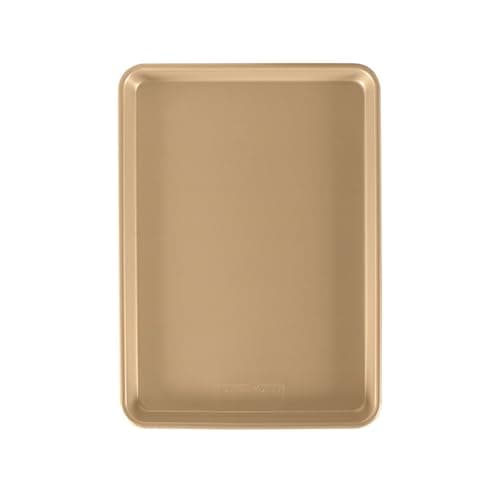
Published specifications for the Nordic Ware Naturals Half Sheet, 18 x 13 in
Exterior dimensions
17.9 x 12.9 x 1 in
Material
Aluminum
Rim
Encapsulated steel rim
Gauge
Not published by Nordic Ware
Warranty
Lifetime
Dishwasher
Hand wash recommended. Automatic dishwasher use is not advised
Made in
America of domestic and imported materials
Good
Aluminum conducts at 237 W/m-K, which is why it browns evenly and a steel pan does not
The encapsulated steel rim is the reason it does not warp in a hot oven
Lifetime warranty on a pan this cheap
Not good
Nordic Ware does not publish a gauge figure, so thickness cannot be compared like for like
Bare aluminum stains and reacts with acid
Not dishwasher safe by the maker's own advice
The trade-off. Bare aluminum discolors and reacts with acid. It will look used within a month and Nordic Ware advises against the dishwasher.
Skip this if. You want a pan that stays looking new, or you will not hand wash. Buy an aluminized-steel coated pan instead and accept the coating as a wear item.
Clad stainless for the saucepans, stockpot and one skillet, plus a cheap coated skillet treated as a consumable and replaced annually. Add two sheet pans and a glass baking dish. Keep the piece count low, make everything induction compatible, and skip cast iron entirely.
›Should you put cast iron in an Airbnb?
No. It rusts within days if left wet, which is what will happen, it scratches glass cooktops, it is heavy enough to be a hazard for someone not expecting it, and it needs maintenance no guest will do. Clad stainless answers the same durability need without any of that.
›Why does rental cookware need to be induction compatible?
Because a magnetic base works on every stove type, including the one that replaces the current range. Cookware that is not induction compatible is tied to the appliance currently installed, and new installations increasingly use induction.
›How often should you replace cookware in a rental?
Treat coated skillets as consumables on a one to two year cycle, or whenever they stop releasing. Clad stainless pieces should last a decade or more. Sheet pans, lids and glass dishes sit in between - keep a spare rather than replacing on a schedule.
›Is a cookware set or open stock better for a rental?
Buy a set for the initial outfit, because the cost per piece is lower and matched cookware presents better. Choose a line that is also sold as open stock, so losing or destroying one piece does not leave you with an orphaned, mismatched kitchen.
Sources
Every figure on this page came from one of these. Follow them and check our arithmetic — that is the point.