Heads up: some links on this page earn us a commission at no extra cost to you. It does not change what we recommend or the order. How we are funded.
The short answer
Buy the enameled cast iron Dutch oven. It is the one expensive cookware gift that works in essentially any kitchen: it needs no seasoning, fits every hob including induction, and the recipient has nothing to learn before using it. The Le Creuset Signature 5.5-quart is the version that sits squarely in this band and has a real secondhand market; the Lodge enameled 6-quart does the same job for a fraction and often lands below this band, which is the honest thing to say about it. Above those, only three other pieces hold up: a fully clad stainless skillet for someone who already cooks, a knife block set for someone with no knives at all, and a hardwood board, which is the piece almost nobody buys themselves. The three expensive gifts that fail hardest are a multi-piece cookware set, a bare cast iron collection, and anything whose oven ceiling or hob compatibility the recipient has to work around.
What changes above a hundred dollars
In the inexpensive band, a cookware gift is nearly riskless. A sheet pan or a cast iron skillet costs little, works anywhere, and if it is wrong, nobody has lost much - cookware gifts under fifty dollars makes that argument in full.
Above this line, three things change at once, and all three work against you.
The piece starts making decisions. A large pot commits shelf space. A set commits a whole drawer and a brand. An expensive skillet commits a material and the technique that material demands. None of those are yours to decide for someone else's kitchen.
Compatibility stops being academic. A cheap pan that does not suit the recipient's hob is a shrug. A large one is an expensive object they cannot use and will not say so about.
Returning it becomes awkward. People quietly re-gift a ten-dollar whisk. Almost nobody returns a visibly expensive pot, which means a wrong one simply lives in a cupboard.
So the filter for this band is not “what is good at this price”. It is what is good at this price AND asks the recipient to accept nothing. That question eliminates most of the category.
A note on the number in the title, because this site publishes no price of its own and keeps no price history. Every figure here comes from a live feed behind a 48-hour freshness gate, and the button is the authority rather than the heading - some of what follows will sit above the line and some below it on any given day. One button on this page carries no number at all: Amazon suppresses the displayed price on the Lodge enameled Dutch oven, so it reads Check price on Amazon. That is the honest state of that listing, not a gap in this page.
The stove question, which you still have to answer
This does not go away because the budget went up; it gets worse, because the money is larger. The full compatibility table - which materials work on gas, coil, smooth top and induction, and which quietly do not - is on cookware gifts, and we are not going to restate it here.
The short version for this band specifically: enameled cast iron and fully clad stainless work on everything, which is most of why they dominate the list below. If you do not know what the recipient cooks on, those two materials are how you buy anyway.
One exception worth naming because it is expensive to get wrong: a large bare cast iron piece on a glass or ceramic smooth top. It works, but it has to be lifted rather than slid, every time, forever - cast iron on glass top stoves covers why. That is a condition, and a gift should not carry one.
The pieces that survive the question
Gift
Who it suits
What it asks of them
Hob limits
Enameled Dutch oven
Almost anyone who cooks at all
Nothing. No seasoning, no technique, no routine
None - works on every hob including induction
Fully clad stainless skillet
Someone who already cooks and owns pans
Technique. Stainless sticks if the pan is not properly preheated
None
Knife block set
A kitchen with no real knives
Honest storage space on the counter
Not applicable
Hardwood cutting board
Anyone, and it is the piece nobody buys themselves
Hand washing and occasional oil
Not applicable
Carbon steel skillet
A cook who has asked for one
Seasoning, drying, oiling - a real routine
None, but it is a commitment
A multi-piece set
Almost nobody, as a gift
Accepting four decisions at once
Depends entirely on the set
Sorted by what the recipient has to accept. The last row is on the list because it is the most common expensive cookware gift and the one that fails most often.
Why the Dutch oven wins this band
It is the only expensive piece of cookware that is simultaneously impressive, useful and demand-free.
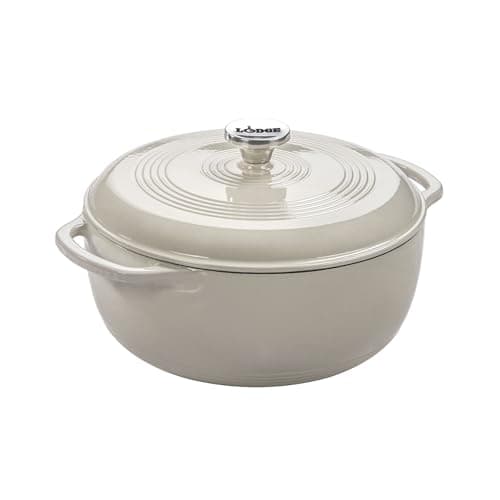
Enameled cast iron needs no seasoning and no special routine. It is ferrous under the enamel, so it works on induction as well as everything else. It does a job - long, slow, covered cooking - that nothing else in a normal kitchen does, so it is not competing with a pan they already own. And it is visible: a large colored pot reads as a real gift in a way a better frying pan does not, which matters when the point of the object is to be given.
The choice within the category is only about money and name. Lodge's enameled 6-quart and Le Creuset's Signature 5.5-quart cook the same way; what differs is enamel quality, the pale interior, the warranty and the resale value - best enameled Dutch ovens compares them properly, and what size Dutch oven settles the capacity question if the household is unusually large or small.
The one genuine disqualifier: weight. A 6-quart enameled pot full of stew is heavy enough to be a real problem for some hands and wrists, and that is not something anyone will tell you when they open it - cookware for arthritis and limited grip covers what to buy instead.
If they already cook
This is the harder case, because a competent cook already owns the obvious things. Two answers work.
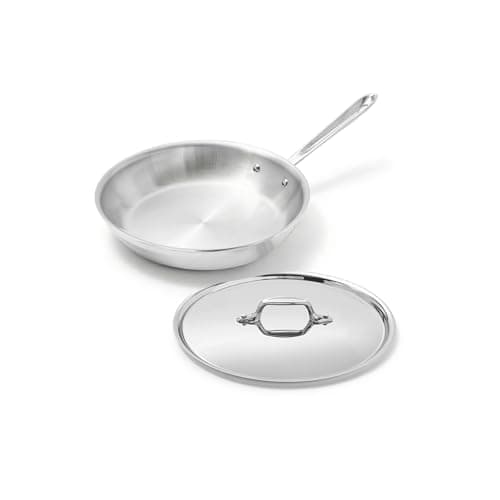
One excellent fully clad skillet. Someone who cooks on a mixed collection of inherited and bargain pans usually has no good stainless pan at all. The All-Clad D3 is published at 600F, oven and broiler safe, induction compatible, with a limited lifetime warranty and a named factory - best stainless steel skillets has the field. Buy the 10-inch unless you know they cook for four or more.
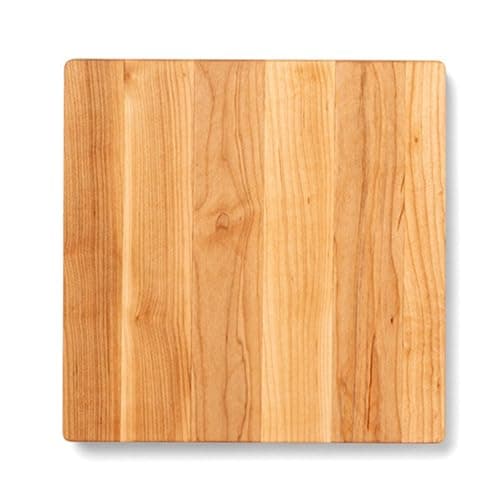
A real cutting board. This is the most reliably under-owned object in a serious kitchen. People who will spend on a pan will not spend on a board, and then they chop on a warped plastic sheet - best cutting boards.
What does not work for a competent cook is a duplicate of something they chose themselves. If they have a nonstick pan they like, a better nonstick pan is not a gift, it is a comment.
The three expensive gifts that fail
The general version of this is on what not to gift a cook. These three are specific to the large-budget band and are worth naming on their own.
A multi-piece cookware set. A set makes four decisions for the recipient at once - storage, hob compatibility, finish and which brand they will buy replacements from. Someone buying a set for themselves accepts those knowingly; someone receiving one has them imposed - is a cookware set a good gift works through the four cases where it does land.
Bare cast iron in quantity. One skillet is a lovely gift. A collection is a maintenance obligation handed over in a box - cast iron as a gift is explicit about who will resent it.
Anything with a low oven ceiling at a high price. This is the one people never check. A set can be expensive and still be published at 350F, which rules out finishing a steak or browning a top under the broiler - oven safe cookware temperatures is the reference, and the number is on the listing if you look for it.
If you would rather not spend this much
Worth saying plainly, because this page exists to serve a budget rather than to defend one: the inexpensive band is genuinely better value in this category. The cheap pieces of cookware are bare cast iron, bare aluminum, tempered glass and simple stainless - materials with nothing applied to them and nothing to wear out. The expensive band buys refinement, documentation and warranty, not a different kind of cooking.
So if the number is flexible, two excellent inexpensive pieces beat one expensive one nearly every time - cookware gifts under fifty dollars is where that money goes furthest, and kitchen gifts that are not pans is the answer when you do not know the kitchen at all.
What we cannot tell you
Whether the person already owns it. That is the real risk at this price and no buying guide can solve it - the only reliable approaches are asking someone who has seen their kitchen, or choosing a piece that is useful in duplicate, which a board and a Dutch oven both are and a frying pan is not.
We also have not cooked with any of these. This site compiles what makers publish, links every source, and marks the gaps - how we work. And we cannot tell you what any of these will cost when you click: every button carries the live number and the stamp below says when it was last checked.
Every one of these works on any hob or is not hob-dependent at all, which is the filter this page is built on. Prices move constantly - the number on each button is the current one.
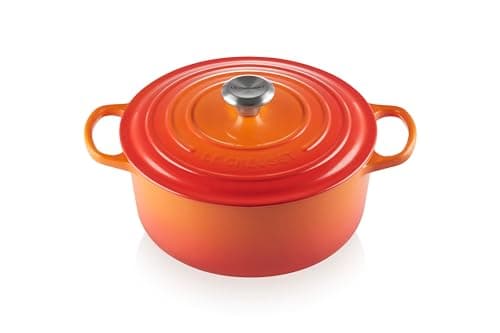
Le Creuset Signature Round Dutch Oven, 5.5 qt
A braising pot bought once, kept for decades and handed on
Prices last checked October 19, 2026. Prices move constantly — the number on Amazon when you click is the real one.
What to buy, if you are buying
These are the products this page's reasoning actually points at. Same rules as everywhere else on the site: published specs, a stated trade-off, and a live price only where one exists.
Top pick · Best large gift in this bandSpecs read September 3, 2026
Le Creuset Signature Round Dutch Oven, 5.5 qt
5.5 quarts, a pale interior you can read fond against, a 500F stainless knob and a limited lifetime warranty. Needs no seasoning, works on every hob, and has a real secondhand market, which changes what it is actually worth. Skip it if you would rather the money went into two pieces than one.
Best for: A braising pot bought once, kept for decades and handed on
Published specifications for the Le Creuset Signature Round Dutch Oven, 5.5 qt
Material
Cast iron with porcelain enamel inside and out
Capacity
5.5 qt
Interior enamel
Sand-colored, so browning and fond stay visible
Knob
Stainless steel, rated to 500F
Induction
Yes - the iron under the enamel is ferrous
Dishwasher
Dishwasher safe; Le Creuset recommends hand washing
Warranty
Limited lifetime
Made in
France
Good
The pale interior is a genuine cooking advantage: you can see whether the fond is browning or burning
Wide, low-profile handles that a hand in an oven mitt actually fits
The one enameled pot with a real secondhand market, which changes the true cost of ownership
Not good
Costs several times a Lodge enameled pot of the same capacity
The pale interior stains permanently, and Le Creuset says so
Chipped enamel is not repairable on any enameled pot, this one included
The trade-off. You are paying a large multiple of what a Lodge enameled pot costs for a difference in enamel quality, finish and resale value rather than in cooking.
Skip this if. You braise a few times a year. The cooking difference over a Lodge enameled pot is small; the price difference is not.
#2 · The same job, usually below this bandSpecs read September 3, 2026
Lodge Enameled Cast Iron Dutch Oven, 6 qt
Six quarts of enameled cast iron that cooks the same way for a fraction, with the fewest conditions attached of anything here. Amazon suppresses its price, so the button below reads Check price rather than a number. Skip it for anyone who cannot lift a heavy pot.
Best for: Braises, stews, tomato sauce, bread - anything long and wet
Published specifications for the Lodge Enameled Cast Iron Dutch Oven, 6 qt
Material
Cast iron with porcelain enamel, inside and out
Capacity
6 qt
Induction
Yes - the iron under the enamel is ferrous
Seasoning
None required - enamel is not a seasoning surface
Acid
Safe for tomato and wine, unlike bare iron
Oven maximum
Set by the knob material - check the specific SKU; Lodge publishes a lower ceiling than for bare iron
Good
Non-reactive, so it handles the acidic cooking bare iron cannot
No seasoning to maintain
Considerably cheaper than the French enameled pots it copies
Not good
Chipped enamel is not repairable, unlike bare iron's seasoning
Oven ceiling is lower than bare cast iron because of the knob
Heavy, and the enamel makes it heavier than bare iron of the same capacity
The trade-off. The enamel is a glass layer. Chip it and the pot is not restorable the way bare iron is, and Lodge's enamel chips more readily than the premium brands'.
Skip this if. You already own a large stainless stockpot and rarely braise. This duplicates it for most weeknight cooking.
#3 · Best for someone who already cooksSpecs read September 3, 2026
All-Clad D3 Stainless 10 in Fry Pan
Fully clad tri-ply, 600F, oven and broiler safe, induction compatible, made in Pennsylvania. The right gift for a cook who owns pans and knows the difference. Skip it for a beginner - stainless punishes an unheated pan, and a gift should not come with a learning curve.
Best for: One good open-stock stainless pan bought instead of a cheap full set
Published specifications for the All-Clad D3 Stainless 10 in Fry Pan
Construction
Fully bonded tri-ply, aluminum core
Oven maximum
600F, oven and broiler safe
Induction
Yes - compatible with any stovetop
Dishwasher
Handwash only (All-Clad published)
Handle
Double-riveted stainless
Weight
3.0 lb (model 4110)
Warranty
Limited lifetime
Made in
Bonded, engineered and assembled in Canonsburg, PA
Good
600F is the highest oven ceiling of any stainless pan on this site
The one pan here whose manufacturing location is published down to the town
Genuinely repairable-adjacent: rivets are the only failure point and the warranty covers them
Not good
Hand wash only
The flared rim makes it a poor pan for anything with liquid
Costs several times what a Tramontina or Cuisinart pan of the same construction costs
The trade-off. Hand wash only. All-Clad publishes that plainly, and it is a real daily cost on a pan you will use every day.
Skip this if. You want a dishwasher-safe pan, or you are buying a whole kitchen on a fixed budget - one D3 skillet costs what a full clad set can cost.
#4 · Best for a kitchen with no knivesSpecs read September 3, 2026
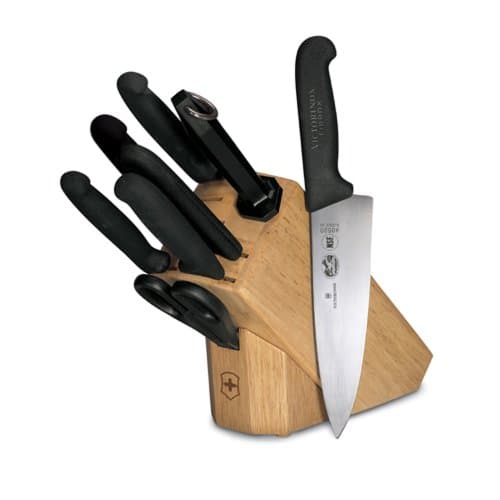
Victorinox Fibrox 8-Piece Block Set
Eight pieces including the 8-inch chef's knife this site recommends on its own merits, published dishwasher safe, lifetime warranty. Does more for someone's cooking than any pan at this price. Skip it for anyone who already owns one good knife - buy a board instead.
Best for: Furnishing a kitchen from nothing without buying five knives you will never pick up
Published specifications for the Victorinox Fibrox 8-Piece Block Set
Pieces
4 in paring, 6 in boning, 8 in chef's, 8 in bread, 10 in slicing, 10 in sharpening steel, kitchen shear, block
Handles
Thermoplastic elastomer (TPE)
Dishwasher
Knives published dishwasher safe
Certification
NSF approved, published on the set listing
Country of origin
Listed as United States for the set; the individual Fibrox chef's knife is published as Switzerland
Blade steel
Not published
Warranty
Not published on the set page
Good
An NSF mark is a real third-party standard rather than a marketing badge
The piece list is genuinely useful - no steak knives padding the count
Includes a sharpening steel, which most block sets treat as an upsell
Not good
Country of origin on the set page disagrees with the individual knife page
No published blade steel and no warranty terms on the set listing
A block takes counter space, and most cooks use two of these eight knives
The trade-off. Victorinox lists the set country as United States while publishing Switzerland for the individual Fibrox chef's knife - a documentation inconsistency worth knowing if you buy on origin.
Skip this if. You only ever reach for one knife. Two good knives and a sharpening steel cost far less than any block set.
An enameled cast iron Dutch oven. It is the only piece at this price that needs no seasoning, works on every hob including induction, does a job nothing else in a normal kitchen does, and asks the recipient to accept nothing. Buy Lodge's enameled 6-quart if the name is not the point and Le Creuset's Signature 5.5-quart if it is.
›Is a cookware set a good gift if I spend enough?
Usually not, and spending more makes it worse rather than better. A set decides four things on the recipient's behalf at once: how much storage they give up, whether it suits their hob, which finish they live with, and which brand they buy replacements from. Someone choosing a set for themselves accepts those knowingly. A recipient has them imposed.
›Should I buy an expensive frying pan as a gift?
Only for someone who already cooks and whose pans you have seen. A fully clad stainless skillet is an excellent gift for a competent cook with a mismatched collection, and a poor one for a beginner, because stainless sticks if the pan is not properly preheated. A gift should not come with a learning curve.
›What should I check before buying expensive cookware as a gift?
Two things on the listing. The hob compatibility, because induction is the one that quietly excludes products; and the published oven maximum, because an expensive set can still be rated to only 350F, which rules out finishing anything under a broiler. Both numbers are published. Most people do not look.
›Is cheap cookware a worse gift than expensive cookware?
Not in this category. The inexpensive end of cookware is mostly bare cast iron, bare aluminum, tempered glass and simple stainless - materials with nothing applied to them and nothing to delaminate. The expensive band buys refinement, documentation and warranty rather than better cooking. Two excellent cheap pieces usually beat one expensive one.
›What large cookware gift should I avoid?
Bare cast iron in quantity, because it hands over a maintenance routine rather than an object; any multi-piece set, for the reasons above; and anything heavy for someone with wrist or grip trouble, which nobody will mention when they open it. A large enameled pot full of stew is a genuine problem for some hands.
Sources
Every figure on this page came from one of these. Follow them and check our arithmetic — that is the point.