Heads up: some links on this page earn us a commission at no extra cost to you. It does not change what we recommend or the order. How we are funded.
The short answer
Buy the skillet first unless you already know you braise. A skillet is a cooking surface: searing, frying, roasting, cornbread, anything you want browned. A Dutch oven is a vessel: braises, stews, stock, bread and deep frying, none of which a skillet can do. The skillet is used more often in most kitchens; the Dutch oven does things nothing else in the cupboard can. If you buy the Dutch oven, buy it enameled.
A surface and a vessel
Both are cast iron, both have the same thermal mass per pound, and both hold heat far better than clad stainless. What differs is geometry, and geometry decides everything.
A skillet is a wide shallow cooking surface with sloped walls. Its purpose is contact: maximum food touching hot metal, with steam free to escape. A Dutch oven is a deep vessel with straight walls and a heavy lid. Its purpose is containment: liquid, steam and low steady heat held together for hours.
Skillet
Dutch oven
What it is
A cooking surface
A vessel
Searing
Excellent
Good, but the walls get in the way of a spatula
Braising
Not possible - no depth, no lid
This is what it exists for
Frying eggs, pancakes, cornbread
Yes
No
Bread
Flatbreads and skillet loaves
The best domestic bread vessel there is
Deep frying
No - not enough depth for safety
Yes, and its mass is why
Stock and soup
No
Yes, up to its capacity
Roasting a chicken
Yes, and it is very good at it
Yes, covered or uncovered
Weight
Heavy but liftable one-handed at 10 in
Two-handed empty at 6 qt
Acidic cooking
Bare iron: avoid long contact
Enameled: fine
Storage
Hangs or stacks
Awkward, heavy, needs a low shelf
Only three rows overlap. The rest are jobs one shape does and the other cannot attempt.
Which gets used more
In most kitchens, the skillet. Weeknight cooking is disproportionately searing, frying and roasting single portions, and that is skillet work. A Dutch oven is a weekend object in a lot of households - genuinely excellent, used once a week at most.
That is the argument for buying the skillet first. It is also cheaper, lighter, easier to store and a better introduction to how the material behaves. Sizing is in what size cast iron skillet.
The exception is a household that cooks stews, curries, chili or bread regularly. If that is you, buy the Dutch oven first - it is doing the cooking you actually do, and the skillet is the optional one.
Bare or enameled, by shape
The material answer differs between the two shapes, and this is where people go wrong.
Skillet: bare
A bare cast iron skillet is what you want. Searing is dry high-heat cooking, seasoning improves with exactly that kind of use, and the acidic problem rarely comes up in a pan you are browning things in. Enameled skillets exist and they are neither better at searing nor cheaper.
Dutch oven: enameled
A Dutch oven is used for long wet cooking, and long wet cooking is frequently acidic - tomato, wine, vinegar. In bare iron that strips seasoning and can leave a metallic taste, which is set out in is cast iron cookware safe. Enamel is non-reactive and needs no seasoning at all.
The full bare-versus-enameled argument is in bare versus enameled cast iron, and it resolves the same way: bare for the skillet, enameled for the pot.
Where they overlap, and who wins
Roasting a chicken: the skillet, narrowly. Better browning underneath and easier to get the bird out.
Searing before a braise: the Dutch oven, because you sear and braise in one pot and keep the fond.
Cornbread and skillet bakes: the skillet, clearly.
No-knead bread: the Dutch oven, and nothing else comes close - a preheated lidded pot turns a domestic oven into a steam oven.
Deep frying: the Dutch oven, and the skillet is genuinely unsafe for it - cookware for deep frying explains the one-third rule.
Cost, and what the money buys
A bare cast iron skillet is one of the cheapest genuinely permanent objects in a kitchen. An enameled Dutch oven ranges from moderate to expensive, and the difference between the ends of that range is enamel quality, handle geometry and resale value rather than cooking - a point made at length in best enameled Dutch ovens.
So the sensible sequence for most people is a cheap skillet now, and a Dutch oven when you know you want one - at whatever price point you can justify, since a Lodge enameled pot cooks the same food as a French one.
We do not make or sell cast iron skillets or Dutch ovens. Both link to the same retailer, both pay us the same commission rate, and we earn exactly the same whichever one you buy — or nothing at all if you buy neither, which is sometimes the right answer. Most of the comparison pages that rank for this question are published by companies that sell one of the two. How we are funded.
What to buy, if you are buying
These are the products this page's reasoning actually points at. Same rules as everywhere else on the site: published specs, a stated trade-off, and a live price only where one exists.
Top pick · Buy this firstSpecs read September 3, 2026
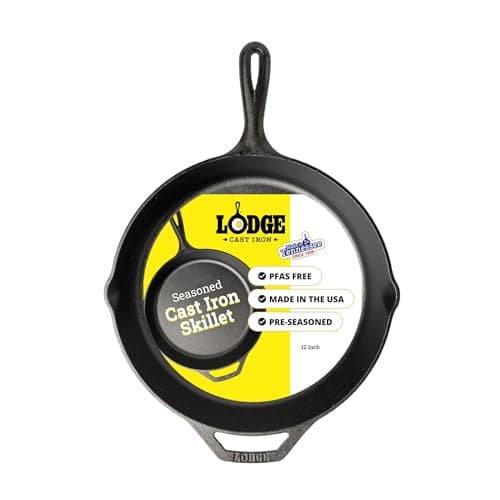
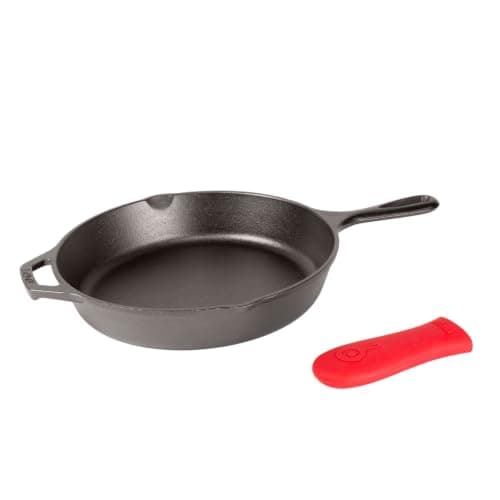
Lodge Seasoned Cast Iron Skillet, 10.25 in (L8SK3)
A 10-inch bare cast iron skillet is the most-used piece of cast iron in most kitchens and the cheapest way into the material.
Best for: Searing, cornbread, and anyone who wants one pan that cannot be worn out
Published specifications for the Lodge Seasoned Cast Iron Skillet, 10.25 in (L8SK3)
Diameter
10.25 in
Weight
5.66 lb
Oven maximum
550F
Induction
Yes - bare iron is ferrous
Seasoning
Pre-seasoned with soy-based vegetable oil, no synthetic chemicals
Warranty
Lifetime
Made in
USA
Care
Hand wash. Lodge's own instructions permit warm soapy water
Good
Effectively unbreakable and fully restorable - a rusted one can be stripped and re-seasoned
Holds heat better than anything else at the price, which is what a sear needs
Lodge publishes its seasoning method openly, so the maintenance is not a mystery
Not good
Heavy
Heats unevenly on a small burner: cast iron conducts at roughly 50 W/m-K, so it is slow to spread and slow to react
Bare iron is reactive; long tomato braises will taste of it
The trade-off. It weighs 5.66 lb empty. You will feel that every time you move it full, and it is the single most common reason a cast iron skillet ends up in a cupboard.
Skip this if. You have wrist or shoulder trouble, or you cook mostly acidic braises. Carbon steel does most of the same jobs at roughly half the weight.
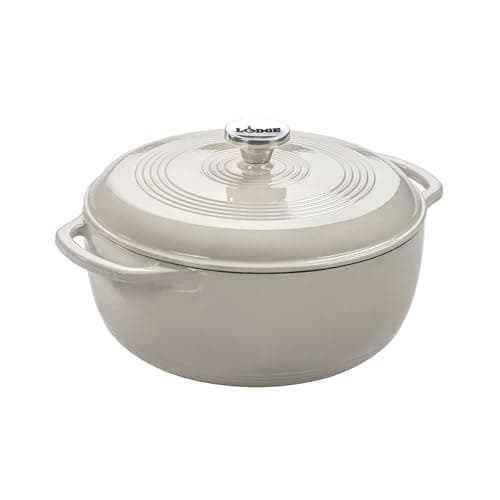
Published specifications for the Lodge Enameled Cast Iron Dutch Oven, 6 qt
Material
Cast iron with porcelain enamel, inside and out
Capacity
6 qt
Induction
Yes - the iron under the enamel is ferrous
Seasoning
None required - enamel is not a seasoning surface
Acid
Safe for tomato and wine, unlike bare iron
Oven maximum
Set by the knob material - check the specific SKU; Lodge publishes a lower ceiling than for bare iron
Good
Non-reactive, so it handles the acidic cooking bare iron cannot
No seasoning to maintain
Considerably cheaper than the French enameled pots it copies
Not good
Chipped enamel is not repairable, unlike bare iron's seasoning
Oven ceiling is lower than bare cast iron because of the knob
Heavy, and the enamel makes it heavier than bare iron of the same capacity
The trade-off. The enamel is a glass layer. Chip it and the pot is not restorable the way bare iron is, and Lodge's enamel chips more readily than the premium brands'.
Skip this if. You already own a large stainless stockpot and rarely braise. This duplicates it for most weeknight cooking.
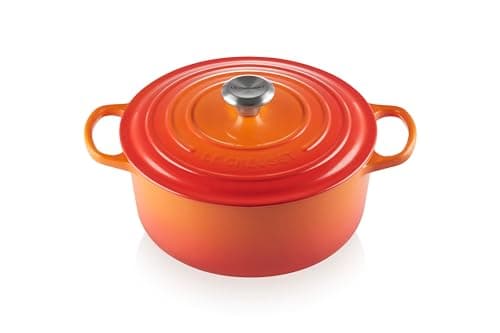
Published specifications for the Le Creuset Signature Round Dutch Oven, 5.5 qt
Material
Cast iron with porcelain enamel inside and out
Capacity
5.5 qt
Interior enamel
Sand-colored, so browning and fond stay visible
Knob
Stainless steel, rated to 500F
Induction
Yes - the iron under the enamel is ferrous
Dishwasher
Dishwasher safe; Le Creuset recommends hand washing
Warranty
Limited lifetime
Made in
France
Good
The pale interior is a genuine cooking advantage: you can see whether the fond is browning or burning
Wide, low-profile handles that a hand in an oven mitt actually fits
The one enameled pot with a real secondhand market, which changes the true cost of ownership
Not good
Costs several times a Lodge enameled pot of the same capacity
The pale interior stains permanently, and Le Creuset says so
Chipped enamel is not repairable on any enameled pot, this one included
The trade-off. You are paying a large multiple of what a Lodge enameled pot costs for a difference in enamel quality, finish and resale value rather than in cooking.
Skip this if. You braise a few times a year. The cooking difference over a Lodge enameled pot is small; the price difference is not.
›Should I buy a cast iron skillet or a Dutch oven first?
The skillet, unless you already know you braise. Weeknight cooking is disproportionately searing, frying and roasting, which is skillet work, and a skillet is cheaper, lighter and easier to store. Buy the Dutch oven first if you cook stews, curries or bread regularly.
›Can a Dutch oven replace a skillet?
Not for anything you turn with a spatula. Straight walls get in the way, and there is no ramp to slide a tool under food. It sears reasonably, but eggs, pancakes and cornbread all want a skillet.
›Can a skillet replace a Dutch oven?
No. A skillet has no depth for liquid, no lid in most cases, and it is genuinely unsafe for deep frying. Braises, stews, stock and no-knead bread all need the vessel rather than the surface.
›Should a Dutch oven be enameled or bare cast iron?
Enameled. Long wet cooking is frequently acidic - tomato, wine, vinegar - and acid strips seasoning from bare iron and can leave a metallic taste. Enamel is non-reactive and needs no seasoning. Skillets are the opposite case: buy those bare.
›Which is better for bread?
The Dutch oven, decisively. A preheated heavy pot with a lid traps the loaf's own steam and turns a domestic oven into something close to a steam oven. A skillet can do flatbreads and skillet loaves and nothing more.
Sources
Every figure on this page came from one of these. Follow them and check our arithmetic — that is the point.