The question parents actually ask is whether a coating can end up in the food. The honest way to settle it is to cook in something that has no coating on it.
Heads up: some links on this page earn us a commission at no extra cost to you. It does not change what we recommend or the order. How we are funded.
The short answer
Cook baby food in a small fully clad stainless saucepan and store it in glass. The Tramontina Tri-Ply 2-quart is the pick: two quarts is the right size for a batch measured in cups rather than quarts, it is clad to the rim so a thick puree does not scorch at the bottom, it is nonreactive with fruit, and Tramontina publishes it as dishwasher safe - which matters when you are washing the same pan daily. The reasoning is simple and it is about materials rather than medicine: a coating is the only part of a pan that can leave the pan, so if that is the thing you want to rule out, buy something that has no coating on it. Bare stainless and tempered glass both qualify, both are published nonreactive with acidic fruit, and glass has the second advantage that you can see what is in it. For storage and reheating, Pyrex publishes its bakeware as dishwasher, microwave and freezer safe. One thing this page will not do is tell you a coating is dangerous - we are not a medical source and we have run no tests.
Quick picks
The whole answer, on one screen. Tap a row to jump to the full write-up. Every pick below carries a stated trade-off further down — including the one at the top.
#
Product
Best for
Price
1
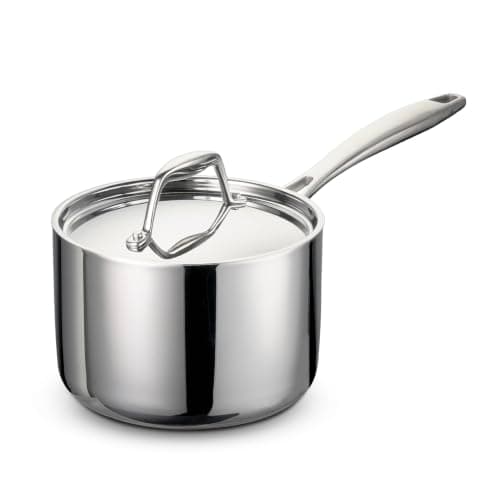
Tramontina Tri-Ply Clad Covered Saucepan, 2 qt
Two quarts of fully clad tri-ply stainless, published dishwasher safe and induction ready, in the size a one or two cup batch actually wants. Nonreactive, so apple and tomato are fine. Skip it if you batch cook for a freezer in large quantities - go up to three quarts, because Tramontina's own listing notes this one boils over easily.
Tri-ply with the aluminum core running up the sidewalls, published 600F, induction, limited lifetime warranty, bonded in Canonsburg: a thick puree will not scorch at the waterline. Skip it on the dishwasher question - All-Clad publishes hand wash only, which is a real daily cost on a pan used every day.
Three nesting tempered glass bowls published microwave and dishwasher safe, so food can be cooked, cooled and reheated in the thing it was mixed in, with nothing applied to the inside. Skip them if dropping matters: Pyrex publishes a 2-year limited warranty, and a dropped glass bowl is swept up rather than dented.
Best for steaming, blending and storing in one vessel
One, two and four cup glass measures with spouts that actually pour, which is most of what portioning a batch into containers involves, and they go in the microwave. Skip them if you want the markings to last forever - Pyrex publishes no fade guarantee and the printed scale is the wear item.
Tempered glass published as non-reactive and safe for tomato, wine and vinegar, and published dishwasher, microwave and freezer safe - which is the whole chain for a batch of roasted squash. Skip it for anything you want browned underneath, and respect the published thermal-shock rule: no hot dish onto a cold wet surface, no liquid into a hot dish.
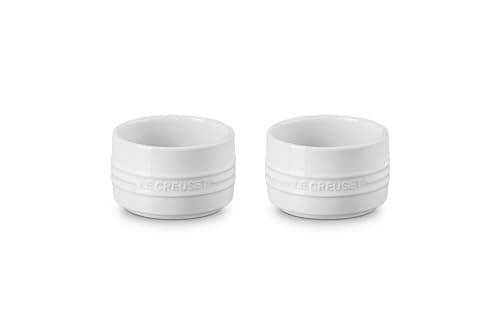
Le Creuset Stoneware Round Straight Wall Ramekin, Set of 2
The only ramekin in our ledger that comes with a published maximum oven temperature from the maker rather than from a retailer, which is a low bar that nothing else clears. Skip it on quantity and price: you get two, and most families portioning a batch want six.
Prices last checked November 12, 2026. Prices move constantly — the number on Amazon when you click is the real one.
The question underneath the question
Parents searching for this are not usually asking which pan browns best. They are asking whether anything from the pan can end up in the food, and that is a question this site cannot answer with a test, because we do not run laboratory tests and we are not a medical source.
What we can do is point at the structure of the problem. A coating is the only part of a pan that is applied rather than built in. Everything else - the iron, the aluminum core, the stainless, the glass - is the pan. So if ruling that out is what you want, the reliable route is not to find a coating with a reassuring label; it is to cook in something that does not have one.
This is not the page that gives a categorical warning. That one exists and it is about a different household: cookware when you have pet birds is the only question on this site with a flat answer, because overheated PTFE is lethal to birds in a way that is documented and specific. Nothing comparable applies here, and we are not going to imply it does. For what the materials themselves are and are not, the healthiest cookware materials and is nonstick cookware safe set out what makers publish.
Three things make this job different
The batches are tiny. A puree is one or two cups. In a big pan a shallow layer scorches before it softens, which is why the 2-quart is the pick rather than the 3 or the 8.
Half the ingredients are acidic. Apple, pear, plum, berry, tomato. That rules out materials that react, and it rules them out for taste and appearance as well as anything else - cooking acidic foods and reactive cookware has the list.
Everything gets reheated. Often in the container it was frozen in. So published microwave, freezer and dishwasher claims stop being convenience features and become the specification.
The materials, by what they publish
Material
Anything applied?
Acidic fruit
Published storage claims
Clad stainless
No
Fine - nonreactive
Dishwasher safe on the Tramontina and Cuisinart lines; All-Clad publishes hand wash only
Tempered glass
No
Pyrex publishes safe for tomato, wine and vinegar
Pyrex publishes dishwasher, microwave and freezer safe on the oblong dish
Porcelain and stoneware
Glaze, fired to the body
Fine
Varies, and mostly unpublished - Le Creuset is the exception in our ledger
Bare cast iron
Seasoning, which is oil
Not for long cooks - it strips seasoning and tastes of it
Not dishwasher safe; has to be dried
Bare aluminum
No
Nordic Ware publishes that it reacts with acid
Nordic Ware advises against the dishwasher
Coated aluminum (PTFE or ceramic)
Yes - a coating
Fine
Usually dishwasher safe; no maker publishes a coating lifespan
The first two rows are the answer. The last row is not here to be condemned - it is here because the thing that makes it different is the thing this page is about.
The documentation problem in small dishes
Portioning a batch into individual dishes is the obvious move, and it runs straight into something we found when auditing this category: ramekins barely document themselves. The DOWAN 4-ounce set - exactly the size a single baby portion wants - publishes no maximum oven temperature at all, not from the maker and not from any retailer we checked, and its own listings disagree about both dimensions and capacity. HIC publishes nothing on the listing we link; a 500F figure for the same piece comes from a different retailer.
For cold storage and the refrigerator that genuinely does not matter. For anything that goes into a hot oven it does, which is why the Le Creuset pair is the pick here despite being the expensive and least practical option on count: it is the only one whose maker publishes a figure.
A routine that uses four of these
Roast or steam. Hard vegetables go into the glass dish; soft fruit goes straight into the 2-quart saucepan with a splash of water.
Puree and cool. Into a glass bowl, which you can see through, so you can tell when the texture is right without lifting a spoon.
Portion. The glass measure pours without dripping down the side, which is the entire reason it is on this list.
Store and reheat. Pyrex publishes freezer, microwave and dishwasher safe on its bakeware, with one rule that matters more here than anywhere else: no sudden temperature change, so a dish out of the freezer does not go into a hot oven - glass vs metal bakeware explains why.
What you do not need
A dedicated baby-food pan. There is no such category in cookware; there are small saucepans, and a good one will still be useful in fifteen years.
A nonstick pan for this specific job. Purees do not stick the way eggs do - they are mostly water - so the one thing a coating buys you is the thing you need least here.
A second set of utensils. If the pan is bare stainless or glass, this question disappears too - which utensils go with which pan.
What we cannot tell you
Anything clinical. We do not test for leaching, we do not publish health advice, and nothing on this page should be read as a claim that one material is safer for a child than another - only that one kind of pan has a coating on it and the other kind does not, which is a fact about construction rather than a fact about health. For feeding questions, ask someone qualified to answer them. How we work sets out what we do and do not do. Nor can we tell you what any of these cost when you click: the button carries the live number.
Which to buy
One pan for this:the Tramontina 2-quart. Clad, nonreactive, dishwasher safe, the right size.
Bare stainless and tempered glass, chosen because neither has anything applied to the surface that touches the food. Prices move constantly - the number on each button is the current one.
Tramontina Tri-Ply Clad Covered Saucepan, 2 qt
Sauces, grains and reheating, in the size a kitchen actually uses daily
Prices last checked November 12, 2026. Prices move constantly — the number on Amazon when you click is the real one.
Every pick, in full
Each write-up below gives the published specs, what the pan is genuinely good at, what it costs you, and who should skip it. The trade-off line is there on the top pick too — a recommendation with no downside is an advertisement.
Top pick · Best pan for cooking baby foodSpecs read September 3, 2026
Tramontina Tri-Ply Clad Covered Saucepan, 2 qt
Two quarts of fully clad tri-ply stainless, published dishwasher safe and induction ready, in the size a one or two cup batch actually wants. Nonreactive, so apple and tomato are fine. Skip it if you batch cook for a freezer in large quantities - go up to three quarts, because Tramontina's own listing notes this one boils over easily.
Best for: Sauces, grains and reheating, in the size a kitchen actually uses daily
#2 · Best if you are cooking for the whole house tooSpecs read September 3, 2026
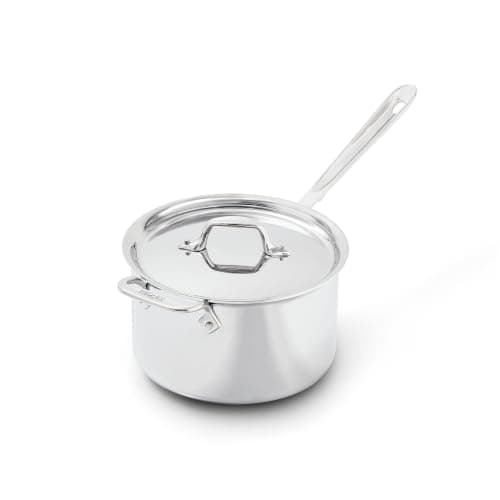
All-Clad D3 Stainless Saucepan, 3 qt
Tri-ply with the aluminum core running up the sidewalls, published 600F, induction, limited lifetime warranty, bonded in Canonsburg: a thick puree will not scorch at the waterline. Skip it on the dishwasher question - All-Clad publishes hand wash only, which is a real daily cost on a pan used every day.
Best for: Rice, custards and reductions - anything that scorches in a disc-bottom pan
#3 · Best for steaming, blending and storing in one vesselSpecs read September 3, 2026
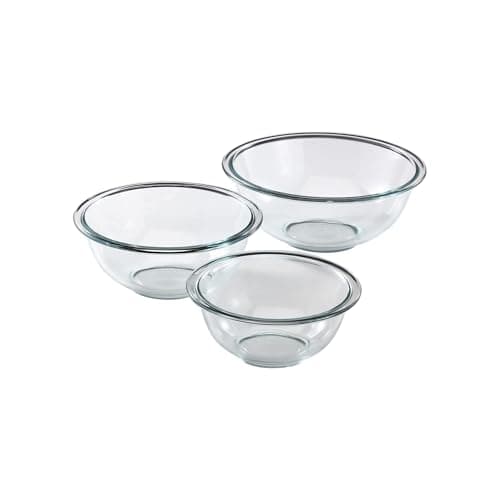
Pyrex 3-Piece Glass Mixing Bowl Set
Three nesting tempered glass bowls published microwave and dishwasher safe, so food can be cooked, cooled and reheated in the thing it was mixed in, with nothing applied to the inside. Skip them if dropping matters: Pyrex publishes a 2-year limited warranty, and a dropped glass bowl is swept up rather than dented.
Best for: Everyday prep, batters, and anything you want to microwave in the bowl you mixed it in
#4 · Best for portioningSpecs read September 3, 2026
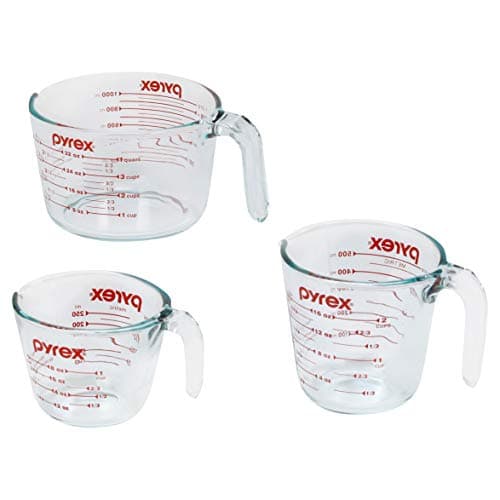
Pyrex 3-Piece Glass Measuring Cup Set
One, two and four cup glass measures with spouts that actually pour, which is most of what portioning a batch into containers involves, and they go in the microwave. Skip them if you want the markings to last forever - Pyrex publishes no fade guarantee and the printed scale is the wear item.
Best for: Liquid measuring, melting butter in the microwave, and reading a level at eye height
#5 · Best for roasting the vegetables firstSpecs read September 3, 2026
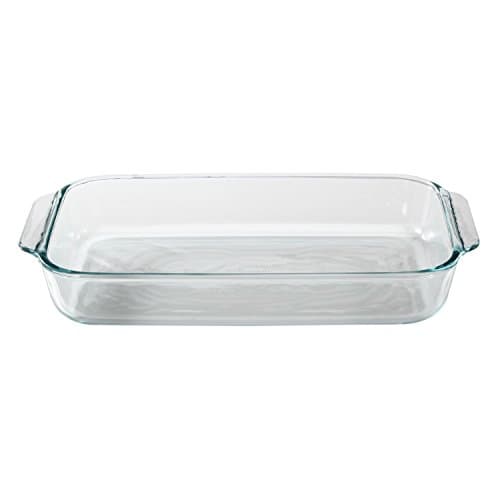
Pyrex Basics Oblong Glass Baking Dish, 3 qt
Tempered glass published as non-reactive and safe for tomato, wine and vinegar, and published dishwasher, microwave and freezer safe - which is the whole chain for a batch of roasted squash. Skip it for anything you want browned underneath, and respect the published thermal-shock rule: no hot dish onto a cold wet surface, no liquid into a hot dish.
Best for: Casseroles, gratins and baked pasta - wet dishes that go oven to table to fridge
#6 · Best single-portion dishSpecs read October 11, 2026
Le Creuset Stoneware Round Straight Wall Ramekin, Set of 2
The only ramekin in our ledger that comes with a published maximum oven temperature from the maker rather than from a retailer, which is a low bar that nothing else clears. Skip it on quantity and price: you get two, and most families portioning a batch want six.
Best for: Anyone who wants a small oven dish they can put under a broiler without guessing
Safe per Le Creuset's stoneware guidance, with clearance published between the dish and the element - check your own broiler
Microwave, dishwasher, freezer, refrigerator
Safe (Le Creuset published, stoneware range)
Stovetop or direct heat
No - Le Creuset publishes that stoneware must not be used on a stovetop
Thermal shock
Le Creuset cautions against washing a hot piece too soon
Dimensions
Not published on the listing we link
Good
The only ramekin here with a maximum oven temperature attached to it, at a published 500F
Broiler guidance exists at all, which matters because browning sugar is what people buy ramekins for
Published safe for microwave, dishwasher, freezer and refrigerator, so it covers make-ahead and reheating
Not good
Its own listing gives two different capacities - 7 oz in the title, 6.75 oz in the URL
A set of two, when most recipes calling for ramekins serve four to six
By far the highest cost per cup in the category
No published dimensions on the listing, so you cannot check it against your air fryer or toaster oven
The trade-off. It is the most expensive route to a ramekin by a wide margin, and you get two rather than the six that most of the recipes wanting ramekins are written for.
Skip this if. You are making creme brulee for a dinner party. Two is the wrong number and buying three sets costs more than a good saucepan.
A small fully clad stainless saucepan, around two quarts. The size suits batches measured in cups, the cladding runs up the sides so a thick puree does not scorch, stainless is nonreactive with acidic fruit, and the common clad lines are published dishwasher safe, which matters on a pan used daily.
›Is nonstick cookware safe for baby food?
We do not publish health advice and we have run no tests, so we will not tell you it is unsafe. What we will say is structural: a coating is the only part of a pan that is applied rather than built in, so if ruling that out is what you want, the reliable route is a pan that has no coating at all. Purees are mostly water and do not stick, so release is the feature you need least here.
›Can you cook baby food in cast iron?
For savory purees, yes. For fruit, not really. Apple, pear, plum and berry are acidic enough that a long cook strips seasoning from bare iron and picks up a metallic taste. Enameled cast iron has no such problem, because the enamel is nonreactive, and so does stainless.
›What should you store homemade baby food in?
Glass, because you can see it and because nothing is applied to the inside. Pyrex publishes its oblong bakeware as dishwasher, microwave and freezer safe. The one published rule to respect is thermal shock: nothing out of the freezer goes straight into a hot oven, and no liquid is added to a hot dish.
›Are ceramic ramekins safe for a hot oven?
Often, but surprisingly few makers will say so with a number attached. Of the ramekins in our ledger, only Le Creuset publishes a maximum oven temperature from the maker. The DOWAN 4-ounce set publishes none at all, and the HIC set's 500F figure comes from a retailer rather than from HIC.
›Do you need a special pan set for baby food?
No. There is no baby-food category in cookware, only small saucepans, and a good two-quart clad pan will still be in daily use long after the purees stop. The pieces worth buying for this are the ones that are useful afterward: a small saucepan, glass bowls and glass measures.
Sources
Every figure on this page came from one of these. Follow them and check our arithmetic — that is the point.