Heads up: some links on this page earn us a commission at no extra cost to you. It does not change what we recommend or the order. How we are funded.
The short answer
If birds live in your home, take PTFE out of the kitchen entirely. Not because normal cooking is dangerous to people - it is not - but because a PTFE coating degrades above roughly 500F and releases fluorinated gases, and birds die from those gases at exposures that would give a person a headache. The temperature is not theoretical: an empty pan forgotten on a high setting reaches it in a couple of minutes. The safe surfaces are the ones with no fluoropolymer anywhere on them - bare cast iron, bare carbon steel, clad stainless steel, enameled cast iron and glass. Ceramic coatings published as PTFE-free are a reasonable second tier - GreenPan's Thermolon, HexClad's TerraBond and Zwilling's Ceraforce are all published free of PTFE - but a household with a bird in it is simpler to keep safe with no coating at all, because then there is nothing to verify, nothing to confuse with a replacement pan, and nothing to get wrong when a guest cooks.
Why this page gives a flat answer when the rest of the site does not
We spend most of this site refusing to give categorical answers about nonstick. We say repeatedly that PTFE is stable at cooking temperatures, that the regulatory position is not alarming, and that the realistic risk is overheating rather than composition - is nonstick safe is that argument in full, and we stand by it.
This household is the exception, and the reason is anatomy rather than chemistry. Birds have a flow-through respiratory system built around air sacs rather than the tidal in-and-out lungs mammals have, and it moves air through gas-exchange surfaces far more efficiently. That efficiency is why canaries were used in mines. It is also why an airborne irritant that is a nuisance to a person can be lethal to a bird in minutes.
So the same facts produce a different recommendation. The margin of safety that makes PTFE a reasonable choice in most kitchens is not a margin at all in a kitchen with a bird in it.
What actually happens, and at what temperature
A PTFE coating is stable through normal cooking. Above roughly 500F it begins to degrade, and the products of that degradation include fluorinated gases. Veterinary diagnostic laboratories describe the resulting condition in birds plainly: the Texas A&M Veterinary Medical Diagnostic Laboratory documents severe lung edema and hemorrhage, with birds showing difficult breathing, wheezing, gasping, weakness, depression or anxious behavior - and notes that often they are simply found dead in their cages.
The number that matters to a cook is not the degradation temperature but how easily it is reached. An empty coated pan on a high setting has nothing absorbing the energy, so its surface temperature runs away in under two minutes. That is the whole exposure scenario: not a gentle fry, but a pan preheated and forgotten - what stove heat settings actually mean.
Which also explains why the published ceilings on coated pans sit well below it. T-fal and Zwilling publish 400F, OXO 430F, Calphalon Premier 450F. Those figures are a safety margin, and in most kitchens exceeding them is a pan problem. In this kitchen it is a bird problem.
Ventilation is not the answer and should not be treated as one. An extractor fan reduces concentration; it does not make a plume safe for an animal in the next room, and birds are routinely housed in or near kitchens because that is where the household is. The answer is removing the material, not managing the fumes.
Every material, with a verdict
Material
Any fluoropolymer?
Bird-household verdict
The honest cost
Bare cast iron
None
Safe. The default answer
Weight, a drying and oiling routine, and a limit on long acidic cooking
Bare carbon steel
None
Safe
A real seasoning commitment, and on de Buyer pans a beeswax coating to scrub off first
Clad stainless steel
None
Safe. The zero-maintenance answer
Food sticks until you learn to preheat it; All-Clad publishes hand-wash only
Enameled cast iron
None - enamel is glass fused to iron
Safe
Heavy, expensive, and chips are permanent
Glass bakeware
None
Safe
Thermal-shock rules, and it browns nothing
Bare and aluminized aluminum bakeware
None on bare aluminum; check aluminized steel for a coating
Safe when uncoated
Reactive with acid, and alkaline dishwasher detergent dulls it
Ceramic nonstick
Published PTFE-free by GreenPan, HexClad, Zwilling and Caraway
Reasonable second tier, if you verify the specific pan
A consumable with no published lifespan, and you must re-verify every replacement
PTFE nonstick
Yes - this is the material in question
Not in this household
None worth discussing here
Coatings with unpublished composition
Unknown
Treat as unsuitable. Not an accusation - you simply cannot check
Scanpan publishes no composition for STRATANIUM and no PFAS statement on its product page
Fluoropolymer status as published by each maker. Where a maker does not publish a composition, this table says so rather than inferring one.
The pans in our ledger, sorted
Fifty-eight products, read against one question. This is the part worth screenshotting if you are standing in a shop.
No coating at all
Lodge cast iron in 8, 10.25 and 12 in, plus the grill pan, reversible griddle, camp Dutch oven and double Dutch oven. Victoria 12 in cast iron. de Buyer MINERAL B PRO and Matfer Bourgeat black steel. Lodge carbon steel. The carbon steel woks from Joyce Chen, Craft Wok and Yosukata. All-Clad D3, Made In, Demeyere Industry 5, Hestan NanoBond, Viking, Misen, Tramontina tri-ply and Cuisinart MultiClad Pro in clad stainless. Lodge, Le Creuset, Staub and Cuisinart in enameled cast iron. Nordic Ware Naturals bare aluminum bakeware and Pyrex glass.
Coated, published free of PTFE
GreenPan - Thermolon, published from sand-derived silicon dioxide and published PFAS-free, PFOA-free and free of lead and cadmium. HexClad - published free from PTFE and PFAS. Zwilling Clad CFX - Ceraforce XTREME, published PTFE-free. Caraway - ceramic, with third-party PFAS testing published and linked. USA Pan bakeware - AMERICOAT silicone, stated free of PTFE, PFOA and BPA.
PTFE, or composition not published
T-fal Professional, OXO Good Grips Pro, Calphalon Premier, Circulon Symmetry and Tramontina's professional restaurant pan are PTFE. Scanpan's STRATANIUM composition is not published and its product page carries no PFAS statement. Our Place's Thermakind and Titanium Pro lines publish less than the brands above. None of that makes them bad pans - it makes them pans you cannot clear for this household.
The question is not whether this is a good surface. It is whether anyone will tell you what it is.
The kitchen sources of PTFE that are not a frying pan
This is the section that matters most, because people replace their pans and then hit one of these. PTFE is used across an enormous range of applications and several of them live in a kitchen.
The oven's self-clean cycle. The highest-risk event in a bird-owning home. It runs the cavity far above normal cooking temperatures and bakes off whatever is inside it, including any coated bakeware left in there. If you run one, the birds should not be in the building.
Coated bakeware, muffin tins and drip pans. Easy to miss because they live in a cupboard. An uncoated aluminum half sheet or a glass dish solves it - non-toxic bakeware.
Small appliances with coated interiors. Air fryer baskets, waffle irons, sandwich presses, bread machine pans, rice cooker pots, electric griddles. Most publish nothing about coating composition, and all of them get hot.
Coated heat-lamp bulbs. PTFE is used on some bulb coatings, including in brooder and reptile heat lamps, which is a hazard worth knowing about if you keep other animals too.
Aerosol cooking spray on a hot coated pan. Not a PTFE source, but it builds a residue that ruins release, which gets people cooking hotter to compensate - how to clean nonstick pans.
What to actually do, in order
Replace the pan you use every day first. It is almost always a coated egg pan, and it is the one that gets preheated empty. A 10.25 in cast iron skillet is the cheapest complete fix on this page.
Then the second pan. One clad stainless pan covers everything cast iron is bad at - acidic sauces, delicate fish, anything you want to deglaze - All-Clad D3, 10 in.
Audit the cupboard, not just the hob. Bakeware, drip pans, the air fryer basket, the waffle iron. Anything coated whose composition you cannot look up goes.
Decide about the self-clean cycle now, not later. Either commit to never running it, or plan where the birds go when you do.
Learn the eggs problem. This is the real cost of the switch and pretending otherwise is unhelpful. Eggs on bare metal need a properly preheated pan and more fat than you are used to - why food sticks and what to replace nonstick pans with.
Tell anyone else who cooks in your kitchen. The most common way a bird-safe kitchen fails is a well-meaning guest arriving with their own favorite pan.
What we cannot tell you
We are a cookware site, not a veterinary one. We have run no tests, we are not qualified to advise on an animal's health, and if you think a bird has been exposed that is a call to an avian vet rather than a question for a web page. What we can do is the thing we do everywhere else: read what each maker publishes about its own materials and tell you which pans you can and cannot verify.
We would also rather be plain about the shape of this advice. The categorical recommendation here is not driven by a claim that PTFE is dangerous in general - we do not think the evidence supports that, and we say so on the pages where that question belongs. It is driven by the fact that this particular animal has no margin, and that removing a material is a cheaper way to manage a risk than managing the risk.
A complete bird-safe kitchen, four pans
Cast iron for searing, clad stainless for everything acidic and delicate, carbon steel if weight is a problem, and enameled cast iron for anything long and wet. No coating anywhere in the set.
Lodge Seasoned Cast Iron Skillet, 10.25 in (L8SK3)
Searing, cornbread, and anyone who wants one pan that cannot be worn out
These are the products this page's reasoning actually points at. Same rules as everywhere else on the site: published specs, a stated trade-off, and a live price only where one exists.
Top pick · The default bird-safe panSpecs read September 3, 2026
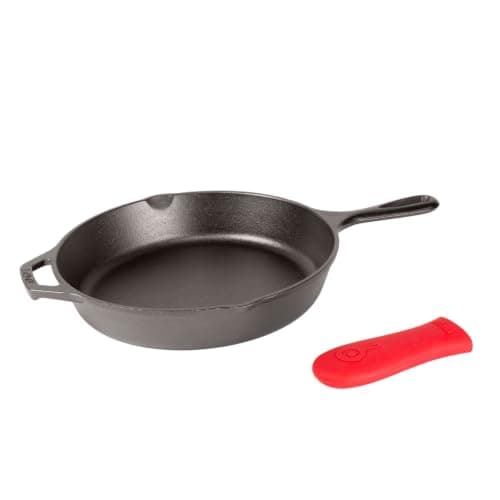
Lodge Seasoned Cast Iron Skillet, 10.25 in (L8SK3)
Bare seasoned cast iron: no coating of any kind, 550F published, and a seasoning layer that is nothing but polymerized soy-based vegetable oil. The honest cost is 5.66 lb and a drying routine.
Best for: Searing, cornbread, and anyone who wants one pan that cannot be worn out
Published specifications for the Lodge Seasoned Cast Iron Skillet, 10.25 in (L8SK3)
Diameter
10.25 in
Weight
5.66 lb
Oven maximum
550F
Induction
Yes - bare iron is ferrous
Seasoning
Pre-seasoned with soy-based vegetable oil, no synthetic chemicals
Warranty
Lifetime
Made in
USA
Care
Hand wash. Lodge's own instructions permit warm soapy water
Good
Effectively unbreakable and fully restorable - a rusted one can be stripped and re-seasoned
Holds heat better than anything else at the price, which is what a sear needs
Lodge publishes its seasoning method openly, so the maintenance is not a mystery
Not good
Heavy
Heats unevenly on a small burner: cast iron conducts at roughly 50 W/m-K, so it is slow to spread and slow to react
Bare iron is reactive; long tomato braises will taste of it
The trade-off. It weighs 5.66 lb empty. You will feel that every time you move it full, and it is the single most common reason a cast iron skillet ends up in a cupboard.
Skip this if. You have wrist or shoulder trouble, or you cook mostly acidic braises. Carbon steel does most of the same jobs at roughly half the weight.
#2 · Bird-safe with no maintenanceSpecs read September 3, 2026
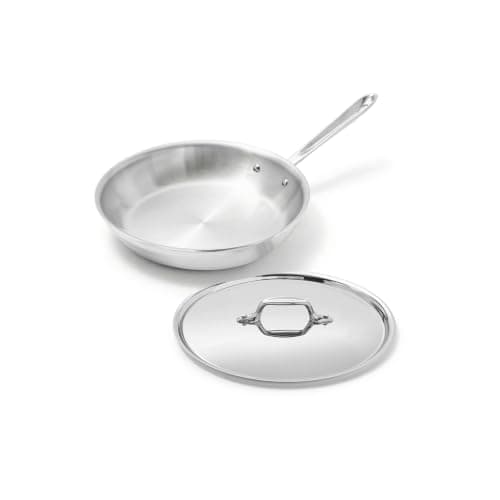
All-Clad D3 Stainless 10 in Fry Pan
An 18/10 stainless cooking surface with nothing applied to it, published at 600F and oven and broiler safe. Nothing to degrade at any temperature your hob can reach.
Best for: One good open-stock stainless pan bought instead of a cheap full set
Published specifications for the All-Clad D3 Stainless 10 in Fry Pan
Construction
Fully bonded tri-ply, aluminum core
Oven maximum
600F, oven and broiler safe
Induction
Yes - compatible with any stovetop
Dishwasher
Handwash only (All-Clad published)
Handle
Double-riveted stainless
Weight
3.0 lb (model 4110)
Warranty
Limited lifetime
Made in
Bonded, engineered and assembled in Canonsburg, PA
Good
600F is the highest oven ceiling of any stainless pan on this site
The one pan here whose manufacturing location is published down to the town
Genuinely repairable-adjacent: rivets are the only failure point and the warranty covers them
Not good
Hand wash only
The flared rim makes it a poor pan for anything with liquid
Costs several times what a Tramontina or Cuisinart pan of the same construction costs
The trade-off. Hand wash only. All-Clad publishes that plainly, and it is a real daily cost on a pan you will use every day.
Skip this if. You want a dishwasher-safe pan, or you are buying a whole kitchen on a fixed budget - one D3 skillet costs what a full clad set can cost.
#3 · Bare metal, lighterSpecs read September 3, 2026
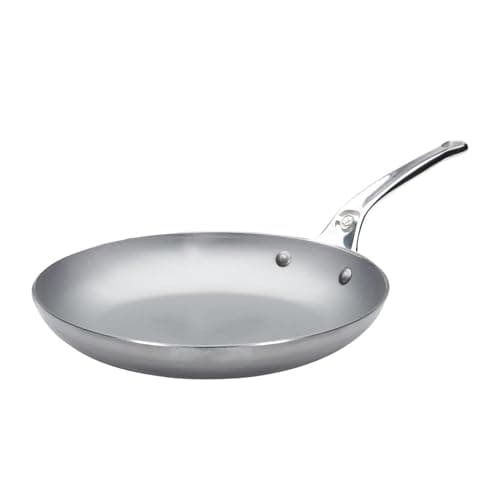
de Buyer MINERAL B PRO Carbon Steel Fry Pan, 11 in
99% iron and 1% carbon by de Buyer's own published figures, 3 mm thick at 4.6 lb. Bare steel and a seasoning you build yourself - no coating in the equation.
Best for: Someone who wants cast-iron searing without cast-iron weight
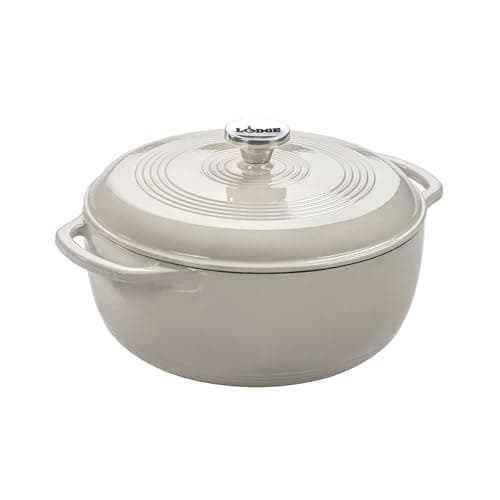
Published specifications for the Lodge Enameled Cast Iron Dutch Oven, 6 qt
Material
Cast iron with porcelain enamel, inside and out
Capacity
6 qt
Induction
Yes - the iron under the enamel is ferrous
Seasoning
None required - enamel is not a seasoning surface
Acid
Safe for tomato and wine, unlike bare iron
Oven maximum
Set by the knob material - check the specific SKU; Lodge publishes a lower ceiling than for bare iron
Good
Non-reactive, so it handles the acidic cooking bare iron cannot
No seasoning to maintain
Considerably cheaper than the French enameled pots it copies
Not good
Chipped enamel is not repairable, unlike bare iron's seasoning
Oven ceiling is lower than bare cast iron because of the knob
Heavy, and the enamel makes it heavier than bare iron of the same capacity
The trade-off. The enamel is a glass layer. Chip it and the pot is not restorable the way bare iron is, and Lodge's enamel chips more readily than the premium brands'.
Skip this if. You already own a large stainless stockpot and rarely braise. This duplicates it for most weeknight cooking.
PTFE nonstick is. The coating degrades above roughly 500F and releases fluorinated gases, and birds have a flow-through respiratory system that makes them far more vulnerable to airborne toxins than mammals. Veterinary diagnostic laboratories document severe lung edema and hemorrhage, with birds often found dead in their cages. If birds live in your home, remove PTFE from the kitchen.
›What cookware is safe to use around birds?
Anything with no fluoropolymer on it: bare cast iron, bare carbon steel, clad stainless steel, enameled cast iron, glass and uncoated aluminum bakeware. These have nothing applied to the cooking surface, so there is no coating to break down at any temperature a domestic hob can reach.
›Is ceramic nonstick safe for pet birds?
It is a reasonable second tier if you verify the specific pan. GreenPan publishes Thermolon as PFAS-free and PFOA-free, HexClad publishes free from PTFE and PFAS, Zwilling publishes Ceraforce as PTFE-free, and Caraway publishes third-party PFAS testing with linked results. The reason we still recommend bare metal first is simplicity: with no coating there is nothing to re-verify every time a pan gets replaced.
›At what temperature does nonstick become dangerous to birds?
PTFE begins to degrade above roughly 500F, which is well above normal cooking. The practical problem is how easily that is reached: an empty coated pan on a high setting has nothing absorbing the energy and its surface temperature runs away in under two minutes. Published oven ceilings of 400F to 450F on coated pans sit deliberately below the degradation point.
›Will using the extractor fan make nonstick safe with birds in the house?
No, and it should not be relied on. An extractor reduces concentration in the room; it does not make a plume safe for an animal elsewhere in the home, and birds are usually housed where the household is. The workable approach is removing the material rather than trying to manage the fumes.
›What else in a kitchen contains PTFE besides pans?
Coated bakeware, muffin tins and oven drip pans; air fryer baskets, waffle irons, sandwich presses, bread machine pans and rice cooker pots; and some coated heat-lamp bulbs. The single highest-risk event is an oven self-clean cycle, which runs the cavity far above cooking temperatures - if you run one, the birds should not be in the building.
Sources
Every figure on this page came from one of these. Follow them and check our arithmetic — that is the point.