Register for the things you would never buy for yourself and would keep for thirty years. Everything else you can buy later, cheaper, when you know what you need.
Heads up: some links on this page earn us a commission at no extra cost to you. It does not change what we recommend or the order. How we are funded.
The short answer
Register for the expensive, permanent pieces and buy the cheap, replaceable ones yourself. That means a clad stainless set or a few open-stock clad pieces, one enameled Dutch oven, one good skillet and a proper bakeware set on the list - and nonstick pans, plastic tools and gadgets off it. Nonstick is a consumable, and a consumable is a poor gift because it will be worn out before the thank-you notes have aged.
One principle does most of the work
Register for things that are expensive and permanent. Buy the cheap and replaceable things yourself.
A registry is a one-time transfer of goods at a moment when people want to give you something lasting. Spending that on a nonstick pan - which no maker will publish a lifespan for, and which will be scratched inside three years - wastes it. Spending it on an enameled Dutch oven or a fully clad set converts it into something still in the kitchen in 2056.
The same logic explains the two most common registry regrets: a huge set with pieces nobody uses, and a beautiful matched line where half the pieces were duplicated by wedding gifts from outside the registry.
Build the list in three price bands
Registries work best when there is something at every level, because guests self-select by budget and a list with three expensive things on it leaves most people buying a gift card.
Band
What belongs here
Why
Group gift / high
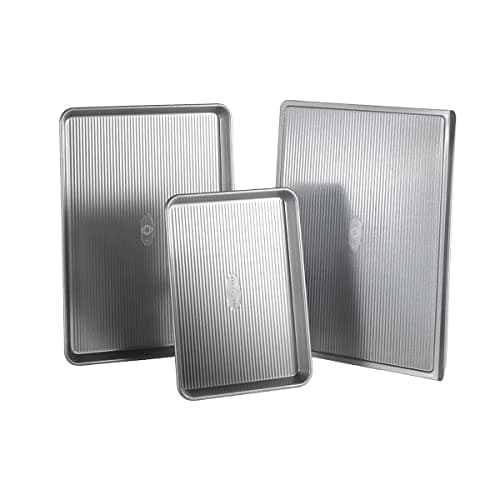
Clad stainless set, enameled Dutch oven, a full bakeware set
Permanent, expensive, and the pieces that define how the kitchen cooks
Middle
One open-stock clad skillet, a large stock pot, a cast iron skillet
Individually giftable, individually useful, no duplication problem
Low
Sheet pans, a loaf pan, a cake pan, a small saucepan
Cheap enough to be a comfortable gift and genuinely used weekly
What belongs on the list
A clad stainless set, or its open-stock equivalent
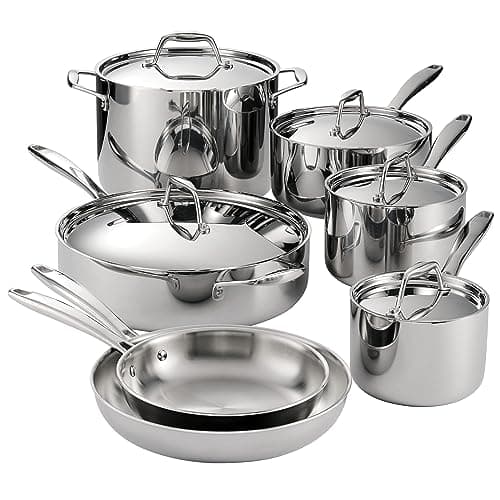
This is the backbone. Fully clad rather than disc-bottom, induction-rated so it survives a future kitchen, dishwasher safe if you can get it. Which one is worked through in the cookware set roundup, and what piece count you need is worth reading before you register for a 14-piece box.
One enameled Dutch oven
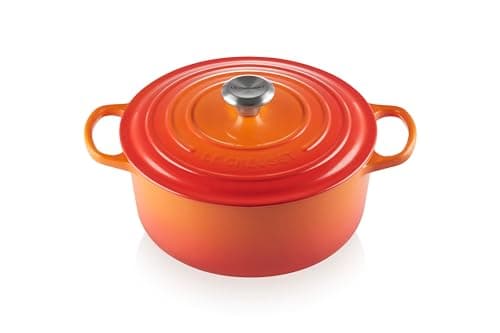
The single most-registered piece of cookware in the country, and for once the conventional wisdom is right. It braises, bakes bread, makes stock and goes to the table. The French pots are the ones people register for precisely because they are hard to justify buying; check price on Amazon or read the enameled Dutch oven roundup for the case against paying that much.
One skillet you would not buy yourself
Either a high-end clad skillet or a good carbon steel pan. Both last decades and both feel extravagant as a self-purchase, which is exactly the registry sweet spot.
Bakeware, as a set
Bakeware is the category people never get around to buying properly, and it is cheap enough to sit in the low and middle bands. The bakeware set roundup covers what a full set should contain and the cake and loaf pan roundup covers the pieces most sets get wrong.
What to keep off it
Nonstick pans. A consumable. No manufacturer publishes a coating lifespan - not one - and giving someone a pan with a hidden expiry date is a poor use of a gift. The lifespan question, honestly.
Anything with a motor. Not cookware, but the same rule: it will be superseded, and the registry is for things that will not be.
A second set in a different finish. One set. People register for two because the photos are nice, and then store one.
Single-purpose pans. The paella pan, the fondue set, the egg poacher. Register for one thing you will use every week instead.
A set is the right registry item and the wrong self-purchase in a small kitchen. Registries are the one moment when piece count is somebody else's problem.
The three registry mistakes worth avoiding
Registering for the aspirational kitchen rather than the current one. If neither of you bakes, a stand mixer and three cake pans are storage. If you both cook every night, register heavier.
Registering for a matched line you cannot add to. Discontinued lines are the reason people end up with four pieces of a seven-piece set. Register for lines that are still in open stock.
Ignoring the stove you will actually have. If there is any chance of induction in the next decade, register only for induction-rated pieces. It costs nothing and it saves buying twice - see cookware for induction.
A registry that holds up in ten years
One pot, one set, one skillet, one bakeware set. Everything else can be bought later, cheaper, once you know how you actually cook.
Le Creuset Signature Round Dutch Oven, 5.5 qt
A braising pot bought once, kept for decades and handed on
The pieces that did not get bought are the ones to fill in yourself, and the good news is that they are the cheap ones. A nonstick pan, a couple of sheet pans and a second saucepan are a small outlay, and buying them afterwards means buying the sizes you have discovered you need rather than the ones a boxed set decided for you.
These are the products this page's reasoning actually points at. Same rules as everywhere else on the site: published specs, a stated trade-off, and a live price only where one exists.
Top pick · The classic registry pieceSpecs read September 3, 2026
Le Creuset Signature Round Dutch Oven, 5.5 qt
The one object on a registry people genuinely keep for thirty years, and the one almost nobody buys for themselves at full price.
Best for: A braising pot bought once, kept for decades and handed on
Published specifications for the Le Creuset Signature Round Dutch Oven, 5.5 qt
Material
Cast iron with porcelain enamel inside and out
Capacity
5.5 qt
Interior enamel
Sand-colored, so browning and fond stay visible
Knob
Stainless steel, rated to 500F
Induction
Yes - the iron under the enamel is ferrous
Dishwasher
Dishwasher safe; Le Creuset recommends hand washing
Warranty
Limited lifetime
Made in
France
Good
The pale interior is a genuine cooking advantage: you can see whether the fond is browning or burning
Wide, low-profile handles that a hand in an oven mitt actually fits
The one enameled pot with a real secondhand market, which changes the true cost of ownership
Not good
Costs several times a Lodge enameled pot of the same capacity
The pale interior stains permanently, and Le Creuset says so
Chipped enamel is not repairable on any enameled pot, this one included
The trade-off. You are paying a large multiple of what a Lodge enameled pot costs for a difference in enamel quality, finish and resale value rather than in cooking.
Skip this if. You braise a few times a year. The cooking difference over a Lodge enameled pot is small; the price difference is not.
Published specifications for the Tramontina Signature Tri-Ply Clad 12-Piece Set
Construction
Tri-ply: 18/10 stainless, aluminum core, magnetic stainless exterior
Pieces
8 in and 10 in fry pans; 1.5, 2 and 3 qt covered saucepans; 5 qt covered deep saute; 8 qt covered stockpot
Oven maximum
500F on the 80116-249DS listing; other SKUs in the line are listed at 350F
Induction
Yes - magnetic stainless exterior
Dishwasher
Listed dishwasher safe
Handles
Precision cast, riveted
Certification
NSF-certified on the 80116-249DS line
Country of origin
Not asserted - retail listings disagree across SKUs (Brazil and China both appear)
Good
Fully clad, not disc-bottom: the aluminum runs up the sidewalls, so sauces do not scorch in a ring at the base
NSF certification on the flagship SKU is a real, checkable third-party mark rather than a marketing badge
Induction-ready without paying an induction premium
Not good
Retail listings disagree on the oven maximum across SKUs in the same line, which is a documentation problem, not a cooking one
Handles run hot on gas
The 12-piece count includes lids; the useful-item count is seven
The trade-off. Handles are the weak point. They are riveted and sturdy, but they get hot on a gas ring in a way the more expensive clad brands' do not.
Skip this if. You want a set you can leave in the oven above 500F, or you cook mostly eggs and pancakes and would rather spend the money on one good nonstick pan.
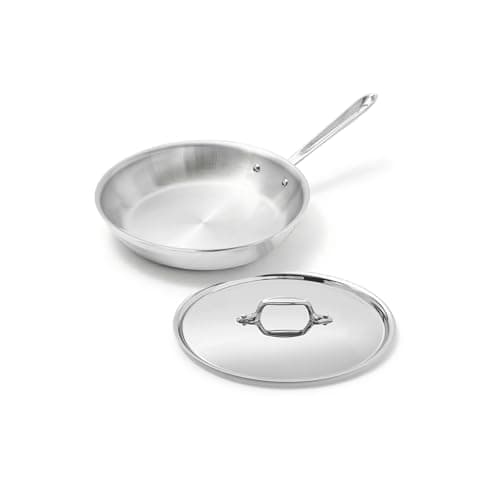
Published specifications for the All-Clad D3 Stainless 10 in Fry Pan
Construction
Fully bonded tri-ply, aluminum core
Oven maximum
600F, oven and broiler safe
Induction
Yes - compatible with any stovetop
Dishwasher
Handwash only (All-Clad published)
Handle
Double-riveted stainless
Weight
3.0 lb (model 4110)
Warranty
Limited lifetime
Made in
Bonded, engineered and assembled in Canonsburg, PA
Good
600F is the highest oven ceiling of any stainless pan on this site
The one pan here whose manufacturing location is published down to the town
Genuinely repairable-adjacent: rivets are the only failure point and the warranty covers them
Not good
Hand wash only
The flared rim makes it a poor pan for anything with liquid
Costs several times what a Tramontina or Cuisinart pan of the same construction costs
The trade-off. Hand wash only. All-Clad publishes that plainly, and it is a real daily cost on a pan you will use every day.
Skip this if. You want a dishwasher-safe pan, or you are buying a whole kitchen on a fixed budget - one D3 skillet costs what a full clad set can cost.
Expensive, permanent pieces: a fully clad stainless set, an enameled Dutch oven, one good skillet and a bakeware set. Keep cheap consumables like nonstick pans off the list and buy those yourself later.
›Should you register for nonstick pans?
No. Nonstick coatings wear out and no manufacturer publishes a lifespan for one, so a nonstick pan is a consumable with a hidden expiry date. Buy them yourself, cheaply, and replace them as they wear.
›How many pieces of cookware should a registry have?
Enough to cover three price bands so guests can self-select. One high-value item like a set or a Dutch oven, two or three mid-priced pieces such as a skillet or a stock pot, and several inexpensive items like sheet and loaf pans.
›Is a Le Creuset Dutch oven worth registering for?
It is the classic registry piece because it lasts decades and few people buy one for themselves at full price. If the budget is better spent elsewhere, a Lodge enameled pot does nearly the same job for a fraction of it.
›Should you register for a cookware set or individual pieces?
A set, if the line is still sold in open stock so you can add to it later. Discontinued matched lines are the main reason people end up with an incomplete set they cannot fill in.
Sources
Every figure on this page came from one of these. Follow them and check our arithmetic — that is the point.