Almost nobody tests cookware the way the word review implies. The question is not whether a reviewer tested the pan - it is whether they tell you what they actually did.
Heads up: some links on this page earn us a commission at no extra cost to you. It does not change what we recommend or the order. How we are funded.
The short answer
Does it say whether it tested or read? The single most informative sentence in any cookware review. "We cooked on these for six weeks" and "we compiled published specifications" are both legitimate. Neither being stated is the warning sign.
Does every number trace to a named document? An oven ceiling, a gauge in millimeters, a weight. If a figure has no source, assume it came from a retail listing - and retail listings contradict manufacturer manuals constantly.
Does it say what each product is bad at? A recommendation with no trade-off is an advertisement. Every pan has a downside, including the winner.
Does it state what it does not know? No maker publishes a nonstick coating lifespan. A review that quietly implies one is making it up.
Does it disclose how it is paid, and does the money move the ranking? Affiliate commission is fine and disclosed everywhere by law. A single-retailer roundup where every pick happens to be the retailer's own brand is a different thing.
Why this page exists, and our obvious conflict in writing it
We are a cookware review site telling you how to judge cookware review sites. You should read that with the skepticism it deserves, and then apply every test below to this site - which is exactly the point, and the reason the checks are mechanical rather than vibes.
Our own answer to check one, stated up front so nothing is hidden behind it: we do not test the products we write about. We own none of them, we run no lab, and we say so on every page. What we do instead is compile published manufacturer specifications, read the actual manuals, quote warranty terms, and link every source - the method in full.
There are only three kinds of cookware review
Nearly everything published about pots and pans falls into one of three categories, and knowing which one you are reading is most of the work.
Kind
What it can tell you
What it cannot
How to spot it
Laboratory testing
Measured heat distribution, release durability over cycles, warp resistance, handle temperature
Long-term ownership, and anything about a model it did not buy
Publishes a method, a sample size and instrument names. Usually paywalled, because testing costs money
Hands-on cooking
How a pan feels, whether the handle is comfortable, how it behaves on a real hob over months
Anything comparative at scale, and anything measurable - a cook is not an instrument
Specific cooking detail, photographs of the actual pan in a real kitchen, and inconsistencies that read as honest
Specification compilation
What each maker publishes and declines to publish, where listings contradict manuals, what a warranty excludes
How anything cooks. This is reading, not cooking
Linked primary sources, published figures with units, and explicit gaps. This site is this kind
All three are legitimate. A review that is one kind while presenting itself as another is the problem.
The failure is never the category. It is a specification compilation written in the voice of a lab test - "we put 47 pans through their paces" attached to numbers that came from product pages.
What Consumer Reports does differently
Worth a section, because it is the most-searched name attached to this question and because its model genuinely is different.
Consumer Reports is a nonprofit that buys the products it tests at retail, accepts no advertising and takes no free samples, and funds itself from subscriptions. That structure removes the conflict that every affiliate-funded site has, including this one. The trade-off is that its ratings sit behind a paywall, and that it tests a selection of models rather than a category.
What it does not do, and what you still need elsewhere: it does not publish the manufacturer documentation trail - the oven ceiling in the manual against the one in the listing, the warranty exclusion wording, the gauge nobody advertises. Those are reading problems rather than testing problems, and they are where most cookware buying decisions actually go wrong.
The useful combination, if you are buying something expensive: a paid testing source for how it performs, and a specification source for what the maker has committed to in writing. They answer different questions and neither substitutes for the other.
The three failure patterns, with a worked example of each
1. Testing language over listing data
The commonest problem in the category. A page says it tested, and then reports figures that are visibly copied from retail product pages - which is how an error propagates across a hundred sites at once.
The example we hit while building this site: Cuisinart's MultiClad Pro is advertised at 550F on its Amazon listing and documented at 500F in Cuisinart's own use-and-care manual, with Cuisinart confirming the manual is correct. Any review quoting 550F read the listing. Any review quoting 500F read the manual. That one number tells you which happened - how to read a cookware listing.
2. A figure that describes a material, not a pan
GreenPan publishes 850F for the Thermolon coating in isolation. That figure is real and it is widely reproduced as a pan rating, which it is not: the finished pan is limited by its aluminum body and its handle. A review repeating 850F as an oven maximum has quoted a materials-science fact as a cooking instruction - oven-safe cookware temperatures.
3. A rating that implies a measurement
A score out of five, or 4.3 stars, states that something was measured on a scale. If no method is published, the number is a summary of an opinion wearing the clothes of data.
This is why there are no star ratings anywhere on this site and no aggregateRating in its structured data: a rating would imply a test we did not run. It costs us search visibility and it is the right call - our editorial policy.
The checklist, as questions you can ask of any page
Ask this
Good answer looks like
If it is missing
Did you test these or read about them?
A plain sentence either way, near the top
Assume reading. Then check whether the numbers survive check two
Where did this number come from?
A link to a manual, a brand spec page or a named standard
Treat the figure as a retail listing until proven otherwise
What is the top pick bad at?
A stated trade-off on the winner, not only on the runners-up
You are reading an advertisement with a ranking on it
What do you not know?
Explicit gaps: no published lifespan, no published gauge, no stated country
Gaps are being filled with inference. That is where fabrication starts
How are you paid, and does it change the ranking?
A disclosure, plus the same commission on every option in a comparison
Check whether every pick conveniently comes from one seller
Why is there a year in the title?
Nothing - but there should be a real last-updated date on the page
A year in a title with no update date is a freshness signal, not freshness
Are the photographs of this pan?
The actual model, or an honest ambient shot, or a labeled placeholder
A stock photo of a different pan standing in for a named model is the imagery version of a fabricated quote
Most cookware errors are reading errors. The listing and the manual disagree more often than you would believe.
Five red flags that are close to decisive
"PFOA-free" presented as a selling point. PFOA was phased out of US cookware manufacturing years ago, so essentially every pan on sale qualifies. A review treating it as a differentiator has not understood the category - nonstick coating names decoded.
A stated nonstick lifespan. Across thirty-one brands we have audited, not one publishes one, and every warranty in the category excludes coating wear. "Lasts five years" is invented - how long nonstick lasts.
A piece count used as a value claim. A 12-piece set counts lids. Tramontina's Signature Tri-Ply Clad 12-piece has seven genuinely distinct items - what piece count you need.
A "winner" with no loser. If every pan in a roundup is recommended, nothing has been evaluated. Watch for pages where even the sixth pick is "a great choice".
Leaching or toxicity claims with no published method. This is the most consequential one, because it is the claim people act on. A site asserting what a specific pan does or does not leach, without publishing a test method and results, has made it up. We cannot test for it either, and we say so - healthiest cookware materials.
Customer reviews, and the two things they are good for
Retail star averages are poor guides to whether a pan is good and genuinely useful for two narrower questions, which is worth separating out rather than dismissing them wholesale.
Failure modes. Sort by one star and read twenty. You are not looking for whether people are unhappy - you are looking for whether they are unhappy about the same thing. Three hundred reports of a handle loosening is real data.
Timeline. Reviews are dated. A coated pan with enthusiastic reviews at two weeks and complaints at eighteen months is telling you its actual service life, which is the figure no manufacturer publishes.
What they cannot tell you is anything comparative, because a four-star pan and a four-star pan were rated by different people against different expectations.
Now apply it to us
In the spirit of the page, here is this site scored against its own checklist, including where it comes out badly.
Check
How this site does
Tested or read?
Read. Stated on every page. We have cooked on none of these pans and do not claim to have
Sources for numbers
Every spec traces to a linked source, and a figure a maker does not publish renders as "Not published"
Trade-offs on the winner
Every product carries a stated trade-off and a "skip it if" line, top pick included
Stated unknowns
Named explicitly: no coating lifespans anywhere, no gauge for several pans, no country for some brands
Funding disclosure
Amazon affiliate commission, disclosed on every page, with the same rate on both sides of every comparison
Ratings
None. No stars and no aggregateRating, because we ran no test that would justify one
Where we are weakest
We cannot tell you how anything cooks, how a handle feels, or how long a coating lasts. For those, a paid testing source or a hands-on reviewer is genuinely better than we are
If a check above matters more to you than specification accuracy, this is the wrong site for that question - and knowing which site answers which question is the whole skill.
The three pans used as worked examples above
A set whose listing and manual disagree about its oven ceiling, a coating whose 850F figure describes a film rather than a pan, and a 12-piece set with seven distinct items. All three are good products used here to show how a number gets misread.
Cuisinart MultiClad Pro MCP-12N 12-Piece Set
A cook who wants a dishwasher-safe clad set and a lifetime warranty
Prices last checked October 6, 2026. Prices move constantly — the number on Amazon when you click is the real one.
What to buy, if you are buying
These are the products this page's reasoning actually points at. Same rules as everywhere else on the site: published specs, a stated trade-off, and a live price only where one exists.
Top pick · The pan that exposes which document a reviewer readSpecs read September 3, 2026
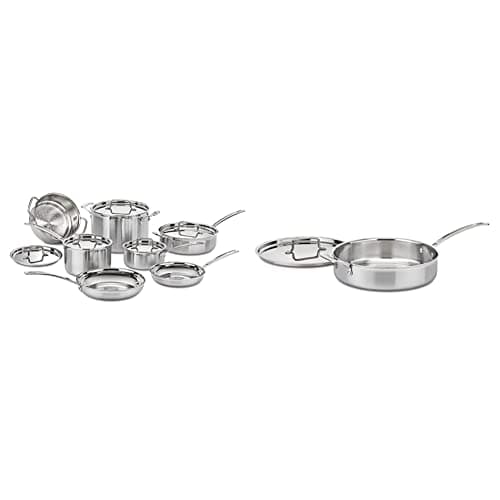
Cuisinart MultiClad Pro MCP-12N 12-Piece Set
A genuinely good tri-ply set, and the clearest test in the category: its listing says 550F and its own manual says 500F. Whichever figure a review quotes tells you whether it read the manual.
Best for: A cook who wants a dishwasher-safe clad set and a lifetime warranty
Published specifications for the Cuisinart MultiClad Pro MCP-12N 12-Piece Set
Construction
Tri-ply: 18/10 stainless interior, pure aluminum core, brushed stainless exterior
Pieces
1.5 and 3 qt covered saucepans; 8 in and 10 in skillets; 3.5 qt covered saute; 8 qt covered stockpot; steamer insert
Oven maximum
500F per the Cuisinart use-and-care manual. Amazon listings say 550F; Cuisinart has confirmed the manual figure
Induction
Yes
Dishwasher
Dishwasher safe
Handles
Riveted solid stainless, cool-grip profile
Warranty
Lifetime
Good
Heat runs up the sidewalls, not just across the base
Genuinely dishwasher safe, which the pricier clad brands often are not
Lifetime warranty on a set at this price
Not good
Published oven maximum contradicts the retail listing for the same product
Handle spine is divisive
No 12-inch skillet in the box, which is the pan most people reach for second
The trade-off. The cool-grip handles have a sharp spine that some people find uncomfortable on a full 8-quart stockpot.
Skip this if. You want the higher oven ceiling that the Amazon listing advertises. The manual says 500F and Cuisinart has confirmed the manual is correct.
#2 · The figure that describes a film, not a panSpecs read September 3, 2026
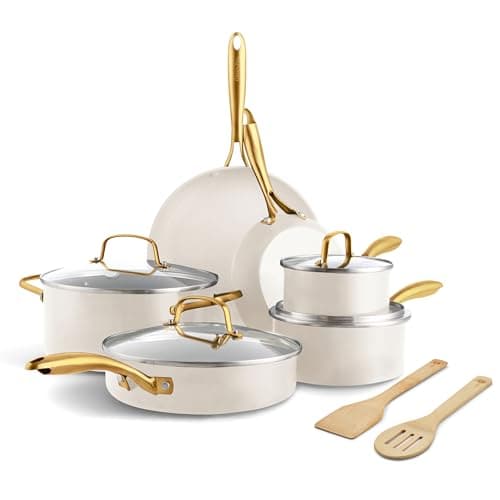
GreenPan Ceramic Nonstick Cookware Set
The ceramic set to buy if you want ceramic, with the clearest published coating composition anywhere. Its widely quoted 850F applies to Thermolon in isolation - the finished pan is limited by its aluminum body.
Best for: Someone who wants nonstick without PTFE and has read what that trades away
Published specifications for the GreenPan Ceramic Nonstick Cookware Set
Coating
Thermolon, from sand-derived Silicon Dioxide (SiO2), sprayed
Coating chemistry
PFAS-free, PFOA-free, free of lead and cadmium (GreenPan published)
Coating heat resistance
850F / 450C for the coating itself (GreenPan published)
Body oven maximum
Varies by line and is lower than the coating figure - check the specific line
Coating lifespan
Not published. No ceramic maker publishes one
Good
GreenPan publishes what the coating is made of in plain terms, which most ceramic brands do not
The coating will not release fumes if you overheat it the way PTFE can
Genuinely good release when new
Not good
Release degrades and nobody will tell you how fast
The 850F figure is for the coating, not the pan, and gets quoted as if it were the pan
Ceramic dislikes high heat and dishwashers, which is most of what a set gets used for
The trade-off. Ceramic nonstick loses release with use and no maker publishes a lifespan, GreenPan included. Treat it as a consumable, not a lifetime purchase.
Skip this if. You are buying a set expecting it to last as long as clad stainless. It will not, and the honest move is to buy one ceramic pan alongside a stainless set.
#3 · The piece count that is arithmeticSpecs read September 3, 2026
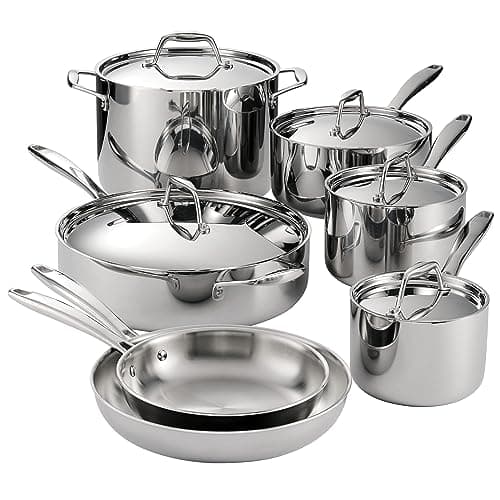
Tramontina Signature Tri-Ply Clad 12-Piece Set
Fully clad at a price that usually buys disc-bottom, and a useful illustration: the twelve pieces are seven vessels and five lids. A saving computed over twelve items is computed over the lids.
Best for: A first kitchen that should not need replacing
Published specifications for the Tramontina Signature Tri-Ply Clad 12-Piece Set
Construction
Tri-ply: 18/10 stainless, aluminum core, magnetic stainless exterior
Pieces
8 in and 10 in fry pans; 1.5, 2 and 3 qt covered saucepans; 5 qt covered deep saute; 8 qt covered stockpot
Oven maximum
500F on the 80116-249DS listing; other SKUs in the line are listed at 350F
Induction
Yes - magnetic stainless exterior
Dishwasher
Listed dishwasher safe
Handles
Precision cast, riveted
Certification
NSF-certified on the 80116-249DS line
Country of origin
Not asserted - retail listings disagree across SKUs (Brazil and China both appear)
Good
Fully clad, not disc-bottom: the aluminum runs up the sidewalls, so sauces do not scorch in a ring at the base
NSF certification on the flagship SKU is a real, checkable third-party mark rather than a marketing badge
Induction-ready without paying an induction premium
Not good
Retail listings disagree on the oven maximum across SKUs in the same line, which is a documentation problem, not a cooking one
Handles run hot on gas
The 12-piece count includes lids; the useful-item count is seven
The trade-off. Handles are the weak point. They are riveted and sturdy, but they get hot on a gas ring in a way the more expensive clad brands' do not.
Skip this if. You want a set you can leave in the oven above 500F, or you cook mostly eggs and pancakes and would rather spend the money on one good nonstick pan.
Some of them, and the test is mechanical rather than a matter of feel. Ask whether the review says if it tested or read the products, whether every number links to a named source, whether the top pick has a stated downside, whether the review says what it does not know, and whether it discloses how it is paid. A page that passes all five is usually worth reading whichever category it falls into.
›Does Consumer Reports test cookware?
Yes. It is a nonprofit that buys the products it tests at retail, accepts no advertising and no free samples, and funds itself through subscriptions, which removes the conflict every affiliate-funded site has. The trade-offs are a paywall and a selection of models rather than a whole category, and it does not publish the manufacturer documentation trail - manual against listing, warranty exclusion wording, unadvertised gauge.
›Why do cookware sites disagree about oven temperatures?
Because retail listings and manufacturer manuals disagree, and most sites quote the listing. Cuisinart's MultiClad Pro is advertised at 550F and documented at 500F in its own manual, with Cuisinart confirming the manual. Whichever figure a review quotes tells you which document it read.
›Are star ratings on cookware meaningful?
Only if a method is published. A score out of five asserts that something was measured on a scale, so without a stated method it is an opinion formatted as data. Retail customer averages are a different thing and are useful for two narrow purposes: spotting repeated failure modes in one-star reviews, and reading the dates to infer real service life.
›What is the biggest red flag in a cookware review?
A leaching or toxicity claim about a specific pan with no published test method and no results. It is the claim readers act on hardest, and it is the one nobody writing about cookware can substantiate without a lab. A stated nonstick coating lifespan is a close second, since not one of the thirty-one brands we have audited publishes one.
›Does a year in the title mean a review is current?
No. A year in a title is a search signal and costs nothing to type. Look for a real last-updated date on the page, and check whether the products listed are still sold. A 2026 title recommending a discontinued line has not been updated for 2026.
Sources
Every figure on this page came from one of these. Follow them and check our arithmetic — that is the point.