A brand is a specification and a warranty, not necessarily a factory. Here is which brands will tell you where their pans are made, and what that disclosure is worth.
Heads up: some links on this page earn us a commission at no extra cost to you. It does not change what we recommend or the order. How we are funded.
The short answer
Most of them do not make their own pans, and that is normal rather than suspicious - contract manufacturing is the default in this category. What separates brands is not whether they own a factory but whether they will tell you where the pan was made. Across our thirty-one brand audits, a minority publish a specific place: All-Clad states its D3 line is bonded, engineered and assembled in Canonsburg, Pennsylvania; Lodge names its South Pittsburg, Tennessee foundry; USA Pan names Greater Pittsburgh; Demeyere publishes Belgium, Scanpan Denmark, Le Creuset, Staub, de Buyer and Matfer Bourgeat France, Hestan and Made In Italy, Victoria Colombia, and Zwilling publishes Vietnam for Clad CFX. A second group publishes nothing checkable - Misen, Caraway, HexClad, Circulon and Our Place all leave country unpublished, Viking publishes only the word "imported", and Tramontina's own retail listings disagree with each other, with Brazil and China both appearing for the same line. None of that is evidence of a bad pan. It is a statement about how much you can check.
Why a brand not owning a factory is normal
Cookware is a contract-manufacturing industry. A small number of plants - in China, Vietnam, Thailand, India, Turkey, Italy, Portugal and a handful of US and French survivors - produce for a very large number of badges. A brand's actual product is usually a specification handed to a factory, a quality standard, a warranty and a distribution network.
That is not a scandal and it is not unique to cheap brands. It is how most consumer hardware works, and some excellent pans come out of shared plants while some disappointing ones come out of dedicated ones. The reason it matters to a buyer is narrower: if a brand is a specification rather than a factory, then the specification is the thing you are buying - and you should be able to read it.
Which is exactly where the brands separate, and it is the same split this site finds everywhere else. The ones with something checkable publish it. The ones without, do not - the same inversion shows up on material disclosure.
What each audited brand publishes about where its pans are made
Read directly from each maker's own published product information, for the specific models in our ledger. Where a brand publishes different answers for different lines, the table says so, because that is itself the finding.
Brand
What it publishes
What that tells you
All-Clad
D3 is bonded, engineered and assembled in Canonsburg, Pennsylvania
The most precise claim in the ledger - it names the town and names the steps it is claiming
Lodge
Cast iron: South Pittsburg, Tennessee. Carbon steel: no country published
A brand being specific where it can and silent where it cannot, within one catalog
USA Pan
USA, Bundy family company, Greater Pittsburgh, Pennsylvania
Names the parent company as well as the place, which almost nobody does
Nordic Ware
Made in America of domestic and imported materials
The standard qualified claim: US manufacture, imported inputs. Legally careful, not evasive
Le Creuset / Staub / de Buyer / Matfer Bourgeat
France
Country-level, consistent across the line, and verifiable against the brands' own factory histories
Demeyere
Belgium
Country-level and consistent, on a line that also publishes a rating for almost everything else
Scanpan
Denmark
Good origin disclosure on a brand that does not publish its surface composition
Hestan / Made In
Italy
Country-level. Note Made In names Italy for this pan but publishes no country for its wider range
Victoria
Colombia
Specific and unusual - most cast iron sold in the US is either Tennessee or unstated
Zwilling
Vietnam, for Clad CFX
A premium European badge naming an Asian plant, which is the honest and common arrangement
Cuisinart
China for the enameled cast iron line; no country published for MultiClad Pro
Different answers within one catalog, which is the normal pattern for a large brand
Craft Wok
Guangzhou, China
City-level specificity from a small brand, which is more than most large ones manage
Viking
Published only as "imported"
The legal minimum. It is a disclosure that discloses nothing
Tramontina
Not asserted - its own retail listings disagree, with Brazil and China both appearing across SKUs
A documentation fault rather than a cooking one, and the clearest case in the ledger
Misen / Caraway / HexClad / Circulon / Our Place
No country of manufacture published
You cannot check. That is the whole finding - not an allegation about the pans
Country-of-origin fields as published by each maker for the models in our product ledger, read on the date stamped on this page.
What "Made in USA" legally means, and does not
The phrase is regulated in the United States, and understanding the regulation explains most of the odd wording you see on cookware.
Under the FTC's Made in USA standard, an unqualified claim requires that all or virtually all of the product be made in the US. A product with meaningful imported content has to use a qualified claim instead - which is precisely what Nordic Ware's "Made in America of domestic and imported materials" is. That phrasing is not weaselling; it is the compliant way to say "we make it here, the steel came from elsewhere."
All-Clad's wording repays the same attention. "Bonded, engineered and assembled in Canonsburg, Pennsylvania" names three operations and stops. It is careful about which steps it is claiming, and that care is the mark of a claim written by someone who had to stand behind it.
A general rule that works surprisingly well across this category: the more specific and the more qualified a manufacturing claim is, the more likely it is to be true. Vague claims are cheap. "Imported" costs nothing to publish and means nothing.
How to tell two brands are selling the same pan
This is the practical payoff of the whole question, and it is something you can do from a phone in a shop. Shared-factory pans tend to share their published numbers, because both badges are quoting the same tooling.
Compare the published dimensions to the decimal. Two pans whose rim diameter, base diameter and height match exactly are very likely the same casting or the same press. Marketing copy is rewritten; tooling dimensions are not.
Compare weights. A weight match to the ounce, across brands, is a strong signal - weight is a function of the die and the gauge, both of which belong to the factory rather than the badge.
Compare the oven ceiling figure. These numbers come from the plant's own testing, so the same figure appearing on two unrelated brands - with the same caveats in the same order - is informative.
Look at the lid. Lids are the most tooling-heavy part of a set and the least redesigned. An identical knob, an identical rim profile and an identical vent on two badges is close to conclusive - cookware lids explained.
Read the care instructions side by side. Care copy is often supplied by the factory and lightly edited. Identical sentences about utensils, detergent or stacking are a tell.
When you find a match, the right conclusion is modest: the pan may be the same, the purchase is not. The badge still determines the warranty, whether you can buy a replacement lid in three years, and whether anyone answers the phone - cookware warranties explained.
Several of these were pressed in the same kind of plant. What differs is what each badge publishes and what it owes you afterwards.
Where the country genuinely changes the pan
It is worth being honest about this, because "made in China" is used as a verdict far more often than it works as one.
Where it matters
Cast iron and enamel. These are foundry processes with real differences in casting consistency, wall thickness control and enamel application between plants. It is the category where origin correlates most visibly with finish.
Recourse. A domestic manufacturer with a named plant is easier to hold to a warranty than a brand that publishes no country at all. This is a customer service argument, not a metallurgy one.
Whether you can get parts. Replacement lids, handle screws and gaskets are far likelier to exist years later from a brand with a stable factory relationship.
Where it does not
Clad stainless performance. Three-layer bonding is a mature process. A well-specified tri-ply pan from a competent Asian plant cooks like a well-specified tri-ply pan from a competent US one, and the spec sheet tells you more than the flag does - tri-ply versus five-ply.
Coating chemistry. The major coatings are licensed or formulated by a handful of suppliers and applied in many countries. Origin tells you nothing about what is in the coating - nonstick coating names decoded.
Safety. Food-contact rules apply to what is sold in a market, not where it was made. There is no version of this question where the country is the safety answer - healthiest cookware materials.
What to do with all this
Buy the specification, not the badge. Ply count, gauge in millimeters, core material, oven ceiling, handle attachment. A brand that publishes all five has told you more than a flag does.
Treat unpublished origin as unpublished, not as bad. Misen publishes every layer of its construction from an 18/0 exterior to an 18/10 interior at 3.0 mm and 800F, and publishes no country. That is a good spec sheet with a gap in it.
Weight contradictions more heavily than silence. A brand whose own listings disagree with each other has a documentation problem you will hit again at warranty time.
If origin is your actual priority, shop it directly. Four brands in our ledger publish a US factory, and that page exists - cookware made in USA.
What we cannot tell you
We have not traced a single supply chain. We have not visited a plant, obtained a bill of materials or confirmed any factory relationship with any manufacturer. Everything on this page is read from what brands publish about themselves, and the one claim we are making is about disclosure quality rather than about who tools what.
Specifically: nothing here asserts that any two named brands share a factory. The section above gives you the tests; the conclusions from them are yours to draw on a specific pair of pans - how we work and what we never publish.
Three levels of manufacturing disclosure
A named town and named operations, a named foundry, and a complete construction spec with no country attached. All three are good pans; they tell you different amounts.
All-Clad D3 Stainless 10 in Fry Pan
One good open-stock stainless pan bought instead of a cheap full set
These are the products this page's reasoning actually points at. Same rules as everywhere else on the site: published specs, a stated trade-off, and a live price only where one exists.
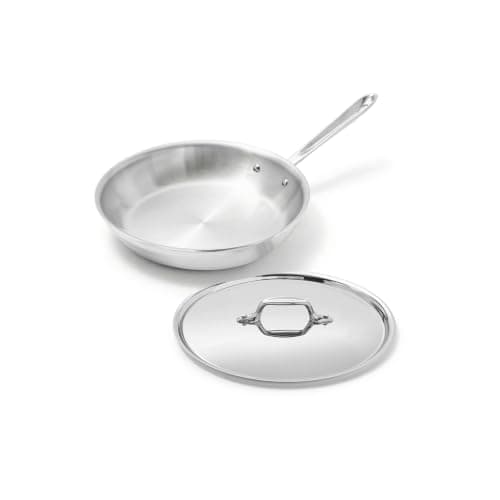
Top pick · Names the town and the operationsSpecs read September 3, 2026
All-Clad D3 Stainless 10 in Fry Pan
Bonded, engineered and assembled in Canonsburg, Pennsylvania - the most precise manufacturing claim in our ledger, because it says which steps it is claiming and stops there.
Best for: One good open-stock stainless pan bought instead of a cheap full set
Published specifications for the All-Clad D3 Stainless 10 in Fry Pan
Construction
Fully bonded tri-ply, aluminum core
Oven maximum
600F, oven and broiler safe
Induction
Yes - compatible with any stovetop
Dishwasher
Handwash only (All-Clad published)
Handle
Double-riveted stainless
Weight
3.0 lb (model 4110)
Warranty
Limited lifetime
Made in
Bonded, engineered and assembled in Canonsburg, PA
Good
600F is the highest oven ceiling of any stainless pan on this site
The one pan here whose manufacturing location is published down to the town
Genuinely repairable-adjacent: rivets are the only failure point and the warranty covers them
Not good
Hand wash only
The flared rim makes it a poor pan for anything with liquid
Costs several times what a Tramontina or Cuisinart pan of the same construction costs
The trade-off. Hand wash only. All-Clad publishes that plainly, and it is a real daily cost on a pan you will use every day.
Skip this if. You want a dishwasher-safe pan, or you are buying a whole kitchen on a fixed budget - one D3 skillet costs what a full clad set can cost.
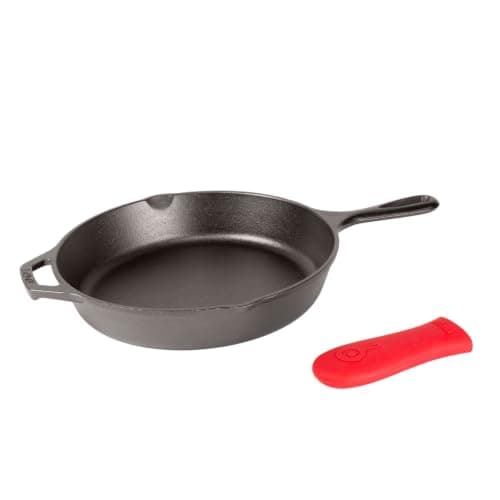
#2 · Names the foundrySpecs read September 3, 2026
Lodge Seasoned Cast Iron Skillet, 10.25 in (L8SK3)
South Pittsburg, Tennessee, published alongside the weight, the oven ceiling and the seasoning composition. Note that Lodge publishes no country at all for its carbon steel line.
Best for: Searing, cornbread, and anyone who wants one pan that cannot be worn out
Published specifications for the Lodge Seasoned Cast Iron Skillet, 10.25 in (L8SK3)
Diameter
10.25 in
Weight
5.66 lb
Oven maximum
550F
Induction
Yes - bare iron is ferrous
Seasoning
Pre-seasoned with soy-based vegetable oil, no synthetic chemicals
Warranty
Lifetime
Made in
USA
Care
Hand wash. Lodge's own instructions permit warm soapy water
Good
Effectively unbreakable and fully restorable - a rusted one can be stripped and re-seasoned
Holds heat better than anything else at the price, which is what a sear needs
Lodge publishes its seasoning method openly, so the maintenance is not a mystery
Not good
Heavy
Heats unevenly on a small burner: cast iron conducts at roughly 50 W/m-K, so it is slow to spread and slow to react
Bare iron is reactive; long tomato braises will taste of it
The trade-off. It weighs 5.66 lb empty. You will feel that every time you move it full, and it is the single most common reason a cast iron skillet ends up in a cupboard.
Skip this if. You have wrist or shoulder trouble, or you cook mostly acidic braises. Carbon steel does most of the same jobs at roughly half the weight.
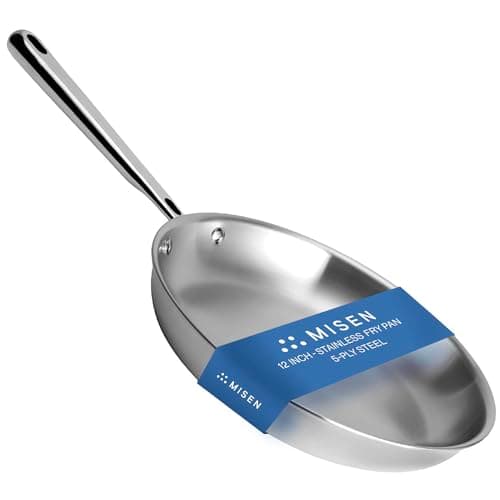
#3 · Complete spec, no countrySpecs read September 3, 2026
Misen 5-Ply Stainless Steel Skillet
Every layer named from an 18/0 exterior to an 18/10 interior at 3.0 mm and 800F, and no country of manufacture anywhere. A good spec sheet with one gap in it, which is not the same as a bad pan.
Best for: Buyers who want the layer stack named rather than counted
Published specifications for the Misen 5-Ply Stainless Steel Skillet
Construction
5-ply, 3.0 mm thick
Exterior
18/0 stainless steel, induction compatible
Core
Aluminum and aluminum alloy
Interior
18/10 stainless steel, published food-contact safe
Diameter
Not published on the pages readable from our build machine
Weight
Not published on the pages readable from our build machine
Handle
Attachment method not published
Oven maximum
800F (426C)
Induction
Yes
Dishwasher
Yes
Made in
Not published
Warranty
Lifetime against defects
Good
Names all five layers including the 18/0 exterior and 18/10 interior
Publishes a 3.0 mm thickness, which is thicker than most tri-ply
800F ceiling and published dishwasher safe
Not good
No published country of manufacture
Product pages did not render specification tables to us; several fields are unread rather than absent
Direct-to-consumer, so returns and retail availability differ from a shelf brand
The trade-off. Misen's product pages did not render their specification tables to our build machine, so several dimensions are recorded here as not published rather than guessed.
Skip this if. You want to hold it first. This is a direct-to-consumer brand with limited retail presence.
Most do not. Cookware is a contract-manufacturing industry, and a brand's product is usually a specification, a quality standard, a warranty and a distribution network rather than a factory. A minority own their plants - Lodge in Tennessee, All-Clad in Pennsylvania, Le Creuset and de Buyer in France, Demeyere in Belgium, Scanpan in Denmark.
›Which cookware brands publish where their pans are made?
Of our thirty-one audits: All-Clad names Canonsburg, Pennsylvania; Lodge names South Pittsburg, Tennessee for cast iron; USA Pan names Greater Pittsburgh; Nordic Ware publishes a qualified US claim; Le Creuset, Staub, de Buyer and Matfer Bourgeat publish France; Demeyere Belgium; Scanpan Denmark; Hestan and Made In Italy; Victoria Colombia; Zwilling Vietnam for Clad CFX; Cuisinart China for its enameled line.
›Which brands do not say where their cookware is made?
Misen, Caraway, HexClad, Circulon and Our Place publish no country of manufacture for the models in our ledger. Viking publishes only the word 'imported'. Tramontina does not assert one, and its own retail listings disagree with each other, with Brazil and China both appearing for the same line. None of that is evidence of a bad pan - it means you cannot check.
›How can I tell if two cookware brands sell the same pan?
Compare the published numbers rather than the copy. Rim and base diameters matching to the decimal, weights matching to the ounce, an identical oven ceiling figure with identical caveats, and an identical lid knob and rim profile are all signals that two badges are quoting the same tooling. Care instructions copied word for word are another.
›What does 'Made in America of domestic and imported materials' mean?
It is the compliant way to make a qualified US origin claim. The FTC's Made in USA standard requires that all or virtually all of a product be US-made for an unqualified claim, so a manufacturer using meaningful imported inputs - steel, for instance - has to qualify it. Nordic Ware uses exactly this wording, and it indicates US manufacture with imported materials.
›Does it matter what country my cookware was made in?
For cast iron and enamel, yes: casting consistency and enamel application genuinely differ between plants. For clad stainless performance, coating chemistry and food-contact safety, no - the specification tells you far more than the origin. Where origin does matter consistently is recourse: a brand with a named plant is easier to hold to a warranty and likelier to still sell you a replacement lid in three years.
Sources
Every figure on this page came from one of these. Follow them and check our arithmetic — that is the point.