Heads up: some links on this page earn us a commission at no extra cost to you. It does not change what we recommend or the order. How we are funded.
The short answer
A braiser is a wide, shallow, lidded pan - usually enameled cast iron, usually 3 to 5 quarts - and the point of the shape is that it holds food in a single layer under a heavy lid. That browns better than a deep pot and reduces a sauce faster. It is a genuinely good third pot and a poor first one: if you own neither, buy a Dutch oven, because it does more.
Quick picks
The whole answer, on one screen. Tap a row to jump to the full write-up. Every pick below carries a stated trade-off further down — including the one at the top.
#
Product
Best for
Price
1
Lodge Enameled Cast Iron Dutch Oven, 6 qt
If you can own only one, a 6 qt enameled Dutch oven braises well and also does stock, bread and deep frying.
Prices last checked October 23, 2026. Prices move constantly — the number on Amazon when you click is the real one.
What we can tell you here
Our audited ledger contains enameled Dutch ovens and cast iron skillets, and it does not contain a separately audited braiser. The method is here: we only put a product card on something whose published specifications we have read. So this page explains the shape and recommends from the pots we have audited, with a tagged category search for braisers themselves.
What the shape actually does
A braise is meat browned hard, then cooked slowly in a small amount of liquid. Both halves of that want different things from a pan, and a braiser is the compromise weighted toward the first half.
Braiser
Dutch oven
Saute pan
Shape
Wide, shallow, lidded
Deep, straight-sided, lidded
Wide, straight-sided, lidded
Typical capacity
3 to 5 qt
5 to 7 qt
3 to 5 qt
Material
Usually enameled cast iron
Enameled or bare cast iron
Usually clad stainless
Food in one layer
Yes - this is the point
No, it stacks
Yes
Browning area
Large
Smaller for the capacity
Large
Sauce reduction
Fast - lots of surface
Slow
Fast
Stock and boiling
No - too shallow
Yes
No
Bread
No
Yes, and it is the best domestic vessel
No
Weight
Heavy
Heavier
Light
A braiser is a Dutch oven traded for surface area, and a saute pan with thermal mass. Both trades are real.
The single-layer point is worth dwelling on. Eight chicken thighs in a 6-quart Dutch oven sit two deep, so the top ones steam. The same eight in a 4-quart braiser sit in one layer touching the base, which is what browning requires — the same surface-area argument made in cookware for batch cooking.
Do you actually need one?
Honestly: probably not, and it is worth saying so on a page that would rather sell you one.
If you own nothing: buy a Dutch oven. It braises acceptably and also does stock, soup, bread and deep frying, none of which a braiser can — what size Dutch oven.
If you own a Dutch oven and a skillet: you can already do everything a braiser does, in two vessels. Brown in the skillet, braise in the pot.
If you braise weekly and want one pan: now a braiser earns its place. It removes a pan from the washing up and keeps all the fond in one vessel.
If you want oven-to-table: a braiser is the best-looking way to do it, which is a real reason people buy them.
What to look for
3.5 to 5 quarts. Below that it holds one portion; above it, the weight stops being manageable in a wide shape.
A wide base rather than a big number. Base diameter is what browns, so read the interior width rather than the quart rating — the same point as Dutch oven sizing.
A heavy, tight lid. A shallow pan has little headroom, so a light lid lets steam escape and the braise dries out.
Wide loop handles that fit a hand in an oven mitt. A wide shallow pan is awkward to lift and the handles are all you have.
A knob rated for your oven. Enameled cast iron is rated by the knob rather than the pot, and it varies by SKU — oven-safe cookware temperatures.
Interior color. Pale shows the fond and stains permanently; black matte hides both — the trade set out in our Staub review.
Handle width decides whether a wide, heavy, shallow pan gets used. It is rarely published and always visible in the product photograph.
Enameled cast iron, and the alternatives
Almost every braiser sold is enameled cast iron, for good reasons: braising is long, wet and frequently acidic, and enamel is non-reactive and holds heat superbly. Bare cast iron in this shape would strip its seasoning on the first coq au vin — is cast iron cookware safe covers why.
Clad stainless braisers exist and are much lighter, at the cost of the thermal mass that keeps a braise steady. That trade is the subject of stainless steel versus enameled cast iron, and for long low cooking the mass genuinely helps.
Identical to any enameled pot: let it cool before washing, hot water and detergent, nothing abrasive, silicone or wooden utensils, and accept that a pale interior will stain. The full routine is in enameled cast iron care.
One shape-specific note: a wide shallow pan is more likely to be used on the stovetop at higher heat than a deep pot, and enamel dislikes being run empty and hot. Get the fat in before the heat.
You braise weekly and want one vessel: a 3.5 to 5 qt enameled braiser, chosen on base width and handle geometry.
You want the reference version:Le Creuset or Staub, depending on interior color.
You only wanted better browning:a cast iron pan plus the pot you already own does it for far less.
The audited pots this page recommends from
Braisers themselves are recommended here as a category, via a tagged search, because we have not audited a specific model. The Dutch ovens above are the honest first purchase.
Lodge Enameled Cast Iron Dutch Oven, 6 qt
Braises, stews, tomato sauce, bread - anything long and wet
Each write-up below gives the published specs, what the pan is genuinely good at, what it costs you, and who should skip it. The trade-off line is there on the top pick too — a recommendation with no downside is an advertisement.
Top pick · Best braiser alternativeSpecs read September 3, 2026
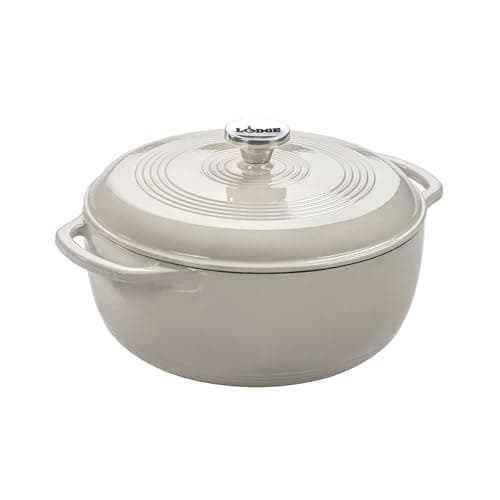
Lodge Enameled Cast Iron Dutch Oven, 6 qt
If you can own only one, a 6 qt enameled Dutch oven braises well and also does stock, bread and deep frying.
Best for: Braises, stews, tomato sauce, bread - anything long and wet
Published specifications for the Lodge Enameled Cast Iron Dutch Oven, 6 qt
Material
Cast iron with porcelain enamel, inside and out
Capacity
6 qt
Induction
Yes - the iron under the enamel is ferrous
Seasoning
None required - enamel is not a seasoning surface
Acid
Safe for tomato and wine, unlike bare iron
Oven maximum
Set by the knob material - check the specific SKU; Lodge publishes a lower ceiling than for bare iron
Good
Non-reactive, so it handles the acidic cooking bare iron cannot
No seasoning to maintain
Considerably cheaper than the French enameled pots it copies
Not good
Chipped enamel is not repairable, unlike bare iron's seasoning
Oven ceiling is lower than bare cast iron because of the knob
Heavy, and the enamel makes it heavier than bare iron of the same capacity
The trade-off. The enamel is a glass layer. Chip it and the pot is not restorable the way bare iron is, and Lodge's enamel chips more readily than the premium brands'.
Skip this if. You already own a large stainless stockpot and rarely braise. This duplicates it for most weeknight cooking.
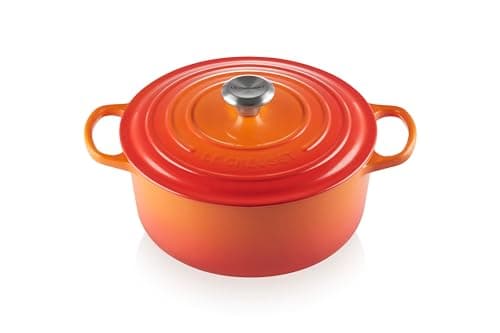
Published specifications for the Le Creuset Signature Round Dutch Oven, 5.5 qt
Material
Cast iron with porcelain enamel inside and out
Capacity
5.5 qt
Interior enamel
Sand-colored, so browning and fond stay visible
Knob
Stainless steel, rated to 500F
Induction
Yes - the iron under the enamel is ferrous
Dishwasher
Dishwasher safe; Le Creuset recommends hand washing
Warranty
Limited lifetime
Made in
France
Good
The pale interior is a genuine cooking advantage: you can see whether the fond is browning or burning
Wide, low-profile handles that a hand in an oven mitt actually fits
The one enameled pot with a real secondhand market, which changes the true cost of ownership
Not good
Costs several times a Lodge enameled pot of the same capacity
The pale interior stains permanently, and Le Creuset says so
Chipped enamel is not repairable on any enameled pot, this one included
The trade-off. You are paying a large multiple of what a Lodge enameled pot costs for a difference in enamel quality, finish and resale value rather than in cooking.
Skip this if. You braise a few times a year. The cooking difference over a Lodge enameled pot is small; the price difference is not.
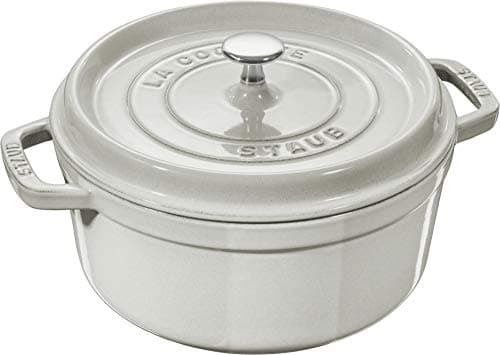
Published specifications for the Staub Round Cocotte, 5.5 qt
Material
Cast iron with enamel inside and out
Capacity
5.5 qt
Interior enamel
Black matte and textured - does not show staining
Lid
Self-basting spikes on the underside
Knob
Metal; the oven rating is set by the knob, so check the specific SKU
Induction
Yes
Warranty
Limited lifetime
Made in
France
Good
Black matte interior is the practical answer to the staining complaint about pale enamel
Heavier lid than most, which matters more than the spikes do on a long braise
Textured interior takes a hard sear better than a glossy enamel does
Not good
You cannot see the fond, which is a real loss on anything you are building a sauce from
Heavy even by enameled cast iron standards
Priced with Le Creuset, so the same skip-if applies
The trade-off. The black matte interior hides fond as well as it hides stains, so you judge browning by smell and by lifting the food rather than by looking.
Skip this if. You want to watch the fond develop. Buy the sand-colored interior instead and accept that it will discolor.
Browning meat and then cooking it slowly in a small amount of liquid, all in one wide shallow lidded pan. The shape holds food in a single layer, which browns better than a deep pot and reduces a sauce faster.
›Do I need a braiser if I have a Dutch oven?
Probably not. A Dutch oven braises acceptably and also does stock, soup, bread and deep frying. A braiser earns its place if you braise weekly and want to brown and cook in one vessel rather than two.
›What size braiser should I buy?
Three and a half to five quarts. Below that it holds one portion; above it, a wide shallow pan gets awkward to lift. Read the interior base width rather than the quart rating, because base area is what browns.
›What is the difference between a braiser and a saute pan?
Material and mass. A braiser is usually enameled cast iron with high thermal mass that holds a steady low temperature; a saute pan is usually clad stainless, much lighter and more responsive. Both are wide with straight or sloping sides and a lid.
›Should a braiser be bare or enameled cast iron?
Enameled. Braising is long, wet and frequently acidic, and acid strips seasoning from bare iron and can leave a metallic taste. Almost every braiser sold is enameled for exactly this reason.
Sources
Every figure on this page came from one of these. Follow them and check our arithmetic — that is the point.