Bare iron rather than enamel. It goes places enamel cannot - a fire, a grill, a broiler - and it minds the acidic braising most people buy a Dutch oven for.
Heads up: some links on this page earn us a commission at no extra cost to you. It does not change what we recommend or the order. How we are funded.
The short answer
Buy bare cast iron if you want a pot that goes on a campfire, under a broiler and onto a grill, and buy enamel if your main use is a long tomato or wine braise. The Lodge 5 quart Double Dutch Oven is the one we can document in bare iron: 12.37 lb, seasoned with 100% natural vegetable oil, published for any stovetop plus oven, grill and campfire, made in the USA and published free of PFAS - with a lid that is also a dual-handle pan.
Quick picks
The whole answer, on one screen. Tap a row to jump to the full write-up. Every pick below carries a stated trade-off further down — including the one at the top.
#
Product
Best for
Price
1
Lodge Cast Iron Double Dutch Oven, 5 qt
Five quarts of bare iron with a lid that doubles as a skillet, published for stovetop, oven, grill and campfire.
Prices last checked October 24, 2026. Prices move constantly — the number on Amazon when you click is the real one.
How we chose these
We have not cooked in them. This page compares published capacity, weight, dimensions, seasoning composition, heat-source compatibility, care guidance, coatings statements, origin and warranty. The method is here, and where a maker publishes nothing the product card says so rather than guessing.
One gap worth naming: Lodge does not publish an oven temperature limit on the Double Dutch Oven product page. It publishes 550F across its seasoned range generally, which we record as the reference figure while noting the product page itself is silent.
Bare or enameled, which is the whole decision
This page exists because "cast iron Dutch oven" and "enameled Dutch oven" are different products that get shopped as one. The enameled roundup is best enameled Dutch ovens; this one is about the bare version.
Bare cast iron
Enameled cast iron
Cooking surface
Seasoning you build and rebuild
Porcelain enamel, permanent
Acidic braising
Strips seasoning; can taste metallic
A non-issue - it is inert
Campfire and coals
Yes, published
No - flame and thermal shock chip enamel
Grill
Yes, published
No
Broiler
In practice yes
No
Maintenance
Dry on the burner, oil occasionally
Wash and put away
Failure mode
Rust, which is fully recoverable
A chip, which is not repairable
Weight, 5 to 6 qt
12.37 lb published for the Lodge 5 qt
Heavier again for the same capacity
Price
Low
Moderate to high
The acidic-braising row is why most buyers should own enamel. The bottom four rows are why bare iron still has a place.
The honest summary: if a Dutch oven is mainly for coq au vin, ragu and chili, buy enamel. If it is for bread, camp cooking, deep frying and dry braises, bare iron is cheaper, tougher and goes places enamel cannot.
The lid that is a second pan
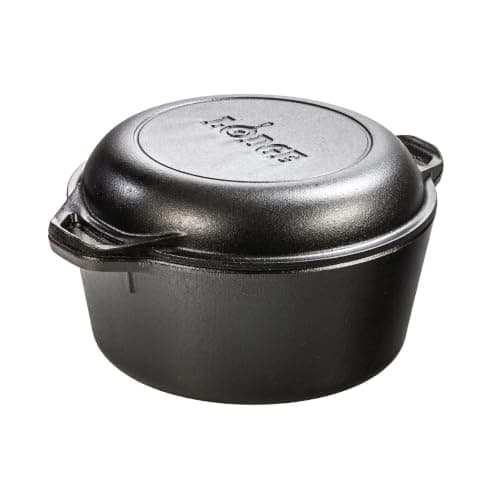
The Lodge Double Dutch Oven is the one bare pot with a genuine design argument: the lid is a dual-handle skillet in its own right. That is published, not inferred, and it matters in two situations.
Camping, where carrying two pieces that are one object is the whole point.
A small kitchen, where a 10-inch shallow pan and a 5-quart pot in one footprint is real cupboard arithmetic — cookware for small kitchens.
The trade is that the lid has no knob, so lifting it hot needs two mitts rather than one hand, and it does not seal as heavily as a domed enameled lid does on a long braise.
What Lodge publishes
Specification
Published figure
Capacity
5 qt
Dimensions
12.62 x 10.37 x 6.31 in
Weight
12.37 lb
Lid
Doubles as a dual-handle pan
Seasoning
100% natural vegetable oil
Heat sources
Any stovetop including induction, plus oven, grill and campfire
Care
Hand wash, dry, oil
Coatings
Made without PFAS
Oven maximum
Not published on the product page; 550F across the seasoned range
Made in
USA
Warranty
Lodge Made Right Warranty
Recorded from Lodge's published product page. The oven-maximum row is a real omission on that page rather than an inference on ours.
The PFAS statement is worth noting because it is a specific, checkable claim in a category where most non-toxic marketing is vague — the same standard applied in non-toxic bakeware.
Five quarts of bare iron already weighs over twelve pounds. Capacity and weight rise together, which is the real ceiling on a Dutch oven purchase.
Sizing bare iron
The sizing logic is the same as for enamel and is set out in what size Dutch oven: 5 to 6 quarts suits most households, 3.5 to 4 for one or two people, 7 and up only if you regularly cook for six.
Bare iron adds one consideration. It is heavy for its capacity and the handles are usually short loops cast into the body, so there is no comfortable long handle to leverage against. A 7-quart bare pot full of stew is a genuinely two-handed lift from a low oven, which is why long oven mitts matter more with this material than with any other.
The camp Dutch oven is a different shape
Worth separating, because search results mix them. A camp Dutch oven has three legs so it stands over coals, and a flanged lid with a raised rim so you can pile coals on top and bake. It is designed for fire and it is awkward on a domestic stovetop, because the legs stop it sitting flat.
If your use is genuinely outdoors, that is the shape to buy rather than a flat-bottomed pot. Camp Dutch ovens — we have not audited a specific model. The wider travelling-kitchen case is in cookware for camping and RVs.
Care, and the acid rule
Hand wash, dry on a burner, wipe a very thin film of oil. Lodge publishes exactly this: hand wash, dry, oil.
Never a dishwasher. The seasoning is polymerized oil and detergent exists to remove oil.
Keep long acidic cooking out of it. A short deglaze is fine; a two-hour tomato braise is what enamel is for — is cast iron cookware safe explains the mechanism.
Store with the lid ajar. A sealed bare pot traps moisture against bare metal, which is how rust starts.
Each write-up below gives the published specs, what the pan is genuinely good at, what it costs you, and who should skip it. The trade-off line is there on the top pick too — a recommendation with no downside is an advertisement.
Top pick · Best bare cast iron potSpecs read September 3, 2026
Lodge Cast Iron Double Dutch Oven, 5 qt
Five quarts of bare iron with a lid that doubles as a skillet, published for stovetop, oven, grill and campfire.
Best for: Camp cooking, bread, and anyone who wants iron rather than enamel in a pot
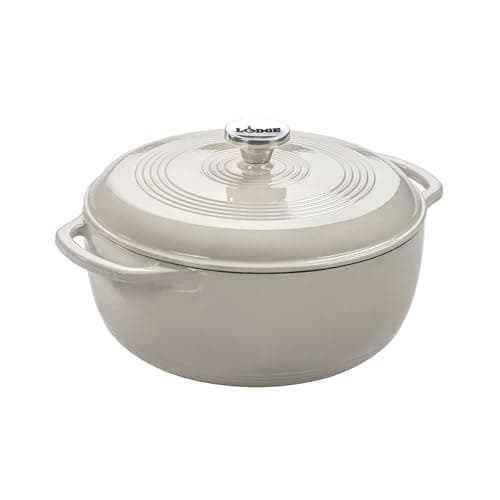
Published specifications for the Lodge Enameled Cast Iron Dutch Oven, 6 qt
Material
Cast iron with porcelain enamel, inside and out
Capacity
6 qt
Induction
Yes - the iron under the enamel is ferrous
Seasoning
None required - enamel is not a seasoning surface
Acid
Safe for tomato and wine, unlike bare iron
Oven maximum
Set by the knob material - check the specific SKU; Lodge publishes a lower ceiling than for bare iron
Good
Non-reactive, so it handles the acidic cooking bare iron cannot
No seasoning to maintain
Considerably cheaper than the French enameled pots it copies
Not good
Chipped enamel is not repairable, unlike bare iron's seasoning
Oven ceiling is lower than bare cast iron because of the knob
Heavy, and the enamel makes it heavier than bare iron of the same capacity
The trade-off. The enamel is a glass layer. Chip it and the pot is not restorable the way bare iron is, and Lodge's enamel chips more readily than the premium brands'.
Skip this if. You already own a large stainless stockpot and rarely braise. This duplicates it for most weeknight cooking.
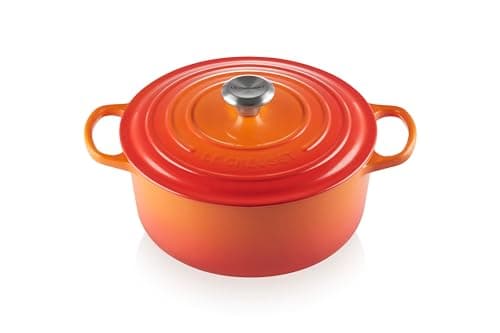
Published specifications for the Le Creuset Signature Round Dutch Oven, 5.5 qt
Material
Cast iron with porcelain enamel inside and out
Capacity
5.5 qt
Interior enamel
Sand-colored, so browning and fond stay visible
Knob
Stainless steel, rated to 500F
Induction
Yes - the iron under the enamel is ferrous
Dishwasher
Dishwasher safe; Le Creuset recommends hand washing
Warranty
Limited lifetime
Made in
France
Good
The pale interior is a genuine cooking advantage: you can see whether the fond is browning or burning
Wide, low-profile handles that a hand in an oven mitt actually fits
The one enameled pot with a real secondhand market, which changes the true cost of ownership
Not good
Costs several times a Lodge enameled pot of the same capacity
The pale interior stains permanently, and Le Creuset says so
Chipped enamel is not repairable on any enameled pot, this one included
The trade-off. You are paying a large multiple of what a Lodge enameled pot costs for a difference in enamel quality, finish and resale value rather than in cooking.
Skip this if. You braise a few times a year. The cooking difference over a Lodge enameled pot is small; the price difference is not.
In bare iron, the Lodge 5 quart Double Dutch Oven - 12.37 lb, seasoned with 100% natural vegetable oil, published for any stovetop plus oven, grill and campfire, and a lid that doubles as a dual-handle pan. For acidic braising, buy enameled instead.
›Bare cast iron or enameled Dutch oven?
Bare iron for bread, camp cooking, grills and dry braises - it goes places enamel cannot. Enameled for anything acidic, because tomato and wine strip seasoning from bare iron and can leave a metallic taste. Most buyers should choose enamel.
›How hot can a bare cast iron Dutch oven go?
Lodge does not publish an oven limit on the Double Dutch Oven product page. It publishes 550F across its seasoned range, and that figure describes the seasoning rather than the iron - the pot itself is published as campfire and grill safe.
›What is a double Dutch oven?
A pot whose lid is also a dual-handle skillet, so it is two pans in one footprint. That suits camping and small kitchens. The trade is no lid knob, so lifting it hot takes two mitts, and a lighter seal than a domed enameled lid.
›Is a camp Dutch oven the same thing?
No. A camp Dutch oven has three legs so it stands over coals and a flanged lid so you can pile coals on top to bake. The legs stop it sitting flat on a domestic stovetop, so buy that shape only if the use is genuinely outdoors.
Sources
Every figure on this page came from one of these. Follow them and check our arithmetic — that is the point.