Heads up: some links on this page earn us a commission at no extra cost to you. It does not change what we recommend or the order. How we are funded.
The short answer
A saute pan is a thin, responsive clad stainless pan with straight vertical walls, built for stovetop work: searing, then deglazing and reducing in the same pan, with heat you can change in seconds. A braiser is a heavy enameled cast iron vessel with sloped lower walls and a tight heavy lid, built for oven work: long, low, covered cooking where you want the temperature never to move. If you cook mostly on the hob and make pan sauces, buy the saute pan. If you cook long braises and already own a skillet, buy the braiser. And if you own neither of these and no Dutch oven, buy a Dutch oven instead - it does almost everything a braiser does and a great deal the braiser cannot.
One line each, then the part that matters
A saute pan is a wide pan with straight, vertical walls and a lid, usually clad stainless, usually 3 to 5 quarts. If you want the full version of what it is and how it differs from a skillet, that is saute pan versus skillet and best saute pans.
A braiser is a wide, shallow, lidded vessel with sloped lower walls, usually enameled cast iron, usually 3 to 5 quarts. Whether it beats a Dutch oven is a different argument and we are not going to repeat it here - best braisers settles that one.
What neither of those pages covers is this comparison, and it comes down to two variables that happen to point in opposite directions: wall geometry and thermal mass.
The comparison, variable by variable
Saute pan
Braiser
Wall shape
Straight and vertical, meeting the base at a sharp angle
Sloped at the base, flaring outward and low
Typical material
Clad stainless - a thin aluminum core between steel layers
Enameled cast iron, a single thick casting with glass fused to it
Thermal mass
Low. It changes temperature almost as fast as you change the dial
High. It takes minutes to heat and minutes to cool, and holds whatever it reaches
Weight
Light enough to lift one-handed and swirl
Heavy. A full one is a two-handed, both-mitts proposition
Where it belongs
The stovetop, with your hand on the dial
The oven, with the door shut
What it is genuinely best at
Searing then building a pan sauce in the same vessel: fond, deglaze, reduce
Long covered cooking at a low fixed temperature: short ribs, shanks, beans, a whole braised head of cabbage
What it is bad at
Anything that wants three hours of unattended even heat. A thin base scorches under a long braise
Anything that wants responsiveness. By the time it reacts to the dial the moment has passed
Reduction
Excellent. Straight walls give high volume for the surface area, then the wide surface boils it off fast
Good, lid off - but the mass keeps driving the reduction after you turn the heat down
Acid
Non-reactive. Tomato, wine and vinegar are fine indefinitely
Non-reactive. Enamel is glass, so acid is fine - unlike bare cast iron
Oven ceiling
Typically 500F or above. Cuisinart documents 500F for MultiClad Pro; All-Clad publishes 600F for D3
Set by the knob, not the body. Le Creuset publishes a stainless knob rated to 500F; check the SKU
Induction
Yes, with a magnetic stainless exterior
Yes - the iron under the enamel is ferrous
Maintenance
None. Dishwasher safe on most clad lines
No seasoning, but chips are permanent and thermal shock cracks enamel
Figures as published by each maker for the models in our ledger. The oven ceiling on an enameled pot is a property of its knob, which is why it has to be read per SKU.
Why the walls are the whole decision
Wall geometry is not styling. It changes what the pan does with liquid and with steam.
Straight walls hold volume and let you reduce hard
A vertical wall means the pan's capacity is close to base area times height, so a saute pan holds considerably more than a skillet of the same diameter. That matters because a sauce you are reducing needs somewhere to start. Then the wide flat base gives you the evaporation surface to take it down fast.
The sharp corner where the wall meets the base is also where fond collects, and that corner is why a saute pan deglazes better than a flared pan: there is a defined place for the browned material to be, and a straight edge for a spoon to work along - why food sticks is the mechanism behind fond.
Sloped walls let you get a spoon under things
A braiser's flare does the opposite job. It gives you access: you can get a spoon or a pair of tongs under a short rib and turn it without fighting a corner, and you can serve out of it. Food sits in a single layer, which is the whole point of the shape, because a single layer browns and a stacked pile steams.
The flare costs you reduction capacity and it costs you the deglazing corner. A braiser will reduce a sauce; it is just not what the geometry is for.
Low, wide and sloped: built so food sits in one layer and a spoon can get underneath it.
Thermal mass decides which one forgives you
This is the second variable and it is the one people underestimate. A clad saute pan has a thin aluminum core and very little metal. A braiser is a single heavy casting. The practical difference is how each pan responds to a mistake.
The saute pan forgives inattention badly and corrects fast. Leave it too hot and it scorches in seconds; turn the dial down and it recovers in seconds too. It rewards a cook standing at the stove.
The braiser forgives inattention well and corrects slowly. It will sit at a stable low temperature for three hours with the oven door shut. Overheat it and you have a problem for several minutes, because the heat is stored in the iron rather than coming from the hob.
Which is why a braise in a thin clad pan tends to catch at the base, and why a pan sauce in a braiser tends to overshoot. Neither is a defect. They are different tools and they want different settings.
Who should buy which
Buy the saute pan if you cook mostly on the hob, if you make pan sauces, if you cook for two to four, and if you already have something that handles long oven work - a Dutch oven, a roasting dish, even a deep sheet pan.
Buy the braiser if you already own a good skillet and a saucepan, if the cooking you want to get better at is long and covered, and if you are willing to lift a heavy pot out of a hot oven.
Buy neither, yet, if you do not already own a Dutch oven. A 5.5 to 6 quart enameled Dutch oven does nearly everything a braiser does, plus stock, pasta, beans, soup and bread - which is a wider range than either pan on this page - is a Dutch oven worth it.
If you want one pan to do both, the honest answer is a deep covered saute pan at 5 quarts rather than 3. It will never braise as evenly as iron, but it will reduce properly and it will not scorch a braise if you keep the oven low.
A detail worth knowing before you buy either: on a saute pan, the handle is the part you will resent. Tramontina's riveted cast handles run hot on a gas ring, and Cuisinart's cool-grip profile has a spine some people find uncomfortable on a full pan. Hold one before you commit - cookware handles explained.
The cheapest way to own a saute pan
Worth stating plainly because it changes the arithmetic. A covered saute pan bought open stock is one of the more expensive single pieces in clad stainless. Bought as part of a set, it is frequently close to free in marginal terms.
Cuisinart's MultiClad Pro 12-piece includes a 3.5 qt covered saute. Tramontina's Signature Tri-Ply Clad 12-piece includes a 5 qt covered deep saute. If you need other clad pieces anyway, the set is the route - set versus open stock.
The braiser has no equivalent shortcut. It is bought alone, and the one reliable discount channel for enameled cast iron is an outlet or a cosmetic factory second - when cookware goes on sale.
What we cannot tell you
We have not audited a dedicated braiser SKU, so the braiser column above describes the shape as makers publish it rather than a specific pan we have specification data for. Where we recommend something concrete for braising we recommend an enameled Dutch oven, because that is what is in our ledger with published figures attached. We also have not cooked in either pan - this site compiles published specifications and does not test - how we work.
Where we stand
We do not make or sell saute pans or braisers. Both link to the same retailer, both pay us the same commission rate, and we earn exactly the same whichever one you buy — or nothing at all if you buy neither, which is sometimes the right answer. Most of the comparison pages that rank for this question are published by companies that sell one of the two. How we are funded.
The pans behind both columns
Two clad sets that include a covered saute pan, and the enameled cast iron pot we would buy instead of a dedicated braiser.
Cuisinart MultiClad Pro MCP-12N 12-Piece Set
A cook who wants a dishwasher-safe clad set and a lifetime warranty
Prices last checked October 6, 2026. Prices move constantly — the number on Amazon when you click is the real one.
What to buy, if you are buying
These are the products this page's reasoning actually points at. Same rules as everywhere else on the site: published specs, a stated trade-off, and a live price only where one exists.
Top pick · The saute pan routeSpecs read September 3, 2026
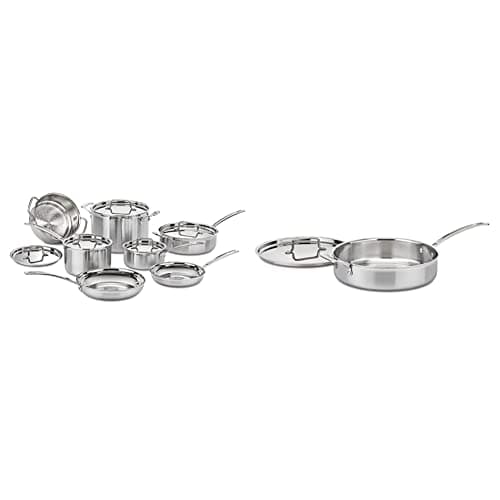
Cuisinart MultiClad Pro MCP-12N 12-Piece Set
The MultiClad Pro set includes a 3.5 qt covered saute pan in tri-ply clad stainless, documented at 500F in Cuisinart's own manual and published dishwasher safe. Buying the shape inside a set is usually cheaper than buying it open stock.
Best for: A cook who wants a dishwasher-safe clad set and a lifetime warranty
Published specifications for the Cuisinart MultiClad Pro MCP-12N 12-Piece Set
Construction
Tri-ply: 18/10 stainless interior, pure aluminum core, brushed stainless exterior
Pieces
1.5 and 3 qt covered saucepans; 8 in and 10 in skillets; 3.5 qt covered saute; 8 qt covered stockpot; steamer insert
Oven maximum
500F per the Cuisinart use-and-care manual. Amazon listings say 550F; Cuisinart has confirmed the manual figure
Induction
Yes
Dishwasher
Dishwasher safe
Handles
Riveted solid stainless, cool-grip profile
Warranty
Lifetime
Good
Heat runs up the sidewalls, not just across the base
Genuinely dishwasher safe, which the pricier clad brands often are not
Lifetime warranty on a set at this price
Not good
Published oven maximum contradicts the retail listing for the same product
Handle spine is divisive
No 12-inch skillet in the box, which is the pan most people reach for second
The trade-off. The cool-grip handles have a sharp spine that some people find uncomfortable on a full 8-quart stockpot.
Skip this if. You want the higher oven ceiling that the Amazon listing advertises. The manual says 500F and Cuisinart has confirmed the manual is correct.
#2 · The braiser route, honestlySpecs read September 3, 2026
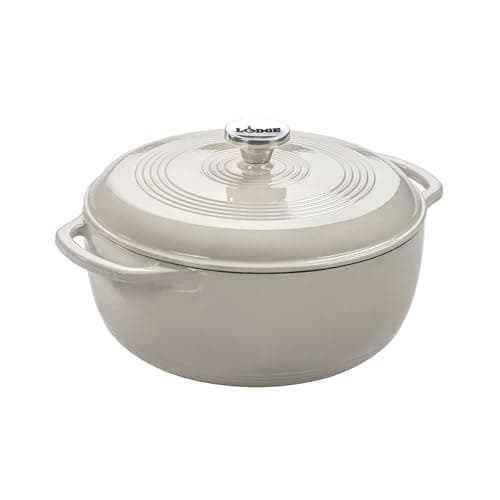
Lodge Enameled Cast Iron Dutch Oven, 6 qt
Enamel inside and out, no seasoning, safe with tomato and wine, and induction-ready because the iron under the enamel is ferrous. We have not audited a dedicated braiser, and this is what we would actually buy in its place.
Best for: Braises, stews, tomato sauce, bread - anything long and wet
Published specifications for the Lodge Enameled Cast Iron Dutch Oven, 6 qt
Material
Cast iron with porcelain enamel, inside and out
Capacity
6 qt
Induction
Yes - the iron under the enamel is ferrous
Seasoning
None required - enamel is not a seasoning surface
Acid
Safe for tomato and wine, unlike bare iron
Oven maximum
Set by the knob material - check the specific SKU; Lodge publishes a lower ceiling than for bare iron
Good
Non-reactive, so it handles the acidic cooking bare iron cannot
No seasoning to maintain
Considerably cheaper than the French enameled pots it copies
Not good
Chipped enamel is not repairable, unlike bare iron's seasoning
Oven ceiling is lower than bare cast iron because of the knob
Heavy, and the enamel makes it heavier than bare iron of the same capacity
The trade-off. The enamel is a glass layer. Chip it and the pot is not restorable the way bare iron is, and Lodge's enamel chips more readily than the premium brands'.
Skip this if. You already own a large stainless stockpot and rarely braise. This duplicates it for most weeknight cooking.
#3 · A 5 qt covered deep saute, includedSpecs read September 3, 2026
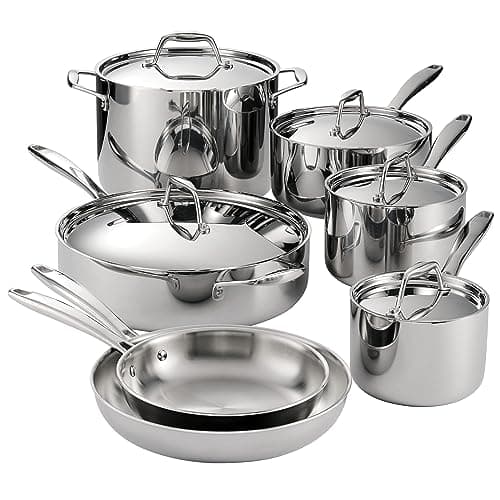
Tramontina Signature Tri-Ply Clad 12-Piece Set
Fully clad tri-ply with a 5 qt covered deep saute in the box, NSF-certified on the flagship SKU and 500F on that listing. The handles run hot on gas, which matters most on the piece you hold longest.
Best for: A first kitchen that should not need replacing
Published specifications for the Tramontina Signature Tri-Ply Clad 12-Piece Set
Construction
Tri-ply: 18/10 stainless, aluminum core, magnetic stainless exterior
Pieces
8 in and 10 in fry pans; 1.5, 2 and 3 qt covered saucepans; 5 qt covered deep saute; 8 qt covered stockpot
Oven maximum
500F on the 80116-249DS listing; other SKUs in the line are listed at 350F
Induction
Yes - magnetic stainless exterior
Dishwasher
Listed dishwasher safe
Handles
Precision cast, riveted
Certification
NSF-certified on the 80116-249DS line
Country of origin
Not asserted - retail listings disagree across SKUs (Brazil and China both appear)
Good
Fully clad, not disc-bottom: the aluminum runs up the sidewalls, so sauces do not scorch in a ring at the base
NSF certification on the flagship SKU is a real, checkable third-party mark rather than a marketing badge
Induction-ready without paying an induction premium
Not good
Retail listings disagree on the oven maximum across SKUs in the same line, which is a documentation problem, not a cooking one
Handles run hot on gas
The 12-piece count includes lids; the useful-item count is seven
The trade-off. Handles are the weak point. They are riveted and sturdy, but they get hot on a gas ring in a way the more expensive clad brands' do not.
Skip this if. You want a set you can leave in the oven above 500F, or you cook mostly eggs and pancakes and would rather spend the money on one good nonstick pan.
›What is the difference between a saute pan and a braiser?
Wall shape and thermal mass. A saute pan has straight vertical walls and a thin clad stainless body, so it holds volume for reducing and responds to the dial in seconds - it is a stovetop pan. A braiser has sloped lower walls and a heavy enameled cast iron body, so food sits in one layer and the temperature barely moves - it is an oven pan.
›Can a braiser be used as a saute pan?
For searing, yes - the mass is an advantage. For building a pan sauce, poorly. The sloped walls hold less liquid for the surface area and give you no corner for fond to collect in, and the stored heat keeps driving a reduction after you turn the dial down, so sauces overshoot.
›Can a saute pan be used as a braiser?
Yes, with care. Keep the oven low and the liquid level up, because a thin clad base will catch under a long braise in a way a heavy casting will not. A 5-quart covered deep saute does this far better than a 3-quart one. Check the oven ceiling first: Cuisinart documents 500F for MultiClad Pro and All-Clad publishes 600F for D3.
›Which should I buy first, a saute pan or a braiser?
Neither, if you do not already own a Dutch oven - a 5.5 to 6 quart enameled Dutch oven covers most braising plus stock, pasta, beans, soup and bread. If you do own one, buy the saute pan, because it adds a capability your Dutch oven does not have: fast, responsive stovetop reduction.
›How many quarts should a saute pan or braiser be?
Three to four quarts suits one or two people; five quarts suits three or more and is the size that can double as a braiser. For a braiser the useful range is the same, and the limit is practical rather than culinary: a full 5-quart enameled cast iron pan coming out of a hot oven is genuinely heavy.
›Is a braiser or saute pan better for induction?
Both work. Enameled cast iron couples very well because the iron under the enamel is ferrous, and it is quieter on induction than clad because a single casting has no bonded layers to vibrate against each other. Clad stainless works too, with a magnetic exterior layer, and is more likely to buzz at high power.
Sources
Every figure on this page came from one of these. Follow them and check our arithmetic — that is the point.