Age is not the problem. Unknown history is. Sorted by material, most of a box of old pans is either better than what you own or beyond saving - and the two are easy to tell apart.
Heads up: some links on this page earn us a commission at no extra cost to you. It does not change what we recommend or the order. How we are funded.
The short answer
What you found
Keep it?
Why
What it needs
Bare cast iron, however rusty
Keep - this is the prize
No coating, nothing to degrade. Rust is surface oxide and seasoning is cooking oil
Scrub to bare metal, re-season. An afternoon, and it is better than new
Bare carbon steel
Keep
Same material logic as cast iron, lighter, and older pans are often thicker
Strip and re-season exactly like cast iron
Clad or heavy stainless
Keep, if the base is flat
Non-reactive with nothing applied to it; there is no wear surface to use up
Check flatness with a straight edge. Bar Keepers Friend for the discoloration
Enameled cast iron, unchipped
Keep
Enamel is glass fused to iron. Intact, it is inert and needs no seasoning
Nothing. Check the whole interior in good light first
Enameled cast iron, chipped inside
Retire from cooking
A chip exposes bare iron under a glass rim that keeps spalling
Nothing fixes this. Decorative or recycling
Any coated nonstick pan
Retire
You cannot date the coating and no maker publishes a lifespan. Unknown wear on an unknown schedule
Replace it cheaply and knowingly
Bare aluminum, dull and pitted
Retire
Pitting is lost metal. It is also reactive, so it was always wrong for long acidic cooking
Recycling. Bright un-pitted aluminum bakeware is fine to keep
Copper with a worn lining
Keep only if you will reline it
Tin linings wear through; relining costs more than many pans are worth
A quote from a re-tinner before you commit
The three faults that nothing fixes
Start here, because it sorts the box fastest. Everything else on this page is restorable or a judgment call. These three are structural, and no amount of scrubbing, seasoning or expense reverses them.
A crack. In cast iron, through enamel into the iron, or in glass. A cracked pan can fail under heat, and the failure is not graceful.
A base that rocks on a flat surface. Lay a straight edge across it. Light under the middle means convex, light at the edges means concave. Warping is permanent, it cannot be trued at home, and on a smooth top or induction hob it ends the pan's usefulness - why pans warp.
Deep pitting in the cooking surface. Pitting is metal that has gone. Surface rust is not pitting; run a thumbnail across it, and if it catches in a crater rather than sliding over roughness, that is pitting.
A loose handle is a fourth candidate but it is often a fixable one: riveted handles can sometimes be re-set, and a cast iron pan has no handle to loosen at all.
Cast iron: keep it, however bad it looks
This is the reason to go through the box at all. Bare cast iron has no coating, no proprietary chemistry and no wear surface. The seasoning is polymerized cooking oil and can be rebuilt from bare metal. Rust is iron oxide on the surface and comes off. A pan that is sixty years old and frightening is, after an afternoon, a pan.
Older castings are frequently better than current ones - thinner walls, smoother machined cooking surfaces - which is why people buy vintage iron deliberately - the vintage cast iron buying guide. The restoration itself is in restoring rusty cast iron.
Reject only for a crack or a base that rocks. Everything else is cosmetic. And if the box has no cast iron in it, a current Lodge skillet publishes 5.66 lb at 10.25 in, 550F and a lifetime warranty for very little money.
Coated pans: the one category to retire on sight
This is the firmest recommendation on the page, and the reasoning is specific rather than squeamish. A coating is a wear surface with a service life, and across the thirty-one brands in our audit ledger not one publishes what that life is. Every warranty in the category excludes coating wear.
With your own pan you at least know roughly how old it is and how it has been treated. With an inherited pan you know neither. You cannot tell whether it was preheated empty on high for years, scrubbed with metal, or run through a thousand dishwasher cycles.
So the calculation is simple: a coated pan is the cheapest thing in the box to replace and the only thing in it with an unknowable amount of life left. Replace it with an inexpensive one bought knowingly as a consumable - how long nonstick lasts and what to replace nonstick pans with.
A flaking coated pan is not a health emergency, and the panic around it is overstated - but it is a bad pan, because a surface that no longer releases is the whole reason to own one. Retire it because it has stopped doing its job.
Stainless and enamel: check one thing each
Stainless: flatness
Heavy old stainless is often excellent and there is nothing on it to use up - the cooking surface is non-reactive metal with nothing applied. Discoloration, rainbow tint and white spots are all cosmetic and come off; the methods are in cleaning burnt stainless.
The one check is flatness, and it matters more than it used to: a base that was acceptable on a gas ring with a grate is a problem on a smooth top or induction hob, where conduction through flat contact is the only transfer path.
Enameled cast iron: the interior, in good light
Intact enamel is glass fused to iron - inert, non-reactive, no seasoning. Take it to a window and look at the whole interior. A chip inside is the end of it for cooking: it exposes bare iron under a glass rim that continues to spall, and nothing re-enamels a domestic pot economically.
Crazing - a fine network of surface lines - is different and common on old enamel. It is not a chip and is generally cosmetic - enameled cast iron care.
The two questions people actually have
Is old cookware safe?
For the materials above, the honest answer is that bare iron, bare carbon steel, stainless and intact enamel are the same materials new and old, and age does not change their chemistry. We are a cookware site reading published documents, not a testing laboratory, and we will not tell you what a specific unlabeled pan contains - healthiest cookware materials sets out what is and is not established per material.
Two genuine cautions. Decorative or unmarked glazed ceramic of unknown origin is the one category where the lead-and-cadmium concern is reasonable rather than folklore, and it is also the category hardest to identify - if it has no maker mark and you cannot establish it was made for food, do not cook in it. Unlined copper reacts with acidic food and should be relined before use - best copper cookware explains the lining question.
Is any of it worth money?
Sometimes, and that is outside what we can assess. We do not value collectibles and do not track the vintage market. If a piece carries a maker mark and looks unusual, find out before you strip it - restoration can reduce the value of a collectible piece even while it improves the pan.
This is restorable, and the restoration is an afternoon. A chipped enamel interior or a base that rocks is not.
What to do with the rest
Pans that fail the three structural tests are not rubbish - cast iron, aluminum, copper and stainless are all recyclable as scrap metal, and a coated pan usually is not because of the coating. The disposal routes are in what to do with old cookware.
And if the box leaves you short, the gaps are usually the same two: a pan that releases eggs, and one non-reactive pan for anything acidic.
Nothing in the box is non-reactive and flat:a clad stainless 10 in pan, published 600F and oven and broiler safe.
You retired the coated pan and still want eggs to release:an inexpensive coated pan, bought knowingly as a consumable.
What an unmarked pan is made of, what it is worth, or whether a specific old glaze is food safe. Those need identification or testing and we do neither. What this page can do is sort by material and by the structural faults that are visible to anyone with a straight edge and good light - how we work.
The three gaps an inherited box usually leaves
Cast iron if there was none to find, one non-reactive clad pan, and an inexpensive coated pan to replace the one you should retire.
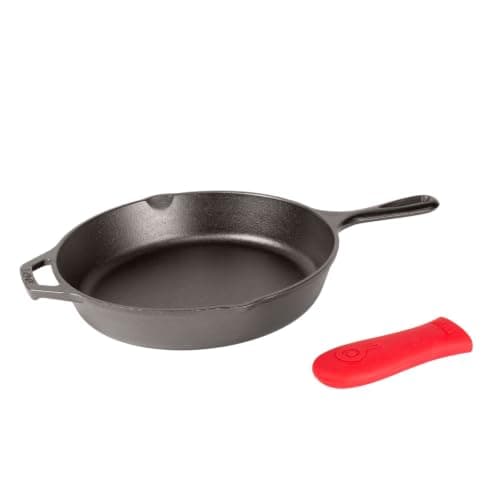
Lodge Seasoned Cast Iron Skillet, 10.25 in (L8SK3)
Searing, cornbread, and anyone who wants one pan that cannot be worn out
Prices last checked October 19, 2026. Prices move constantly — the number on Amazon when you click is the real one.
What to buy, if you are buying
These are the products this page's reasoning actually points at. Same rules as everywhere else on the site: published specs, a stated trade-off, and a live price only where one exists.
Top pick · If there was no cast iron to inheritSpecs read September 3, 2026
Lodge Seasoned Cast Iron Skillet, 10.25 in (L8SK3)
10.25 in, 5.66 lb, 550F published, lifetime warranty, named Tennessee foundry. The thing you were hoping to find in the box, new, for very little. The trade is the same as for an inherited one: hand wash, dry immediately, wipe with oil.
Best for: Searing, cornbread, and anyone who wants one pan that cannot be worn out
Published specifications for the Lodge Seasoned Cast Iron Skillet, 10.25 in (L8SK3)
Diameter
10.25 in
Weight
5.66 lb
Oven maximum
550F
Induction
Yes - bare iron is ferrous
Seasoning
Pre-seasoned with soy-based vegetable oil, no synthetic chemicals
Warranty
Lifetime
Made in
USA
Care
Hand wash. Lodge's own instructions permit warm soapy water
Good
Effectively unbreakable and fully restorable - a rusted one can be stripped and re-seasoned
Holds heat better than anything else at the price, which is what a sear needs
Lodge publishes its seasoning method openly, so the maintenance is not a mystery
Not good
Heavy
Heats unevenly on a small burner: cast iron conducts at roughly 50 W/m-K, so it is slow to spread and slow to react
Bare iron is reactive; long tomato braises will taste of it
The trade-off. It weighs 5.66 lb empty. You will feel that every time you move it full, and it is the single most common reason a cast iron skillet ends up in a cupboard.
Skip this if. You have wrist or shoulder trouble, or you cook mostly acidic braises. Carbon steel does most of the same jobs at roughly half the weight.
#2 · If nothing in the box is flat and non-reactiveSpecs read September 3, 2026
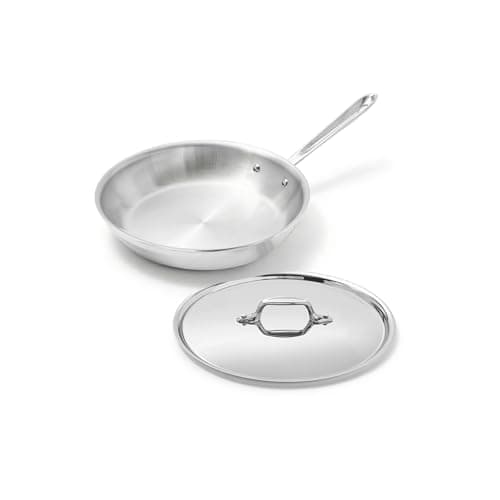
All-Clad D3 Stainless 10 in Fry Pan
Fully bonded tri-ply with an 18/10 stainless surface, published 600F and oven and broiler safe, made in Canonsburg, Pennsylvania. Nothing applied to it, so there is no wear surface to inherit. Published hand wash only.
Best for: One good open-stock stainless pan bought instead of a cheap full set
Published specifications for the All-Clad D3 Stainless 10 in Fry Pan
Construction
Fully bonded tri-ply, aluminum core
Oven maximum
600F, oven and broiler safe
Induction
Yes - compatible with any stovetop
Dishwasher
Handwash only (All-Clad published)
Handle
Double-riveted stainless
Weight
3.0 lb (model 4110)
Warranty
Limited lifetime
Made in
Bonded, engineered and assembled in Canonsburg, PA
Good
600F is the highest oven ceiling of any stainless pan on this site
The one pan here whose manufacturing location is published down to the town
Genuinely repairable-adjacent: rivets are the only failure point and the warranty covers them
Not good
Hand wash only
The flared rim makes it a poor pan for anything with liquid
Costs several times what a Tramontina or Cuisinart pan of the same construction costs
The trade-off. Hand wash only. All-Clad publishes that plainly, and it is a real daily cost on a pan you will use every day.
Skip this if. You want a dishwasher-safe pan, or you are buying a whole kitchen on a fixed budget - one D3 skillet costs what a full clad set can cost.
#3 · To replace the coated pan you should retireSpecs read September 3, 2026
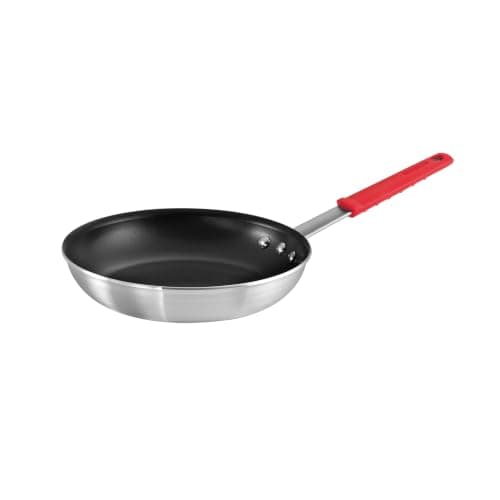
Tramontina Professional Restaurant Fry Pan, 10 in
An inexpensive commercial-style coated pan, bought knowingly as a consumable rather than inherited with an unknown history. No maker in the category publishes a coating lifespan, which is exactly why a secondhand one is not worth keeping.
Best for: Eggs, pancakes and fish, in a kitchen that also owns a stainless or iron pan
Published specifications for the Tramontina Professional Restaurant Fry Pan, 10 in
Body
Heavy-gauge aluminum
Coating
PTFE nonstick
Induction
No - aluminum body is not ferrous
Coating lifespan
Not published, by this or any nonstick maker
Good
Cheap enough that replacing it every couple of years is a real plan rather than a failure
Heavy gauge for a nonstick pan, so it does not warp on the first hot burner
Silicone handle sleeve that actually stays cool
Not good
Not induction compatible
PTFE, which some buyers will rule out on principle
No published coating lifespan, so the value case is unverifiable by design
The trade-off. It is PTFE. That is fine at normal cooking temperatures, and it is not a pan to preheat empty on high.
Skip this if. You want to avoid PTFE entirely. Buy ceramic instead and accept the shorter release life rather than pretending either one lasts forever.
Bare cast iron, bare carbon steel, stainless and intact enamel are the same materials new or old, and age alone does not change their chemistry. Two real cautions: unmarked decorative glazed ceramic of unknown origin is the one category where the lead-and-cadmium concern is reasonable, and unlined copper reacts with acidic food and needs relining before use.
›Should I keep old rusty cast iron?
Yes - it is the best thing you can find in a box of old pans. Rust is surface iron oxide and comes off, and the seasoning is polymerized cooking oil that rebuilds from bare metal. Older castings are often thinner and smoother than current ones. Reject it only for a crack or a base that rocks on a flat surface.
›Should I keep an inherited nonstick pan?
No. A coating is a wear surface with a service life, not one maker in the category publishes what that life is, and every warranty excludes coating wear. With an inherited pan you cannot know its age or how it was treated. It is the cheapest thing in the box to replace and the only one with an unknowable amount of life left.
›What faults mean an old pan is not worth keeping?
Three, and none of them is fixable. A crack, in iron, through enamel or in glass. A base that rocks on a flat surface, which means it has warped and cannot be trued at home. And deep pitting in the cooking surface, which is lost metal rather than surface roughness.
›Is a chipped enamel pot still usable?
Not for cooking. A chip inside exposes bare iron under a glass rim that keeps spalling, and nothing re-enamels a domestic pot economically. Crazing is different - a fine network of surface lines is common on old enamel and is generally cosmetic rather than a failure.
›Is old cookware worth money?
Sometimes, and it is outside what we can assess - we do not value collectibles or track the vintage market. If a piece carries a maker mark and looks unusual, find out before you strip it, because restoration can reduce the value of a collectible piece even while it improves the pan.
Sources
Every figure on this page came from one of these. Follow them and check our arithmetic — that is the point.