The channel changes the price, the information you get and what happens when something goes wrong. These are not interchangeable, and one of them is the only place a specific material is cheap.
Heads up: some links on this page earn us a commission at no extra cost to you. It does not change what we recommend or the order. How we are funded.
The short answer
It depends on what you are buying, and the differences are large. For a specific named model at a price you can check, buy online - the listing names the SKU and you can compare it against the maker's own manual. To judge weight, handle and balance before you commit, go to a department store and pick the pan up, because no specification tells you how a 12-inch pan feels full. For bare-metal pans at commercial prices, use a restaurant supply house, where open-stock aluminum and carbon steel cost a fraction of retail. For enameled cast iron, look for a brand outlet or factory second, which is the only channel where that material is routinely and genuinely cheaper. And for bare cast iron, buy secondhand - it is the one category where a thrift shop beats every retailer on earth, because the material does not wear out.
A word on our own position, before the comparison
We earn an affiliate commission on Amazon links, and we earn nothing from four of the seven channels below - including two we recommend over Amazon for specific purchases. You should weigh this page knowing that, and you should know we know it. How we are funded is the full version.
The honest summary is that online retail is the best channel for a named model bought on specifications, which is most of what this site writes about, and it is not the best channel for several other things. Those are below.
The seven channels, compared
Channel
Genuinely best for
What it costs you
What to check
Online retail (Amazon and the like)
A specific SKU at a price you can verify, plus the widest open-stock selection anywhere
Listings contradict manufacturer manuals constantly, and you cannot touch the pan
Match the model number against the maker's own manual. Our Cuisinart audit found the listing says 550F and the manual says 500F
The brand's own site
The manual, the full spec, the warranty terms and registration, replacement lids and parts
Usually the highest price, and the narrowest selection
Whether it runs an outlet or factory-second channel - that is where the price actually moves
Department store
Picking the pan up. Weight, handle shape, balance, lid fit, how the rivets feel
Limited lines, and staff knowledge that varies enormously
Lift the biggest pan in the set one-handed. That is the piece that decides whether you use it
Restaurant supply house
Bare aluminum, carbon steel and commercial stainless open stock at prices retail cannot touch
No marketing, no pretty packaging, no induction on most of it, and sizes aimed at a line cook
Whether the base is ferrous if you cook on induction, and whether an NSF mark matters to you
Warehouse club
A whole clad set at one price, and own-label sets that are genuinely decent value
A handful of SKUs that rotate, and no ability to buy a single replacement piece later
The piece count against the useful-item count. Lids are counted as pieces
Discontinued colors and lines from real brands at real discounts
One-off stock, no spec sheet on the shelf, and no chance of matching it later
Look up the model on your phone before you buy. An unidentifiable pan is an unresearchable pan
Secondhand (thrift, estate sales, marketplaces)
Bare cast iron, full stop. Also vintage carbon steel and solid copper
Nothing published, no warranty, and you are inspecting it yourself
Cracks, a wobble on a flat surface, pitting. Rust is cosmetic and seasoning is rebuildable
Channels ranked on what each is genuinely best at rather than on price alone. We earn a commission from the first channel and from nothing in rows two through seven.
Online retail: right for a named model, wrong for a browse
If you have read a specification and decided on a pan, online retail is the correct channel and it is not close. You get the exact SKU, a price you can compare, and - on most listings - the published construction details.
The failure mode is specific and worth naming, because we hit it repeatedly while building this site: retail listings and manufacturer manuals disagree. Cuisinart's MultiClad Pro is listed at 550F on Amazon and documented at 500F in its own use-and-care manual, and Cuisinart has confirmed the manual is correct. Tramontina's published oven ceilings contradict each other across SKUs in the same line. Neither is a conspiracy; both are reasons to check the manual before you trust the listing - how to read a cookware listing.
The brand's own site, and the outlet channel hiding on it
Brand sites are usually the most expensive place to buy and the most useful place to read. The manual is there, the warranty terms are there, the oven ceiling is there, and the replacement-parts page exists - which matters more than people expect, because a cracked lid or a lost handle screw is the normal way a good set dies - replacing a piece of your cookware set.
The thing to look for on a brand site is whether it runs a second channel: an outlet, a factory store, a seconds or imperfects program, or a periodic sale. Enameled cast iron is where this matters most. Le Creuset and Staub both sell through outlet stores, and Lodge operates a factory store, and a cosmetic second - a glaze blemish, an off-color patch - cooks identically to a perfect one. That is the only reliable way to buy enameled cast iron for meaningfully less than list.
Department stores: the only channel that answers the weight question
There is one thing no specification on this site can tell you, and we should be straightforward about it: how a pan feels. We publish weights - 5.66 lb for the 10.25 in Lodge skillet, 4.6 lb for the 11 in de Buyer, 3.0 lb for the All-Clad D3 10 in, 2.70 lb for the Scanpan Classic - and those numbers are real, but a number is not a hand.
Go and pick things up if any of the following is true:
You have wrist, grip or shoulder trouble, or any arthritis. The weight and the leverage of the handle matter more than any performance figure - cookware for arthritis and limited grip.
You are buying your first cast iron. 5.66 lb empty is a different proposition full and one-handed, and people routinely discover this after buying.
You are choosing between handle styles. All-Clad's double-riveted stainless, Cuisinart's cool-grip spine and de Buyer's cast stainless Heat Stop are genuinely divisive shapes, and thirty seconds of holding one settles an argument you cannot settle by reading - cookware handles explained.
Perfectly reasonable sequence: handle the pans in a shop, then buy whichever one your hand picked, from wherever is cheapest. Nobody is owed your purchase for letting you hold a pan, but the shop that let you is worth something too.
Restaurant supply: cheap bare metal, and the catch
A restaurant supply house sells the pans a commercial kitchen replaces as consumables: bare aluminum saute pans and stockpots, carbon steel, heavy commercial stainless. They are plain, they are sold as single pieces, and they cost a fraction of retail for equivalent metal.
Three catches. Most bare aluminum open stock is not induction compatible, because aluminum is not ferrous. Sizes are built for a professional line, so a "small" stockpot can be enormous. And bare aluminum is reactive, so it wants dry heat and neutral food rather than a long tomato braise - is aluminum cookware safe has the detail.
What transfers to a home kitchen and what does not is its own question, and we are not going to rehearse it here: restaurant cookware for home kitchens.
Commercial open stock is cheap, plain, reactive and usually not induction-ready. Three of those four are fine.
Off-price retail: real brands, discontinued colors
The discount bins at TJ Maxx, HomeGoods, Marshalls and Ross carry genuine brand cookware, and the reason it is there is almost always a discontinued color, a discontinued line, or a retailer's overstock. The pan is not defective and the discount is not fake.
The cost is information. There is no spec sheet on the shelf, the model number may be only on the box, and you cannot come back for a matching piece in six months. The workaround is mechanical: find the model number before you pay, look it up on your phone, and check the oven ceiling and the dishwasher guidance. If you cannot identify the model, you cannot research it, and an unresearchable pan is a gamble regardless of price.
Secondhand, where one category is genuinely cheap
This is the recommendation on this page we are most confident about, and it earns us nothing. Bare cast iron does not wear out. Seasoning is cooking oil and can be rebuilt from bare metal; rust is surface iron oxide and comes off; a pan that is sixty years old and ugly is, after an afternoon, a pan.
Inspect for the three things that are not fixable: a crack, a base that rocks on a flat surface, and deep pitting in the cooking surface. Everything else is cosmetic - restoring rusty cast iron and the vintage cast iron buying guide cover both the inspection and the restoration.
Carbon steel and solid copper are the same story with a caveat. Carbon steel restores exactly like cast iron. Copper is the one secondhand category to be careful with, because the tin lining wears through and relining is expensive enough to make a cheap pan an expensive one - best copper cookware explains the lining problem.
What does not survive secondhand: anything coated. A used nonstick pan has an unknown amount of life left in a surface nobody publishes a lifespan for, which makes it the one thing on this list worth buying new and cheap instead of used and cheaper.
Which channel, by what you are buying
What you want
Buy it here
Why
A clad stainless set
Online, or a warehouse club if the SKU is one you researched
Set pricing is where the real arithmetic is, and online is where you can verify the SKU
One good open-stock stainless pan
Online, after holding the handle in a shop
Open stock rarely discounts, so you are buying on fit rather than price
Bare cast iron
Secondhand first, Lodge new if you would rather not restore anything
The material is indestructible, so condition is cosmetic and price should be too
Enameled cast iron
A brand outlet or factory-second channel
The only place this material is reliably cheaper. Cosmetic seconds cook identically
A coated pan for eggs
Anywhere cheap, new
It is a consumable with an unpublished lifespan. Buy it at a price you will not resent replacing
Carbon steel
Online for de Buyer or Matfer, restaurant supply for plain commercial pans
The branded pans publish specs worth having; the commercial ones are the same metal with no documentation
Bakeware
Online or restaurant supply
Commercial aluminum half sheets are the professional standard and cost very little
What we cannot tell you
We cannot tell you which shop near you stocks what, we do not track local inventory, and we have no relationship with any retailer except an Amazon affiliate account. We also publish no price of our own: every number on this site comes from a live feed behind a 48-hour freshness gate, and when that gate closes the buttons say "check price" rather than showing a figure we cannot stand behind - how we work.
Three purchases, three different right channels
A clad set where online SKU verification matters most, a cast iron skillet you should look for secondhand first, and the commercial aluminum half sheet that is cheap in every channel.
These are the products this page's reasoning actually points at. Same rules as everywhere else on the site: published specs, a stated trade-off, and a live price only where one exists.
Top pick · Buy this one onlineSpecs read September 3, 2026
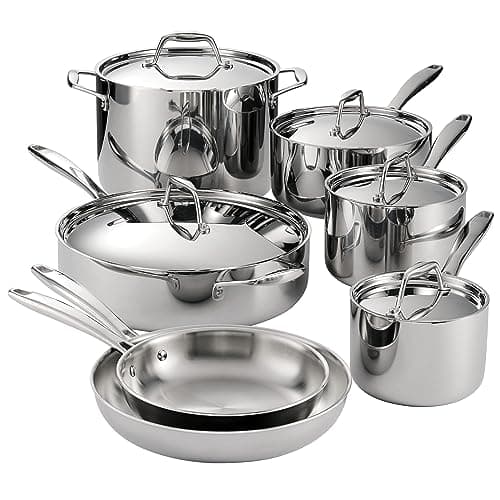
Tramontina Signature Tri-Ply Clad 12-Piece Set
A named SKU is exactly what online retail is good at: NSF-certified on the 80116-249DS line and 500F on that listing. Verify the model number, because other SKUs in the same line publish 350F.
Best for: A first kitchen that should not need replacing
Published specifications for the Tramontina Signature Tri-Ply Clad 12-Piece Set
Construction
Tri-ply: 18/10 stainless, aluminum core, magnetic stainless exterior
Pieces
8 in and 10 in fry pans; 1.5, 2 and 3 qt covered saucepans; 5 qt covered deep saute; 8 qt covered stockpot
Oven maximum
500F on the 80116-249DS listing; other SKUs in the line are listed at 350F
Induction
Yes - magnetic stainless exterior
Dishwasher
Listed dishwasher safe
Handles
Precision cast, riveted
Certification
NSF-certified on the 80116-249DS line
Country of origin
Not asserted - retail listings disagree across SKUs (Brazil and China both appear)
Good
Fully clad, not disc-bottom: the aluminum runs up the sidewalls, so sauces do not scorch in a ring at the base
NSF certification on the flagship SKU is a real, checkable third-party mark rather than a marketing badge
Induction-ready without paying an induction premium
Not good
Retail listings disagree on the oven maximum across SKUs in the same line, which is a documentation problem, not a cooking one
Handles run hot on gas
The 12-piece count includes lids; the useful-item count is seven
The trade-off. Handles are the weak point. They are riveted and sturdy, but they get hot on a gas ring in a way the more expensive clad brands' do not.
Skip this if. You want a set you can leave in the oven above 500F, or you cook mostly eggs and pancakes and would rather spend the money on one good nonstick pan.
#2 · Look for this one secondhand firstSpecs read September 3, 2026
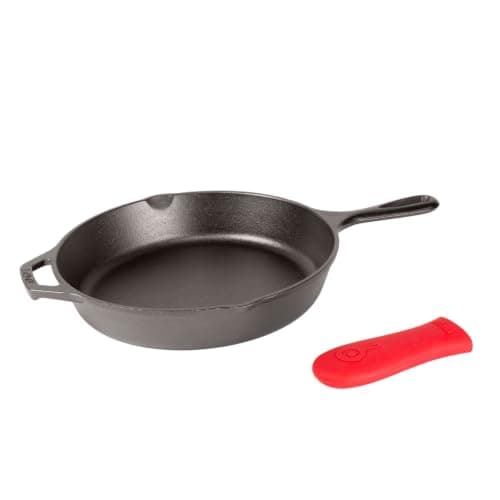
Lodge Seasoned Cast Iron Skillet, 10.25 in (L8SK3)
Bare cast iron does not wear out, so condition is cosmetic and price should be too. Buy it new at this price if you would rather not restore anything - 5.66 lb, 550F, lifetime warranty, named Tennessee foundry.
Best for: Searing, cornbread, and anyone who wants one pan that cannot be worn out
Published specifications for the Lodge Seasoned Cast Iron Skillet, 10.25 in (L8SK3)
Diameter
10.25 in
Weight
5.66 lb
Oven maximum
550F
Induction
Yes - bare iron is ferrous
Seasoning
Pre-seasoned with soy-based vegetable oil, no synthetic chemicals
Warranty
Lifetime
Made in
USA
Care
Hand wash. Lodge's own instructions permit warm soapy water
Good
Effectively unbreakable and fully restorable - a rusted one can be stripped and re-seasoned
Holds heat better than anything else at the price, which is what a sear needs
Lodge publishes its seasoning method openly, so the maintenance is not a mystery
Not good
Heavy
Heats unevenly on a small burner: cast iron conducts at roughly 50 W/m-K, so it is slow to spread and slow to react
Bare iron is reactive; long tomato braises will taste of it
The trade-off. It weighs 5.66 lb empty. You will feel that every time you move it full, and it is the single most common reason a cast iron skillet ends up in a cupboard.
Skip this if. You have wrist or shoulder trouble, or you cook mostly acidic braises. Carbon steel does most of the same jobs at roughly half the weight.
#3 · Cheap in every channelSpecs read September 3, 2026
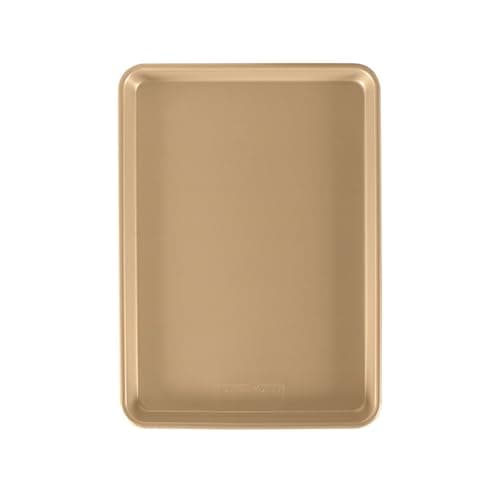
Nordic Ware Naturals Half Sheet, 18 x 13 in
17.9 by 12.9 in of bare aluminum with an encapsulated steel rim and a lifetime warranty. Restaurant supply sells the same thing unbranded for less, and both are the right answer.
Best for: Roasting vegetables, sheet-pan dinners, cookies - the pan you use most weeks
Published specifications for the Nordic Ware Naturals Half Sheet, 18 x 13 in
Exterior dimensions
17.9 x 12.9 x 1 in
Material
Aluminum
Rim
Encapsulated steel rim
Gauge
Not published by Nordic Ware
Warranty
Lifetime
Dishwasher
Hand wash recommended. Automatic dishwasher use is not advised
Made in
America of domestic and imported materials
Good
Aluminum conducts at 237 W/m-K, which is why it browns evenly and a steel pan does not
The encapsulated steel rim is the reason it does not warp in a hot oven
Lifetime warranty on a pan this cheap
Not good
Nordic Ware does not publish a gauge figure, so thickness cannot be compared like for like
Bare aluminum stains and reacts with acid
Not dishwasher safe by the maker's own advice
The trade-off. Bare aluminum discolors and reacts with acid. It will look used within a month and Nordic Ware advises against the dishwasher.
Skip this if. You want a pan that stays looking new, or you will not hand wash. Buy an aluminized-steel coated pan instead and accept the coating as a wear item.
It depends on the material. Bare cast iron is cheapest secondhand, because it does not wear out and condition is cosmetic. Bare aluminum and carbon steel are cheapest at a restaurant supply house. Enameled cast iron is cheapest through a brand outlet or factory-second channel. Clad stainless sets are cheapest online or at a warehouse club during a sale window.
›Is it better to buy cookware online or in a store?
Online for a specific model you have already researched, because you can verify the SKU and compare prices. In a store when the decision depends on how the pan feels - weight, handle shape, balance and lid fit are things no specification communicates, and they are the usual reason a pan gets left in the cupboard.
›Should I buy cookware from a restaurant supply store?
For bare aluminum, carbon steel and heavy commercial stainless, yes - it is the same metal at a fraction of retail. Check three things first: most bare aluminum open stock is not induction compatible, the sizes are built for a professional line, and bare aluminum is reactive so it is wrong for long acidic cooking.
›Is secondhand cast iron safe to buy?
Yes, and it is the single best value in cookware. Seasoning is polymerized cooking oil and can be rebuilt from bare metal, and rust is surface oxide that comes off. Reject only three faults, which are not fixable: a crack, a base that rocks on a flat surface, and deep pitting in the cooking surface.
›Why do Amazon listings and manufacturer manuals disagree about oven temperature?
Because retail listings are written by merchandisers and manuals are written by the engineering side. We found it repeatedly: Cuisinart's MultiClad Pro is listed at 550F and documented at 500F in its own manual, with Cuisinart confirming the manual, and Tramontina's published ceilings contradict each other across SKUs in one line. Always trust the manual.
›Is it worth buying cookware from a discount store like TJ Maxx?
Often, yes. The stock is usually discontinued colors or lines from real brands rather than anything defective. The cost is information: find the model number before you pay and look up the oven ceiling and dishwasher guidance, because you cannot research a pan you cannot identify, and you will not be able to buy a matching piece later.
Sources
Every figure on this page came from one of these. Follow them and check our arithmetic — that is the point.