There are three kinds of aluminum pan and the answer is different for each one. The version of the question that matters is narrower than the internet suggests.
Heads up: some links on this page earn us a commission at no extra cost to you. It does not change what we recommend or the order. How we are funded.
The short answer
For almost every pan you can buy today, yes. The distinction that settles it is which aluminum you are touching. In a clad pan the aluminum is sealed between steel layers and never contacts food at all, so the question does not apply. In an anodized pan the surface is an electrochemically hardened oxide layer that does not behave like bare metal. Only bare aluminum - uncoated commercial pans, sheet pans, stovetop pots in older kitchens - transfers measurably, and it does so most with acidic food and long cooking. On dietary exposure, EFSA's 2008 assessment set a tolerable weekly intake of 1 mg aluminum per kg of body weight and named cereals and cereal products, vegetables, beverages and certain infant formulae as the main contributors. Cookware was not on that list.
Three kinds of aluminum pan, three different answers
Nearly all of the confusion here comes from treating one word as one material. These three are not variations on a theme; they are different food-contact situations.
Type
What your food touches
Does aluminum transfer?
Where you meet it
Clad aluminum
Stainless steel - the aluminum is a core sealed between steel layers
No. It is never a food-contact surface
Almost every quality stainless pan: All-Clad D3, Cuisinart MultiClad Pro, Tramontina tri-ply, Misen, Demeyere
Anodized aluminum
A hardened aluminum-oxide layer, then usually a nonstick coating on top
Not while the layer is intact and sealed
Hard-anodized pans: Calphalon, OXO, Circulon, most "hard anodized" listings
Bare aluminum
Aluminum itself
Yes - measurably more than stainless, and most with acid and long contact
The safety question only genuinely lands on the third row. Most modern retail cookware is in the first two.
So before anything else, work out which pan you own. If the base grips a magnet and the interior is bright steel, it is clad and this page is academic for you - disc-bottom versus fully clad explains how to read the construction.
What the published assessments actually say
Two documents carry most of the weight here, and both are public.
The European Food Safety Authority's 2008 scientific opinion on aluminum from dietary intake set a tolerable weekly intake of 1 mg aluminum per kilogram of body weight. Its finding on sources is the part relevant to cookware: the main contributors to dietary aluminum exposure are cereals and cereal products, vegetables, beverages and certain infant formulae. Food additives and the food itself dominate; leaching from pans is a small contributor by comparison.
The US Agency for Toxic Substances and Disease Registry's Toxicological Profile for Aluminum covers the toxicology in full and is freely readable. It is the document to go to rather than a summary, including on the two questions people usually arrive with.
The Alzheimer's question, addressed directly
This is the reason most people search for this page, so it should not be buried. The aluminum-and-Alzheimer's link originates in research from the 1960s and 1970s that later work did not support, and it is not an established cause. The Alzheimer's Association lists it among the myths about the disease.
That is not the same as a guarantee about anything, and we are not a medical authority - we are a cookware site reading public documents. What we can say is that the specific claim "aluminum pans cause Alzheimer's" is not supported by the bodies that study the disease, and that if you want to reduce dietary aluminum the published evidence points at processed food rather than at your saucepan.
Where bare aluminum genuinely does matter
There is a real mechanism here and it is worth stating accurately rather than dismissing. Bare aluminum is reactive: acidic and strongly alkaline food attacks the natural oxide film, which both increases transfer and does visible damage.
A tomato sauce simmered for three hours in a bare aluminum pot is the textbook case. It will transfer the most, and it can also pick up a metallic taste and a gray cast - see cooking acidic foods and reactive cookware.
Alkaline dishwasher detergent is the other direction, and it is why bare aluminum bakeware goes dull, chalky and pitted in a dishwasher - is bakeware dishwasher safe.
Lemon, vinegar, wine and rhubarb are the same story in miniature. Short contact is unremarkable; a long simmer is the thing to move to a different pan.
The practical rule for bare aluminum is simple and has nothing to do with chemistry anxiety: use it for dry heat and neutral food, and use something non-reactive for anything acidic cooked for a long time. That is exactly how professional kitchens use it.
Why bare aluminum is the right answer for bakeware
It is worth saying plainly that this material is not a compromise in baking - it is the preferred one. Bare and aluminized aluminum conducts heat faster and more evenly than steel, which is why half sheet pans are made of it and why professional bakeries use nothing else.
Baking is also the use case where the reactivity concern mostly evaporates: cookies, roasted vegetables and bread are not acidic liquids held at a simmer for hours. The exception is a tomato or citrus bake sitting in the pan overnight, which is a food storage habit rather than a cooking one - sheet pan materials and non-toxic bakeware go further.
Anodized aluminum, and the thing the marketing skips
Anodizing is an electrochemical process that thickens and hardens the aluminum oxide layer on the surface. It makes the body harder, more scratch-resistant and far less reactive than bare aluminum. That part is genuine.
What the marketing tends to skip is that a hard-anodized pan usually has a nonstick coating applied on top of the anodized body, so the surface your food touches is the coating, not the anodized metal - and the anodizing does nothing at all for that coating's lifespan. OXO publishes a three-layer PTFE surface on a hard-anodized body; Calphalon publishes a multi-layer PTFE surface on one. Neither publishes a coating lifespan, because no maker does.
There are two consequences worth carrying away. Is hard-anodized cookware safe is largely a question about the coating rather than the aluminum, and hard-anodized cookware problems are mostly coating problems too. The second: most standard hard-anodized lines are not induction-compatible, because aluminum is not ferrous.
Hard-anodized describes the body. The surface your food touches is usually a coating applied over it.
What to actually do about it
If your pan is clad stainless, do nothing. The aluminum is structural and sealed.
If it is hard-anodized, judge it as a coated pan. Obey the published ceiling - 430F for the OXO line, 450F for Calphalon Premier - and replace it when release goes.
If it is bare aluminum, keep it for dry heat and neutral food. Sheet pans, roasting, blanching, boiling pasta. Move long acidic cooking to stainless or enameled cast iron.
If a bare aluminum pot is pitted, dull-gray and shedding, that is a retirement signal on condition grounds, not a chemistry verdict - when to replace your cookware.
If you want the question gone entirely, buy a surface with nothing applied and nothing exposed: the non-toxic frying pan options are all either bare iron, bare steel or clad stainless.
What we cannot tell you
We have measured nothing. We have not run a migration test on a single pan, and the numbers on this page come from public assessments and from what makers publish about their own construction. Anyone presenting a transfer figure for a specific pan without publishing the method should be read skeptically, including us - how we work.
The three aluminum situations, one pan each
A clad pan where the aluminum never touches food, a bare aluminum sheet pan where the material is the right choice, and a hard-anodized pan to judge as a coated one.
All-Clad D3 Stainless 10 in Fry Pan
One good open-stock stainless pan bought instead of a cheap full set
Prices last checked October 6, 2026. Prices move constantly — the number on Amazon when you click is the real one.
What to buy, if you are buying
These are the products this page's reasoning actually points at. Same rules as everywhere else on the site: published specs, a stated trade-off, and a live price only where one exists.
Top pick · Aluminum that never touches foodSpecs read September 3, 2026
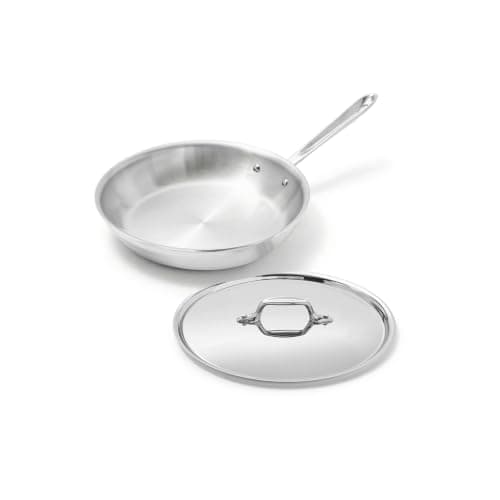
All-Clad D3 Stainless 10 in Fry Pan
A fully bonded tri-ply pan: the aluminum core is sealed between two steel layers and does the heat conduction, while an 18/10 stainless surface does the food contact. The question does not apply to this pan at all.
Best for: One good open-stock stainless pan bought instead of a cheap full set
Published specifications for the All-Clad D3 Stainless 10 in Fry Pan
Construction
Fully bonded tri-ply, aluminum core
Oven maximum
600F, oven and broiler safe
Induction
Yes - compatible with any stovetop
Dishwasher
Handwash only (All-Clad published)
Handle
Double-riveted stainless
Weight
3.0 lb (model 4110)
Warranty
Limited lifetime
Made in
Bonded, engineered and assembled in Canonsburg, PA
Good
600F is the highest oven ceiling of any stainless pan on this site
The one pan here whose manufacturing location is published down to the town
Genuinely repairable-adjacent: rivets are the only failure point and the warranty covers them
Not good
Hand wash only
The flared rim makes it a poor pan for anything with liquid
Costs several times what a Tramontina or Cuisinart pan of the same construction costs
The trade-off. Hand wash only. All-Clad publishes that plainly, and it is a real daily cost on a pan you will use every day.
Skip this if. You want a dishwasher-safe pan, or you are buying a whole kitchen on a fixed budget - one D3 skillet costs what a full clad set can cost.
#2 · Bare aluminum, used correctlySpecs read September 3, 2026
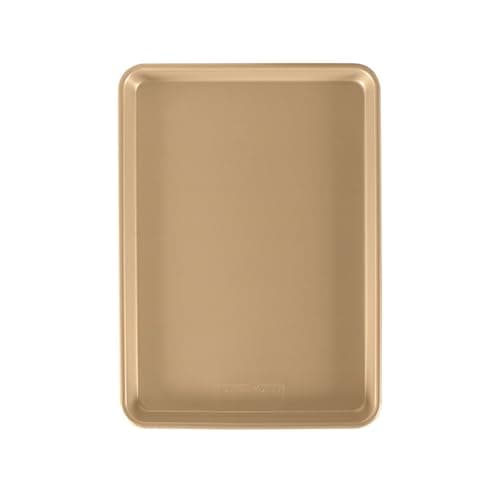
Nordic Ware Naturals Half Sheet, 18 x 13 in
Dry heat and neutral food is exactly what bare aluminum is for, which is why professional bakeries use nothing else. Keep it out of the dishwasher, where alkaline detergent dulls and pits it.
Best for: Roasting vegetables, sheet-pan dinners, cookies - the pan you use most weeks
Published specifications for the Nordic Ware Naturals Half Sheet, 18 x 13 in
Exterior dimensions
17.9 x 12.9 x 1 in
Material
Aluminum
Rim
Encapsulated steel rim
Gauge
Not published by Nordic Ware
Warranty
Lifetime
Dishwasher
Hand wash recommended. Automatic dishwasher use is not advised
Made in
America of domestic and imported materials
Good
Aluminum conducts at 237 W/m-K, which is why it browns evenly and a steel pan does not
The encapsulated steel rim is the reason it does not warp in a hot oven
Lifetime warranty on a pan this cheap
Not good
Nordic Ware does not publish a gauge figure, so thickness cannot be compared like for like
Bare aluminum stains and reacts with acid
Not dishwasher safe by the maker's own advice
The trade-off. Bare aluminum discolors and reacts with acid. It will look used within a month and Nordic Ware advises against the dishwasher.
Skip this if. You want a pan that stays looking new, or you will not hand wash. Buy an aluminized-steel coated pan instead and accept the coating as a wear item.
#3 · Anodized, so judge the coatingSpecs read September 3, 2026
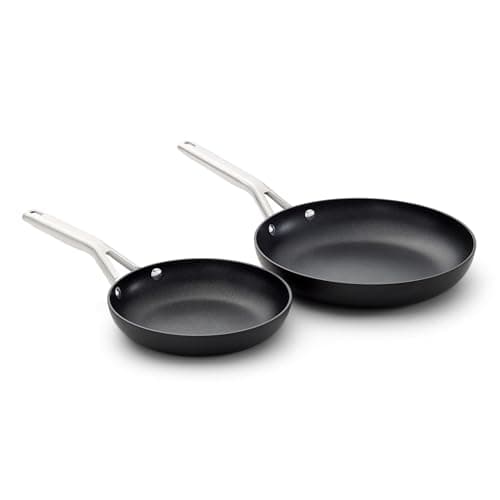
Calphalon Premier Hard-Anodized Nonstick Fry Pan, 10 in
A hard-anodized body under a multi-layer PTFE surface published as metal-utensil safe at 450F. The anodizing hardens the aluminum and does nothing for the coating, which is the part that wears out.
Best for: A nonstick pan in a kitchen where the utensil drawer is not going to be policed
For almost all modern cookware, yes. In a clad stainless pan the aluminum is sealed between steel layers and never touches food. In a hard-anodized pan the surface is a hardened oxide layer, usually under a nonstick coating. Only bare aluminum transfers measurably, and most of that happens with acidic food cooked for a long time.
›Does aluminum cookware cause Alzheimer's disease?
It is not an established cause. The link comes from research in the 1960s and 1970s that later work did not support, and the Alzheimer's Association lists it among the myths about the disease. If your goal is reducing dietary aluminum, published assessments point at food additives and processed food rather than at pans.
›How much aluminum do I get from cookware?
Far less than from food. EFSA's 2008 opinion set a tolerable weekly intake of 1 mg aluminum per kg of body weight and identified cereals and cereal products, vegetables, beverages and certain infant formulae as the main contributors to dietary exposure. Cookware leaching was not among the main sources it named.
›Should I throw away my old aluminum pots?
Not for chemistry reasons. Replace them on condition: pitting, a chalky gray surface, a badly warped base or a loose handle are all real reasons to retire a pan. Otherwise keep bare aluminum for dry heat and neutral food and cook long acidic dishes in something non-reactive.
›Is anodized aluminum safer than bare aluminum?
Less reactive, yes. Anodizing thickens and hardens the oxide layer so the surface does not behave like bare metal. The thing to understand is that most hard-anodized pans then have a nonstick coating applied on top, so the food-contact surface is the coating and the anodizing does nothing for that coating's lifespan.
›Is aluminum bakeware safe?
Yes, and it is the material professional bakeries use, because it conducts heat faster and more evenly than steel. Baking is also the use case where reactivity matters least. The one habit to avoid is storing acidic food in the pan, and the one care rule is to keep bare aluminum out of the dishwasher, where alkaline detergent dulls and pits it.
Sources
Every figure on this page came from one of these. Follow them and check our arithmetic — that is the point.