Heads up: some links on this page earn us a commission at no extra cost to you. It does not change what we recommend or the order. How we are funded.
The short answer
“Titanium cookware” is three different products. If you want titanium bonded into a cooking surface by a documented process, buy the Hestan NanoBond: a stainless pan with titanium alloy bonded to it, published to 1050F, dishwasher safe, with no coating to wear out. If you want a coating-free pan on a budget, the honest answer is not titanium at all - it is carbon steel. If you want an actual uncoated titanium pan, the Plateful 12-inch is one of the few genuinely sold as such, published to 750F - but its own listing gives three irreconcilable capacities and publishes no thickness, weight or warranty. And if the pan says titanium ceramic, titanium-infused or Ti-anything for under fifty dollars, the titanium is a constituent of a coating, the coating is the consumable, and what titanium cookware claims actually mean is the page to read before you spend.
Quick picks
The whole answer, on one screen. Tap a row to jump to the full write-up. Every pick below carries a stated trade-off further down — including the one at the top.
#
Product
Best for
Price
1
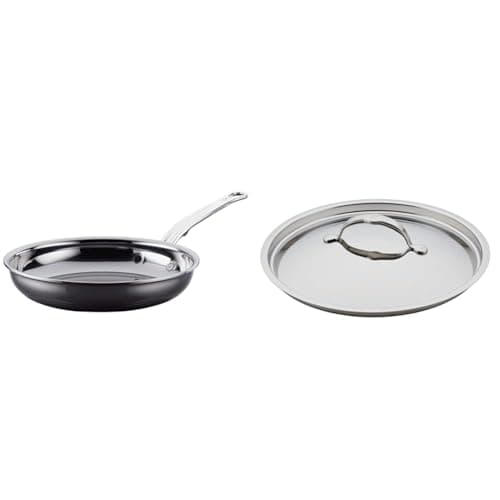
Hestan NanoBond Titanium Skillet, 11 in
Titanium alloy bonded to stainless by a published process, 1050F, dishwasher safe, no coating to fail. The only product in this category whose titanium claim comes with a documented construction. Skip it if the price is the point - this is the most expensive answer here by a wide margin.
Published 3 mm fully clad with a stainless exterior, aluminum core and titanium interior, no coating at all, 1000F, dishwasher and metal-utensil safe, limited lifetime warranty. Skip it if you expect coating-grade release - a micro-textured metal face still needs fat and technique.
Best titanium cooking surface on clad construction
Plateful Uncoated Titanium Fry Pan with Lid, 12 in
Actual uncoated titanium, 12 in, published to 750F - the highest oven figure in this ledger - and induction compatible. Skip it if you want the listing to make sense: it gives the capacity as 3.7 quarts, as one liter, and as a 12-inch pan, all on the same page.
Gotham Steel Hammered Ti-Cerma Nonstick Fry Pan with Lid, 12 in
A twelve-inch coated aluminum pan with a glass lid, 500F and a ten-year limited warranty, where the titanium is one constituent of a ceramic coating. Honest value for what it is. Skip it if you believed the name described the metal.
Prices last checked October 19, 2026. Prices move constantly — the number on Amazon when you click is the real one.
The word covers three different products
This is the whole problem with the category, and no listing will sort it out for you because every one of them uses the same word.
What is sold
What the titanium is
Typical price band
Wears out?
Titanium-infused / titanium ceramic coating
A constituent of a sprayed coating on an aluminum pan
Lowest
Yes - it is a coating, and no maker publishes a lifespan
Titanium bonded to steel (Hestan NanoBond)
Titanium alloy bonded into the stainless surface by a published process
Highest
No - there is no coating
Uncoated titanium pan
The pan body itself
High
No - there is nothing applied
Titanium-reinforced PTFE
Particles mixed into a PTFE coating for abrasion resistance
Low to middle
Yes - still PTFE, still a consumable
Four distinct things sold under one word. The price band is the most reliable sorter, which is a bad sign for a material claim.
The terminology itself - what “infused”, “reinforced” and “Ti-” prefixes describe, and whether any of it is a scam - is already covered in full on what titanium cookware claims actually mean. This page assumes you have decided to buy something and is about which one.
The one with a documented process
Hestan's NanoBond is the only product in this category whose titanium claim comes attached to a published construction rather than a word on a box. It is a stainless pan with titanium alloy bonded into the cooking surface, and the consequences are the ones you would want.
Nothing to wear out. It is not a coating, so there is no lifespan question - which is the single largest unknown in all coated cookware.
A 1050F published ceiling. The highest in this ledger apart from the uncoated titanium pan, and far above anything coated.
Dishwasher safe and metal-utensil tolerant, because the surface is metal.
What it is not is nonstick. It is a stainless pan with a harder, smoother surface, and it behaves like stainless: preheat properly or food sticks - why food sticks to stainless applies unchanged. The full read on the brand, including what the three published percentages mean, is on our Hestan review.
The uncoated titanium pans, and the question nobody answers
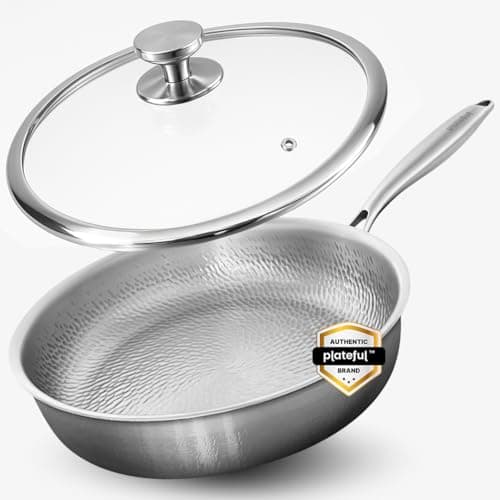
A small number of pans really are made of titanium - a sheet of the metal, no coating, no cladding. The Plateful 12-inch is one, published as SGS-certified uncoated titanium, safe to 750F, induction compatible and dishwasher safe.
Two things are worth stating plainly about this corner of the market.
The listings are unusually careless for products at this price. The Plateful pan's own listing gives its size as 3.7 quarts in one field, “1 Litres” in another and 12 inches in a third. It publishes no thickness, no weight and no warranty. That is not a small omission on a pan costing what a good clad skillet costs.
Nobody publishes a heat-distribution figure, and that is the question. Titanium's selling points are strength, corrosion resistance and lightness. Whether a thin unclad titanium pan spreads heat evenly across its base is the thing a buyer would most want to know, and not one maker in the category publishes a test, a figure, or even a claim specific enough to check. We are not going to supply a number they have not.
If what you want is a pan with no coating at all - which is a completely reasonable thing to want - carbon steel does that job for a fraction of the price, with decades of documentation and a known routine behind it. It needs seasoning and drying, which titanium does not; is carbon steel worth it is the honest comparison, and what to replace nonstick pans with covers the whole set of coating-free options.
The four, side by side
Hestan NanoBond
Our Place Titanium Pro
Plateful uncoated
Gotham Steel
What the titanium is
Alloy bonded into the stainless surface
The interior layer of a 3-ply clad pan
The pan body
A constituent of a ceramic coating
Coating to wear out
No
No - published coating-free
No
Yes
Oven maximum
1050F
1000F, per Our Place
750F, per the maker
500F, per the maker
Induction
Yes
Yes
Yes
Yes
Dishwasher
Yes
Yes, per Our Place
Yes, per the maker
Yes, per the maker
Published thickness
Not published
3 mm fully clad
Not published
Not published
Published weight
Not published
Not published
Not published
Not published
Warranty
See the brand review
Limited lifetime
Not published
10 year limited
Price band
Highest
High
High
Lowest
Only one of the four publishes a construction thickness and none publishes a weight. That is the state of documentation in this category, and it is worse than in clad stainless or cast iron.
The safety question, answered narrowly
“Titanium cookware health risks” is one of the most searched phrases in this category, so it deserves a direct answer rather than a dodge.
Titanium metal itself is not the thing people are actually asking about. It is used in implants and is chemically inert at cooking temperatures. If the pan is genuinely titanium, or genuinely titanium bonded into steel, there is no coating chemistry to ask questions about at all - which is the real safety argument for both Hestan's pan and the uncoated ones.
The question people are usually asking is about the coated pans that merely have titanium in the name, and there the answer is the same as for any coated pan: it depends on the coating, not on the word. Gotham Steel publishes a PFOA, PFOS and PTFE-free claim for its Ti-Cerma surface, which puts it in the ceramic category rather than the PTFE one - is ceramic cookware safe and is nonstick safe are the two pages that answer this properly, and nonstick coating names decoded translates the rest of the vocabulary.
At the cheap end of this category, the titanium is in here - a constituent of a sprayed coating, not a property of the pan.
When not to buy any of this
Two cases, both common.
You want nonstick release. Then buy nonstick and treat it as a consumable. Neither the bonded-titanium pan nor the uncoated one is a release surface, and paying a premium for a titanium claim to get a pan that behaves like stainless is a disappointment waiting to happen - best nonstick pans.
You want a pan with nothing applied to it. Then buy cast iron or carbon steel, which cost a fraction, are documented to death, and have no listing contradictions to work around - best non-toxic frying pans approaches the same question from the coating-free direction.
What we cannot tell you
What three of these four pans weigh, or how thick they are. Only Our Place publishes a construction thickness, at 3 mm fully clad; none of the four publishes a weight, which is unusual even by this category's standards.
Nor can we tell you how evenly an uncoated titanium pan heats, because no maker publishes a test and we have run none. We have not cooked in any of these pans; this site compiles what makers publish, links every source and says where the gaps are - our editorial policy.
Which to buy
You want the titanium claim to mean something documented:the Hestan NanoBond 11-inch. 1050F, no coating, dishwasher safe.
You want a genuinely uncoated titanium pan:the Plateful 12-inch, with the listing's contradictions understood.
You want a big cheap coated pan and know what you are getting:the Gotham Steel hammered 12-inch. 500F, ten-year limited warranty, coating is the consumable.
All four, plus the pan this page keeps pointing at
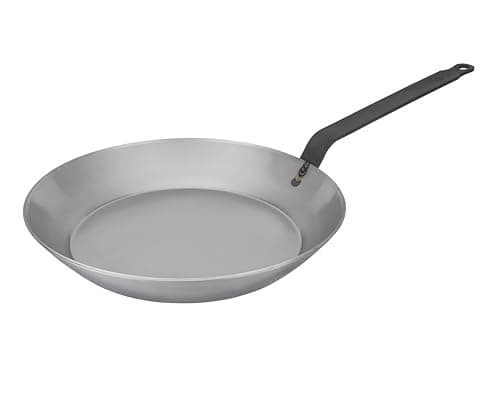
The Matfer carbon steel pan is here because it is the coating-free answer at a fraction of the price, and half the people reading this page want that rather than titanium specifically. Prices move constantly.
Hestan NanoBond Titanium Skillet, 11 in
High-heat searing and anyone who wants a stainless surface that tolerates metal utensils and a dishwasher without complaint
Prices last checked October 19, 2026. Prices move constantly — the number on Amazon when you click is the real one.
Every pick, in full
Each write-up below gives the published specs, what the pan is genuinely good at, what it costs you, and who should skip it. The trade-off line is there on the top pick too — a recommendation with no downside is an advertisement.
Top pick · Best titanium cookware overallSpecs read September 3, 2026
Hestan NanoBond Titanium Skillet, 11 in
Titanium alloy bonded to stainless by a published process, 1050F, dishwasher safe, no coating to fail. The only product in this category whose titanium claim comes with a documented construction. Skip it if the price is the point - this is the most expensive answer here by a wide margin.
Best for: High-heat searing and anyone who wants a stainless surface that tolerates metal utensils and a dishwasher without complaint
Published specifications for the Hestan NanoBond Titanium Skillet, 11 in
Construction
Triple-bonded stainless steel with a ProCore aluminum core
Surface
Molecular titanium nano-layers bonded to 18/10 stainless steel
Diameter
11.0 in
Induction contact area
8.0 in
Weight
2.68 lb
Handle
Flush rivets
Oven maximum
1050F (565C), published oven, broiler and grill safe
Induction
Published as optimized for induction
Dishwasher
Published 100% dishwasher safe
Metal utensils
Published 100% metal utensil safe
Coatings
Published made without PFAS, nickel, lead or cadmium
Hardness claim
Published as 400% harder than typical stainless steel; no test method published
Conductivity claim
Published as 35% greater than other aluminum clad cookware; no test method published
Made in
Italy
Warranty
Lifetime against manufacturing defects
Good
A 1050F published ceiling, which removes every oven and broiler question
Publishes the induction contact diameter, which almost nobody does
Nickel-free cooking surface, which matters for nickel-sensitive buyers
Not good
Three headline performance percentages with no published test method
The most expensive skillet in our ledger
Flush rivets are still rivets - Demeyere welds instead
The trade-off. The headline claims - 400% harder, 35% more conductive, 20% more surface area - are published as figures with no published test method behind them.
Skip this if. You want value. This is the most expensive skillet on this site and a clad pan at a fifth of the price sears well.
#2 · Best titanium cooking surface on clad constructionSpecs read September 3, 2026
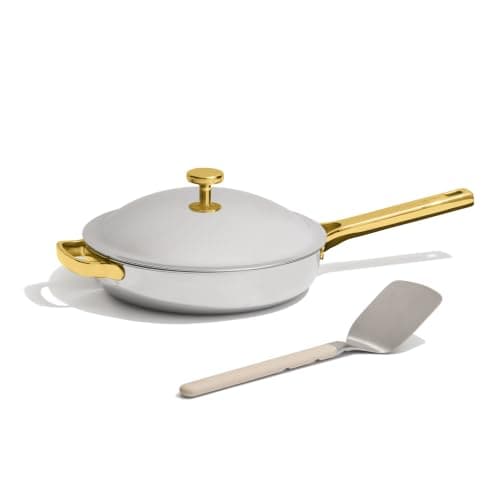
Our Place Titanium Always Pan Pro
Published 3 mm fully clad with a stainless exterior, aluminum core and titanium interior, no coating at all, 1000F, dishwasher and metal-utensil safe, limited lifetime warranty. Skip it if you expect coating-grade release - a micro-textured metal face still needs fat and technique.
Best for: Anyone who wants release without a wear surface, and will pay for it
Published specifications for the Our Place Titanium Always Pan Pro
Construction
Published 3 mm fully clad - stainless exterior, aluminum core, titanium interior
Surface
NoCo coating-free nonstick, published as a micro-textured titanium surface that mimics the Lotus Effect
Coatings
Published made without PFAS including PTFE
Oven maximum
1000F published; 750F on the Gold version
Dishwasher
Published completely dishwasher safe
Metal utensils
Published safe
Induction
Published to work on all cooktops
Care
Published recommendation to rub a teaspoon of neutral oil into the interior after cleaning
Warranty
Limited lifetime, published as covering quality and craftsmanship
Made in
Not published
Dimensions and weight
Not published on the product page
Good
No coating at all, so there is no wear surface to fail
Published dishwasher safe and metal-utensil safe, which the ceramic line is not
A 1000F ceiling removes every oven and broiler question
Not good
The coating-free release claim has no published test method
Still recommends oiling the interior after cleaning, which a truly nonstick surface would not need
No published country of manufacture, dimensions or weight
The trade-off. “Coating-free nonstick” is an engineering claim with no published test behind it, and a textured metal surface is not a coating-grade release.
Skip this if. You want the cheap, easy egg pan. This is priced as premium clad cookware, because that is what it is.
#3 · The genuinely uncoated titanium panSpecs read October 17, 2026
Plateful Uncoated Titanium Fry Pan with Lid, 12 in
Actual uncoated titanium, 12 in, published to 750F - the highest oven figure in this ledger - and induction compatible. Skip it if you want the listing to make sense: it gives the capacity as 3.7 quarts, as one liter, and as a 12-inch pan, all on the same page.
Best for: A cook who wants a coating-free pan and has read what titanium does and does not do
Published specifications for the Plateful Uncoated Titanium Fry Pan with Lid, 12 in
Diameter
12 in
Capacity
Listed as 3.7 qt in the size field and “1 Litres” in the part number - not reconcilable
Material
Titanium, described as SGS-certified and uncoated
Oven maximum
750F, per the maker
Induction
Yes - all cooktops, per the maker
Lid
Included
Dishwasher
Yes, per the maker
Thickness
Not published
Weight
Not published
Warranty
Not published
Heat distribution
No figure or test published
Model
TI_PAN_LID
Good
Genuinely uncoated, so there is no surface to wear out or flake
The highest published oven figure of any pan in this ledger at 750F
Published for induction and for metal utensils
Not good
Three irreconcilable capacity figures on one listing
No published thickness, weight or warranty
No published heat-distribution data, which is the question this material actually raises
Several times the price of a carbon steel pan that is also coating-free and is documented
The trade-off. Its own listing gives the size as 3.7 quarts, the part number as “1 Litres” and the diameter as 12 inches. Three numbers, no agreement, and no thickness, weight or warranty published anywhere.
Skip this if. You expect it to behave like nonstick. “No coating nonstick” describes the surface finish, not a release claim anyone has tested and published.
#4 · What titanium means at the cheap endSpecs read October 17, 2026
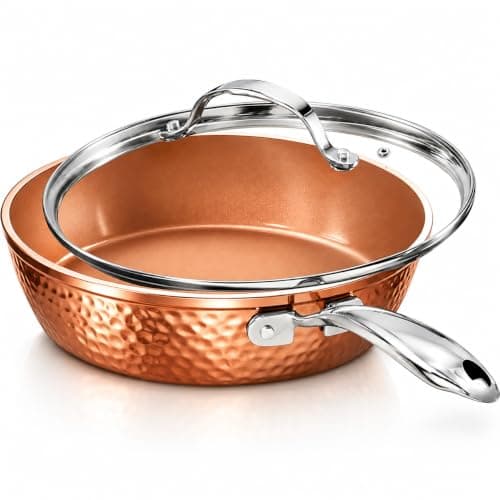
Gotham Steel Hammered Ti-Cerma Nonstick Fry Pan with Lid, 12 in
A twelve-inch coated aluminum pan with a glass lid, 500F and a ten-year limited warranty, where the titanium is one constituent of a ceramic coating. Honest value for what it is. Skip it if you believed the name described the metal.
Best for: A cheap large nonstick pan with a lid, bought knowing the coating is the consumable
Published specifications for the Gotham Steel Hammered Ti-Cerma Nonstick Fry Pan with Lid, 12 in
Diameter
12 in
Body
Forged aluminum, hammered copper-tone exterior
Coating
“Ti-Cerma” ceramic-and-titanium, triple coated, per Gotham Steel
Oven maximum
500F, per the maker
Induction
Yes - the listing names induction, gas, electric and glass or ceramic
Lid
Vented tempered glass, included
Dishwasher
Yes, per the maker
Warranty
10 year limited
PFAS
Free of PFOA, PFOS and PTFE, per the maker
Coating lifespan
Not published
Weight
Not published
Made by
E Mishan & Sons (EMSON)
Good
A published oven ceiling and a published ten-year warranty, which several pricier coated pans do not give
Twelve inches with a vented glass lid at the price of a bare eight-inch pan elsewhere
Induction included, which the comparable Blue Diamond pan is not
Not good
No published coating thickness, body gauge, weight or expected lifespan
The titanium in the name is in the coating, not the pan
A ten-year warranty on a consumable surface is a warranty against defects, not against wear
The trade-off. Gotham Steel publishes a 500F oven ceiling, a ten-year limited warranty and a PFOA, PFOS and PTFE-free claim, and publishes no coating thickness, no body gauge, no weight and no lifespan.
Skip this if. You want the titanium in the name to mean the pan is titanium. It is a coating constituent, and this site has a page on what that wording is doing.
Hestan's NanoBond, if you want the titanium claim to come with a documented construction: it is titanium alloy bonded into a stainless cooking surface, published to 1050F, dishwasher safe, with no coating to wear out. If you want an actually uncoated titanium pan, the Plateful 12-inch is one of the few sold as such, published to 750F - with the caveat that its listing contradicts itself about its own size.
›Is titanium cookware actually titanium?
Usually not. The word covers four different products: a constituent of a sprayed ceramic coating on an aluminum pan, particles mixed into PTFE, titanium alloy bonded into stainless, and an actual uncoated titanium pan. Price band sorts them more reliably than the name does, which tells you how much the word is doing.
›Is titanium cookware safe?
Titanium metal is chemically inert at cooking temperatures, so a genuinely titanium pan, or titanium bonded into steel, has no coating chemistry to ask questions about at all - which is the real safety argument for both. The question people usually mean is about cheap coated pans with titanium in the name, and there the answer depends on the coating rather than the word.
›Is titanium cookware a scam?
The material is real and two of the four products here are genuinely what they say. What is misleading is the use of one word for four different things at four price levels, so that a thirty-dollar coated aluminum pan and a pan with titanium bonded into its steel are sold under the same term. Read what the listing says the titanium IS, not where the word appears.
›Is titanium cookware nonstick?
Not in the way a coated pan is. Bonded-titanium and uncoated titanium pans are metal surfaces and behave like stainless: preheat the pan properly or food sticks. Pans that say 'titanium nonstick' are coated pans whose coating contains titanium, and those behave like whatever the coating is. Buying titanium expecting release is the most common disappointment in this category.
›Is titanium cookware better than stainless or carbon steel?
For a coating-free pan on a budget, no - carbon steel does the same job for a fraction of the price with decades of documentation behind it, at the cost of seasoning and drying. Titanium's advantages are weight, corrosion resistance and, in Hestan's bonded form, a very high oven ceiling. No maker publishes heat-distribution data for an unclad titanium pan, which is the thing that would settle the comparison.
Sources
Every figure on this page came from one of these. Follow them and check our arithmetic — that is the point.